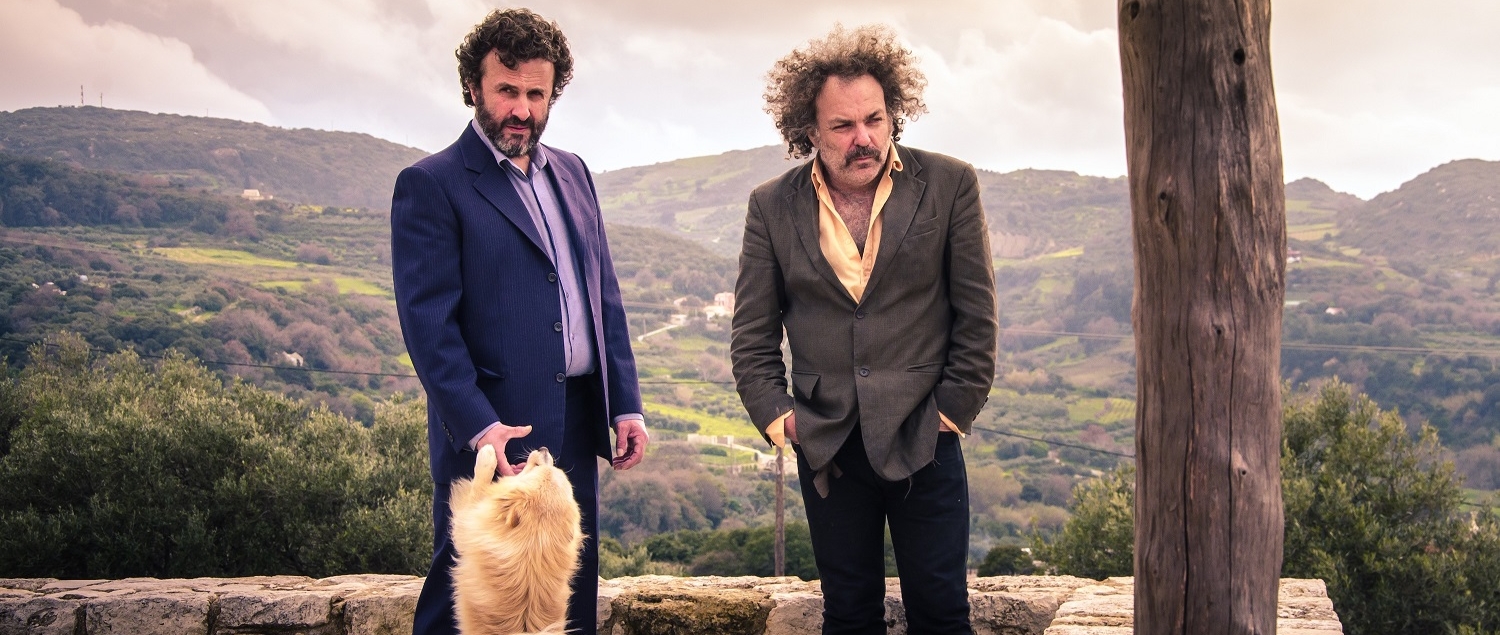
Xylouris and White’s shared history is far longer than the band’s existence, whose first album Goats was released in 2014. Xylouris comes from a legendary musical family from the island of Crete, whose contributions to modern Greek music date back many decades. After moving to Melbourne in 1988, he began performing live with the Xylouris Ensemble, an evolving group containing family members and friends. Sharing bills with the Dirty Three, he crossed paths with White, who grew up in Clifton Hill.
“I met George in Melbourne, out and about at shows during the early ‘90s. On some occasions he would sit in on a few songs during Dirty Three sets. It was around this time that I was obsessively trying to hear every Xylouris recording I could find.”
In 2009, nearly 20 years after their first interactions, the beginnings of Xylouris White were forged. “After a bunch of years there was the Nick Cave-curated All Tomorrow’s Parties festival at Mount Buller, which George and his father [Psarandonis] were playing, and they asked me to play with them. It was around that time that we started talking about doing something together, which came to its fruition about three years ago when I went to Crete for the first time and we started developing what became Goats.”
The new album, Black Peak, is vast in its scope and origin, recorded sporadically across the world in locations as far-removed as Crete and Brooklyn. Xylouris’ lute playing is intense and dynamic, having repurposed the instrument to a leading melodic role, when it’s conventionally used as a rhythmic counterpoint to the lyra. White’s drumming is immediately recognisable, sometimes gently textural and other times scattered and oblique. The words, sung in Greek, are beautifully guttural. On paper, this sounds like a combination of overtly disparate approaches, made even more unusual by the fact that drums are absent in Greek music. But White has strong ideas about the group’s intent.
“We’re not an experiment. We’re not an exercise in any way. I try to be respectful about what we’re playing, in the context of tradition. But really, it’s a very natural band.”
The delineation of the group’s genre was an issue that arose during the release of the first album. With the industry’s terminology being limited to pop, classical and world, the latter was chosen by the group’s label, and Goats inadvertently ended up at No.1 on the Billboard World Music chart (“We’re still waiting on the Grammy”). This confusing categorisation has the risk of implying that Xylouris White’s music is likely to be heard in the context of a niche genre. However, the group has found itself translating easily to a broader contemporary audience, much like the Dirty Three has done.
“It’s happening already. We recently played a festival where Angel Olsen was after us, and the last band was Wolves in the Throne Room. To me, the melodies and rhythms are very accessible. It’s not difficult music.”
The opening track is arresting in its directness. Although coloured by the complex tonalities of the lute, there is much familiarity in the propulsive momentum. The texture is different, but the impulses in the playing often evoke the same feeling that a guitar ensemble would.
“I didn’t consciously change my approach to play with George. In the Dirty Three I will often bring out percussion instruments, but here it’s just a standard drum kit. It’s what I know, and I like the formality of it.”
White describes Xylouris as having a traditional background, whereas he resolutely described himself as a “rock drummer”. However, his philosophies on playing are far more considered than this self-proclamation may suggest. “There’s a lot of tropes in drumming that people take for granted. As I get older I do embrace the purity of the backbeat, but I’m interested in finding out what else you can do.”
By Lee Parker