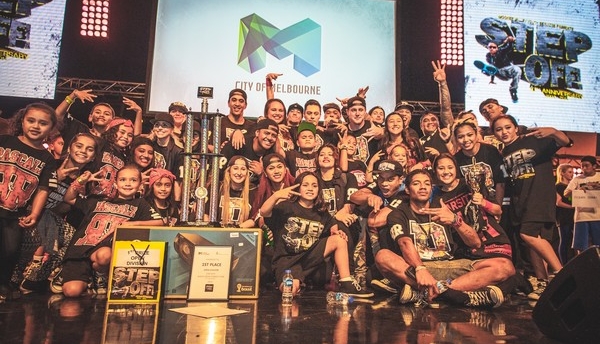
Another sponsor of Step Off is Jason Coleman’s Ministry of Dance, where Singleton teaches. “I’ve been at Ministry since the doors opened about seven years ago,” says Singleton. “I teach full-timers there and I also teach an open casual class, so it’s been great to be part of a school that is about providing opportunity to young dancers to be a part of the entertainment industry and not just to gain experience in upgrading skills, but also experience in performance.”
Her passion for hip hop dance was realised at the age of 12 (“I was brought up in the gangster era”). “The dancers that inspire me are hardworking dancers who are dedicated to their craft and really committed to making something of any opportunity that comes their way,” says Singleton. “It’s the idea of not giving up on a dream, and that dream is to dance for as long as you can in whatever form that is, rather than it being a passing moment that you’re experiencing for a certain time in your life.”
Singleton’s stage name, Robotgirl, comes from her early days of doing robotic dancing at underage dance parties. Exposure is important to learning the vocabulary of the various hip hop dance styles. “When I was young, we went to underage parties all the time,” she says. “You saw somebody breaking, somebody popping; whereas now unless you see a video clip or have a dance teacher, you might be none the wiser. There are styles that are associated with hip hop, but not necessarily hip hop like locking or another social club dance called waacking, so unless they were exposed to it they wouldn’t have a clue what that is. The community itself is always inspiring and creating new concepts and you’re always being blown away by what’s going on around the world. You’re always motivated to keep pushing yourself and evolving with it as well.”
Her dance crew, Hollabak, will be celebrating their 10th anniversary the day after Step Off. Singleton has already attained the artist’s goal of working with her idol. Last year, she won the competition to dance with Madonna at the Grand Opening of Hard Candy Fitness in Toronto, which was founded by the pop icon.
“That was the best experience of my life,” Singleton affirms. “It was an amazing opportunity and an opportunity I wasn’t expecting to have in this country. She was the main artist I wanted to work with, so for that to have happened is surreal. I don’t know how I’ll ever be able to top something like that ever again, unless it was to work with her again. She’s my idol.”
There’s no doubt hip hop dancing is challenging and demanding both physically and mentally. “When I auditioned for the Madonna competition, that day I gave 120 per cent to that experience,” says Singleton. “I flew back that day to go straight to a performance that I was committed to and the very next day I had a 12-hour shoot day to shoot a video with my dance crew. The next day I realised I pushed my body so extreme that my calves had pretty much seized up and I was struggling to walk. I had a week to get my body sorted to be able to fly to Canada, so I was getting consistent massages that week and I wasn’t able to take any of my classes because I went into protection mode.” Thankfully, she recovered in time for her performance with Madonna.
From a very young age, Singleton was inspired by TLC. “They’ve always been an inspiration in terms of their music, what their voices were in terms of what they say, their style and how they project themselves as performers,” she considers. “Also, Missy Elliott and artists who do their own thing like FKA twigs or Banks. I’m mainly inspired by female artists. It’s more to do with their lyrical content. With the boys, you find their beats and their music amazing to dance to, but nine times out of ten, what they’re saying isn’t really okay – that female representation – so you take it with a grain of salt.”
Singleton believes it’s crucial for a hip hop dancer to have an understanding and appreciation of African American culture and street culture. “I think it’s extremely important for any hip hop dancer to understand the history and have a sense of it,” she asserts. “As the generations go on, it’s a responsibility to be that person to mention the history and encourage them to do their own research and to understand why things are the way they are now. To understand the history of hip hop music allows you to be a better dancer.
“When someone knows me as a dancer, that’s my proudest feeling. I enjoy being known as a dancer because it’s very much a part of my identity and who I am and how I like to express myself.”
BY CHRISTINE LAN