Damon Mudge bought a guitar off a stranger on a street in Italy, wrote an album in someone else's garden, then came home and demoed the whole thing alone in a paddock shack.
At no point does he tell this story like it’s unusual. It isn’t, to him. That’s just what making something he’s proud of requires. It started, as these things often do, with something to prove.
Mudge had just come out of a band project, one with no shortage of creative voices, and found himself wondering what he actually sounded like on his own. So when his partner Lily, a painter, suggested a residency abroad, he said yes.
Stay up to date with what’s happening in and around Melbourne here.
He bought a guitar off a stranger on a street in Italy, moved into a house with an old janky piano in it, and started writing. Every morning at 5:30 he’d put on a pot of coffee, sit in the garden, and see what came. Then he’d have lunch, drink some wine, smoke some cigarettes, and do it all again.
“I acknowledge how lucky I was to have that experience,” he says. “You obviously don’t have to go all the way to Italy to achieve it. You just have to make the effort to spend time with yourself, spend time away.”
That particular blend of gratitude and groundedness is all over Country Living City Benefits, his debut solo album.
What came out of those two weeks was a record about coping with a touch of existential dread. Friends, bad decisions, imagination, community, presence. The album’s title lifts from the actual slogan of Queanbeyan, the town outside Canberra where Mudge grew up, a place he describes, affectionately, as somewhere “everyone considers a bit of a shithole.”
“I think that sense of existential dread is quite common,” he says. “What I wanted to comment on is: here’s all these things we can do.”
The first song is essentially advice from his mother. Whenever he complained of boredom as a kid, she’d say, ‘Use your imagination’. The rest fans out from there: songs about turning to your friends, making poor decisions together, substance use, capitalism, fake news.
Heavy material, but Mudge carries it lightly. He wanted listeners to be able to put the record on and switch off for 40 minutes. He pressed it to vinyl so they actually would.
Back in Melbourne after Italy, he wheeled his piano into a workers’ shack on his partner’s parents’ farm and spent two more weeks locked inside demoing the whole thing. The solo process, it turned out, was exactly what the songs needed.
“It enabled me to really make something that was what I wanted to make,” he says. “I’d been toying with the idea of writing something more piano-centric for a while. It forced me to write in a different way. They’re composed and arranged really differently to a guitar-centred arrangement.”
Then he called Louis Montgomery, an old Canberra friend and producer now based in Melbourne, and asked him directly: is this good enough to put out?
Montgomery thought so, but they recorded it again anyway. Mudge doesn’t regret it. The piano is central to all of it, and has been Mudge’s point of difference for years.
“There are so many great people making cool stuff,” he says, “but I’m really interested in this instrument. All you need is a well-oiled band and a van to bring it along with you. It’s not that much of a pain.” He pauses and laughs. “People have said ‘You’re making it hard for yourself.’ But there’s something important to me about it. It’s not really worth doing if I don’t take it that far.”
He tried a keyboard once, played one show, walked offstage and gave it away. “Any piano player would know why you wouldn’t just play a keyboard. There’s no feel behind it.”
The real instrument, he says, has to hit. To find out what that meant for him, he built a playlist spanning 60 years of piano in rock contexts, starting with a childhood obsession with Elton John and spiralling outward.
“I discovered all these artists I’d never really given much thought to. Nina Simone, Carole King, and I was like, ‘how have I never listened to this before?'”
Then further still, into the White Stripes’ third album, where the piano is purely rhythmic, just that and drums, hitting hard. “I can do this retro ’70s rock thing right through to a very rhythmic, on-the-beat sound. I needed the piano to really hit.”
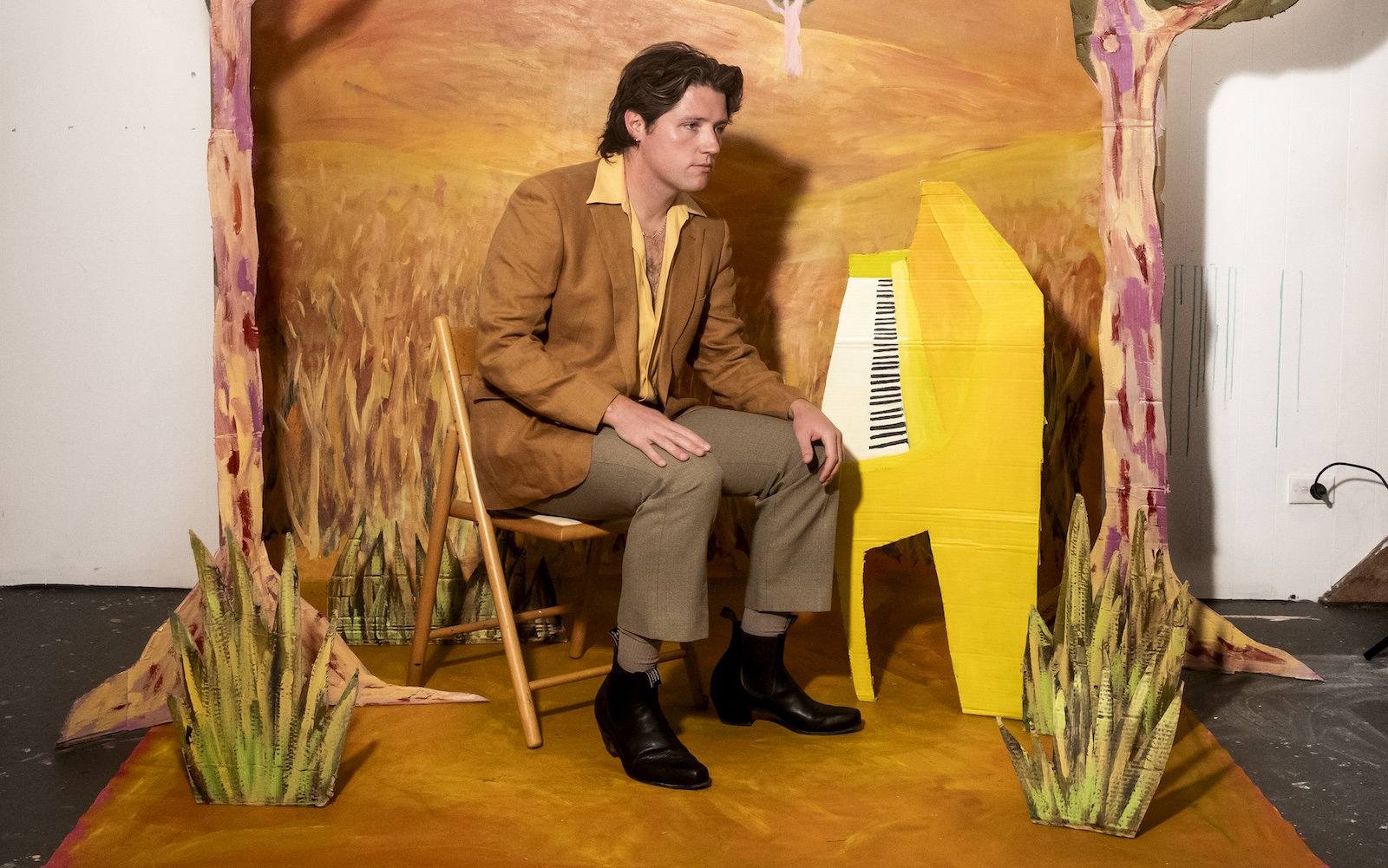
Live, he’s bringing five people onstage, including long-time collaborator Oscar Erbus on bass, and drummer Sylvie Gunn opening the full tour with her own set. He’s planning to paint the gigging piano yellow. The album art was painted by his partner. A friend did the photography, another did the screen printing for merch.
“I’d done a lot of it by myself,” he says, “so I was really keen to engage my friends on the backend.” He pauses. “It made it feel like it wasn’t just mine.”
Country Living City Benefits is out now. Find it here.