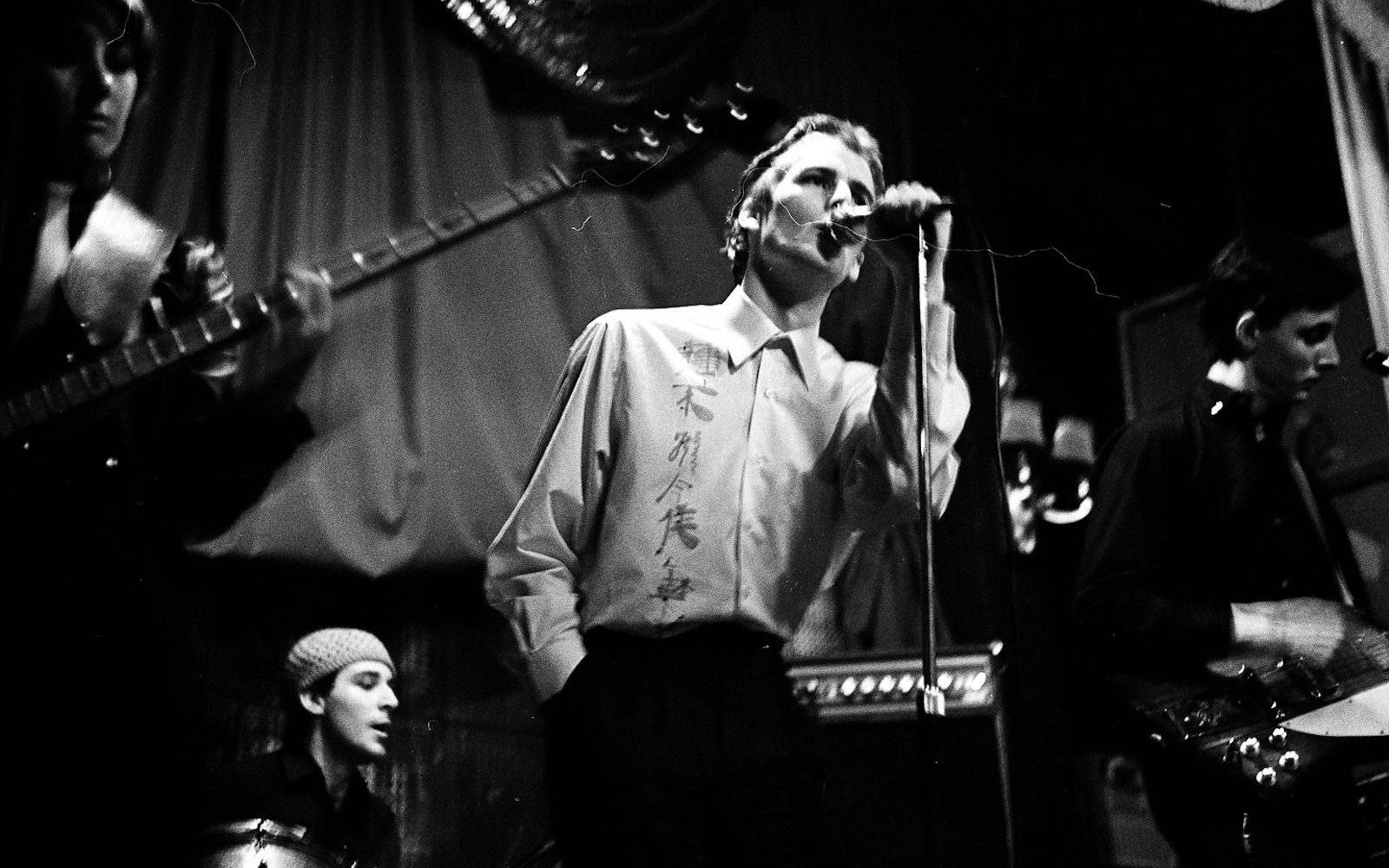
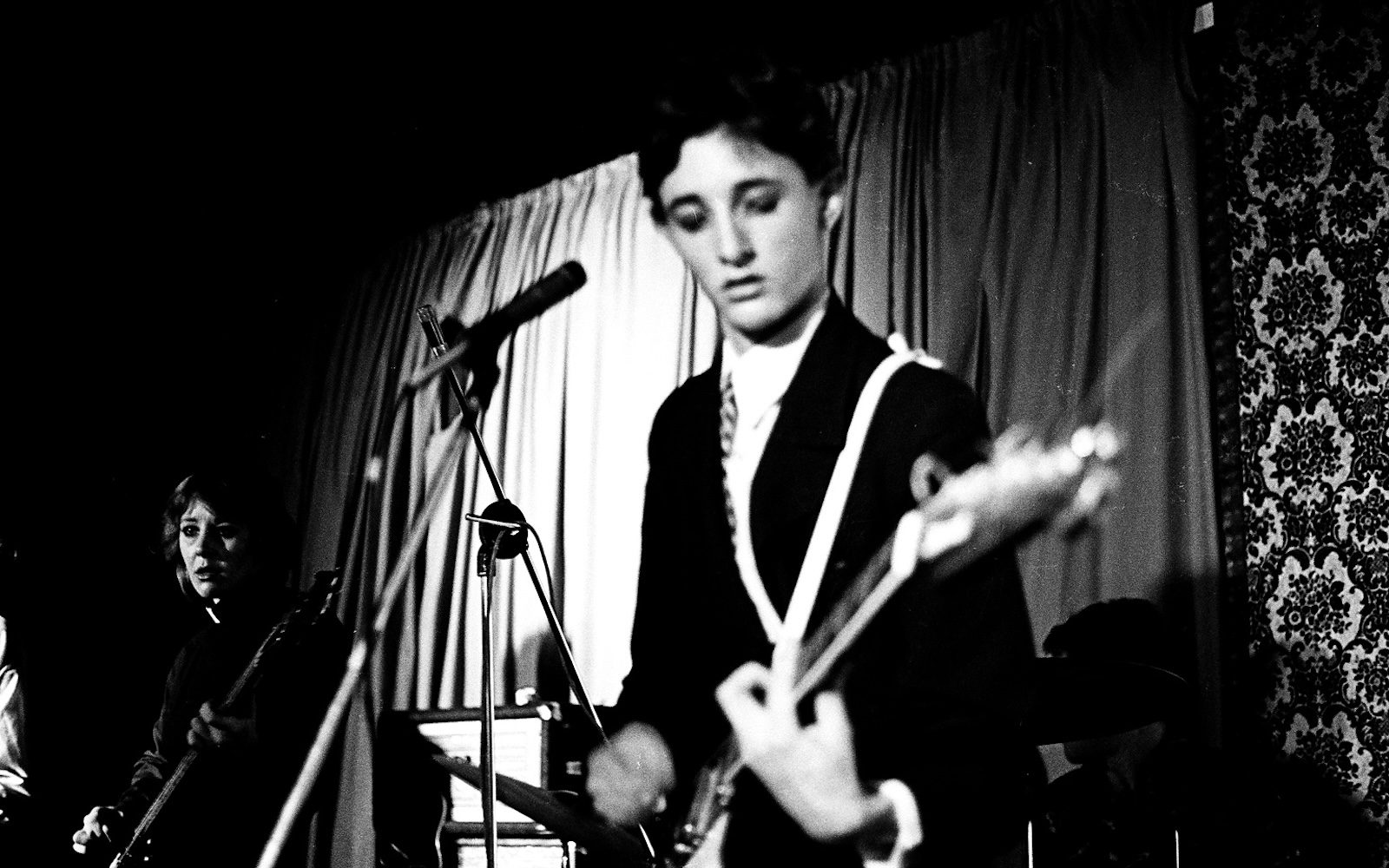
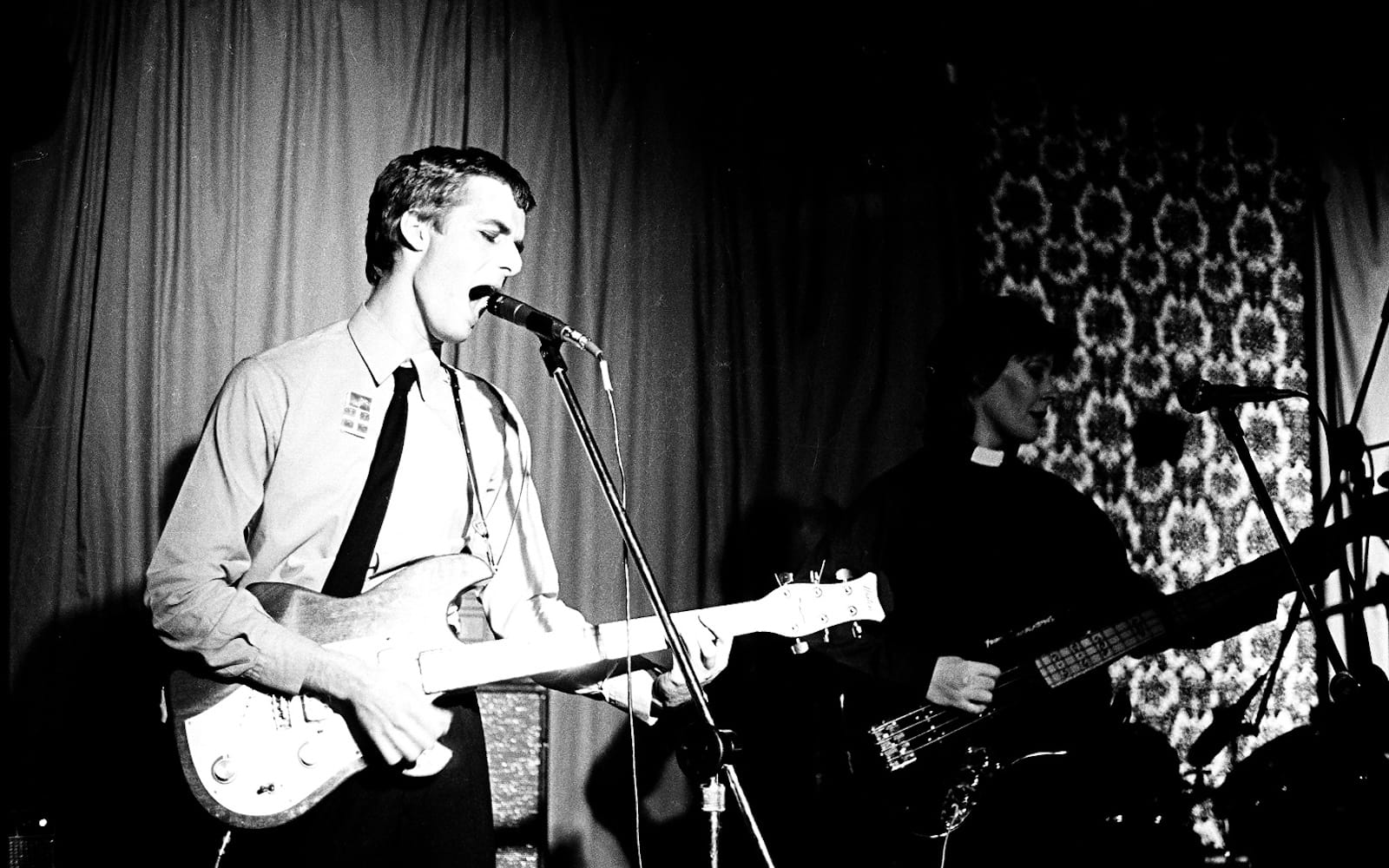
Young Charlatans have burst onto the scene with their first official release, 1978 – nearly 50 years after it was recorded.
Composed of of Rowland S. Howard and Ian “Ollie” Olsen on vocals and guitar, Janine Hall on bass and Jeffrey Wegener on drums, the band made an explosive entrance into the Australian music scene. Their presence has been paradoxical, fleeting yet enduring: disbanding only a year after forming. Like a bolt of lightning that arrives before its thunder, their sound is raw and charged with the youthful vigour their very name suggests.
The band only ever played a total of 13 gigs over the span of five months, yet their discography includes some of Australia’s greatest anthems. Singles such as Shivers and Win/Lose have gone on to have lives and legacies of their own. What I find particularly special about 1978 is that it doesn’t try to disguise the bandroom. Venues such as the Tiger Lounge are just as present in the recordings as the Charlatans themselves.
The making of
In this day and age, having a relationship with the sonic environment outside of songs feels more vital than ever. If anything, I find the technical hiccups that usher a live experience strangely gratifying. These screechy, dynamic moments demand the mechanics of a performance to be heard and considered. The static pop and crackle of a taped recording and the buzzy feedback of an amplifier affirm the feeling of having heard something completely temporal and unique.
By not disguising these textures behind a remastered facade, 1978 preserves the sense of the musicians falling into place with each other – then the audience – until it all reaches a boiling point. There is an unspoken camaraderie to be found in locking into the same groove.
Within our living memory, the demo has traditionally functioned as a low-budget bid for commercial success. It poses as a band’s business card, to be sent off with the hope of escaping the shadows of some major label executive’s mailbox.
Yet, the Charlatans’ 1978 recordings arrive at a curious moment: just one year before the Tascam four-track Portastudio would make home recording broadly accessible. Heard in this light, the demos feel less like commercial overtures and more like artefacts from the cusp of a technological and music industry shift.
Perhaps this can also be attributed to the unique arrangement the band had with their North Melbourne recording studio. As the band’s Jeffrey recalls:
“There was a guy [there] who ran a big sort of hire place, and he was really… just a lovely bloke. When he charged us for rehearsing it wasn’t much, [let’s] put it that way. So we were lucky… There was some support, y’know?”
The undercurrent of informal generosity Jeffrey portrays is an echo of the community support that largely came to insulate the Charlatans from commercial expectation. Later, it would define how the band was collectively remembered. There is a sense of the band’s demos being a rehearsal room in and of themselves, a playground to experiment in. Now, they stand as the archive of an important Australian zeitgeist.
The decision to release 1978 primarily on vinyl reinforces this impulse to preserve the transient. The internet has given listeners the illusion of universal availability. Yet, so much compelling music from the Charlatans’ era has not been reissued, let alone made accessible on streaming, albeit perhaps a single or two dropped on the odd compilation album. The only means to access these tracks is by getting your hands on the original pressings.
On the other hand, this limitation has led to bands developing this sort of mythic status within certain circles: giving bands a legacy where they may not have had conventional success at the time. Here lies another strange tension of which 1978 finds itself caught in the middle.
Listening to The Young Charlatans demos with the distance of time makes one consider how drastically some of these preliminary singles have evolved. Win/Lose, for instance, is completely unrecognisable from the version on The Complete Studio Works 1978–80 by Whirlywirld — despite being re-recorded only a year or two later. The single sonically shifts again in 1986, when Ollie served as the musical director, composer and producer for Richard Lowenstein’s Dogs in Space. The version which features on the soundtrack takes on the sense of a thumping dance-club, where the Charlatans’ early iteration is urgent, as though running frenzied laps around the pulse of Janine’s ruminating rhythm.
Another single featured on the soundtrack – not once, but twice – is Shivers, performed by none other than Melbourne’s delinquent darlings The Boys Next Door and Marie Hoy. 1978 offers listeners the chance to get reacquainted with the quintessential Australian heartbreak hit.
The Charlatans are responsible for the earliest recording of the single. What may be striking to 1978 listeners is the track’s original rhythmic drive. Jeffrey brings an off-beat, economical style that transforms what is, on paper, a straightforward three-chord progression into something far more dynamic. Where the Boys Next Door lean into a sparse piano-led arrangement, the preliminary demo is built around a distinct cadence: a strummed, distorted guitar pattern. As a result, the emotional register of Shivers is accordingly and fundamentally altered. The later version is haunted in self-pity, while the Charlatans’ take is more defiant, even cynical.
At the end of the day, both versions of Shivers are disarmingly simple in structure. It’s the single’s strength. As Jeffrey puts it: “All great music has tension… and that doesn’t mean more notes. It means less notes.”
Rather than driving towards resolution in a conventional I-IV-V blues pattern, Shivers lingers between the tonic and subdominant, rocking back and forth without fully arriving. The expected pull towards the dominant is weakened, almost incidental.
This creates a kind of harmonic stasis: a loop that feels both tense and suspended. The song never quite resolves; rather, is moored conceivably forever, lulling its only real trajectory of movement. It’s this lack of release which becomes the song’s emotional engine, mirroring the obsessive, unresolved quality at the heart of Rowland’s lyrics.
It also helps explain the single’s recognisability beyond its cultural cachet. Having been built on the classic chordal progression foundational to so many rock, pop, blues and folk songs, Shivers is endlessly adaptable. Its simplicity allows it to move with ease across styles and interpretations. Perhaps this is why it has been covered so widely across many disparate genres and decades, from fellow Melburnian Courtney Barnett to American virtuoso Cat Power. As Jeffrey reflects:
“Any song will evolve and that can be [to] more or less a degree. If it’s a good song, it will be — as Ed Kuepper says — ‘eternal.’”
What I find particularly compelling is how the Charlatans’ rhythmic sensibility reverberates beyond the band into their divided futures, with Janine’s walking bass lines on tracks like Broken Hands, She’s Not The Chosen One and Accident all carrying Shivers’ gentle, back-and-forth sway. It’s the restless, pacing bassline that resurfaces in the oscillating synthesiser part underpainting Whirlywirld’s Window to the World.
The Charlatans subvert not only chord convention, but the very frameworks used to define them: genre, subculture, even land borders. They remain stubbornly difficult to categorise, defiantly a contradiction to themselves.
Across every portrait and surface of the LP, the Charlatans appropriate the sartorial codes one would expect of Mods and Teddy Boys and, as such, highlight their disposition of social defiance. Each setting is elevated into a kind of black-tie event: the bustling street curb, the ambiguous exterior of a health centre, the sticky-floored pub, the television interview. There is unmistakably a transplantation of a long-sleeve British subcultural uniform into a land of climatic extremes.
As their manager Bruce Milne puts it, “You just can’t wear suits in any other city [than Melbourne] in the country … You know, apart from Hobart, because it’s just too hot most of the bloody year.”
A community affair
And yet, the band resists any neat geographic or cultural classification. Janine is from New Zealand, Jeffrey from Ipswich, and Rowland and Ollie were born and bred in Melbourne. The band came together in Sydney.
There is the sense that one’s inner-city social circle doubled as active audience members, industry connections and a critical sounding board. For one, Jeffrey’s old schoolmate and later housemate Clinton Walker was – and still is – a music journalist, also having written the insert for 1978 all these years later. Scene dwellers like Bruce acted as the Charlatans’ manager; his brother Peter Milne photographed the band. Rowland designed the logo for Peter’s fanzine Pulp.
Jeffrey describes these collective memories in the same meandering fashion as one would drift from out the isolation of a murky city alleyway towards the bustling glow of a boozer’s windows.
“People knew each other and this was pre-internet so we used to walk ‘round the pubs, people would talk, you’d go to shows. And we were young, you know, we were invincible, so there’s a vibrancy to that.”
What I find so remarkable is the sense that everyone involved was driven by a sheer love of the scene. It’s all very purist. Music journalism, for one, declared itself as an art form in its own right alongside rock music itself. Since pop music had originally mainstreamed music journalism, emerging in tandem with bands like The Beatles, underground scenesters found themselves needing to create their own publications to cultivate a community of their own. Out came the rise of self-made, xeroxed independent press: the inception of fanzines such as Pulp and Newsflash, both prominently featured in 1978’s LP insert.
When meeting with Bruce, I notice these clippings actually derive from the Charlatans’ original press kit. Decades later, they were still being used by David Laing, the band’s present-day publicist, before only recently being returned to Bruce. These zine excerpts have become surviving vestiges of bands otherwise destined to fade into ephemera, their original context as critical meeting points within the scene now deemed significant cultural documents.
“I’d done a fanzine in ’77 in Melbourne and Clinton in Brisbane had done a fanzine, a punk fanzine,” Bruce explains. “ I did one called Plastered Press and he’d done one called Suicide Alley.
“And because we’re the only two people who’d done fanzines, somehow we connected with each other and that’s when we decided to do Pulp together. So we were talking all the time. And I think he must have come down to Melbourne and he knew Jeffrey and Ollie and Rowland were looking for a drummer. I think Clinton would have suggested, ‘Hey, you should jump on Jeffrey because he’s a great drummer.
“So [Jeffrey] played with The Saints … [and] I think they met up with Janine in Sydney, because they moved up to Sydney for a short while and lived in this horrible squat. You know, no running water sort of place. It was terrible. And then they came back to Melbourne once they’d sort of gone, ‘Yeah, this is the lineup we want’, and that’s when they started gigging”.
It is this improvisational, suburban rendition of a music industry which could also be seen in the attitudes of its artists.
“The positive side of music is you don’t have to be a technically brilliant musician to play, so one of the things that is good about [the scene] was people were just playing, people were getting up and saying ‘I’m gonna learn an instrument, join a band…’” Jeffrey says.
His sentiment is corroborated by Clinton.
“We just felt like we were kids on the tear and someone says, ‘You want to try this? I’ll have a go at that. I’ll have a go at anything.’”
And so, when faced with being simultaneously trapped and defined by their national identity, what is a band like the Charlatans to do? As contextualised by Clinton in his introduction to Inner City Sound: Punk and Post-Punk in Australia, 1976–1986:
“For too long Australian rock, like the very fibre of the country, has been almost totally subservient to Anglo/American imperialism. Since 1976, however, there has been a distinct movement which, for perhaps the first time, has moved closer towards an Australian rock of its own invention and identity. The sad part of it is that this simply hasn’t been acknowledged in its homeland – a better response has come from overseas. Mainstream Australian rock continues to kow-tow to English and mostly American demands, is unoriginal and insignificant.
“True, much of this music would seem to have been initially inspired by similar stirrings in England and America, and to a certain extent it was. But equally it proves the adage that the mark of a truly significant movement is when similar things happen at the same time yet independently.”
The Charlatans sit precisely within this tension. Their outward indebtedness to Anglo-American style is less an act of imitation than a framework to be tested: re-appropriating the ashes of preceding subcultures to construct new localised meanings. Beyond this, the Charlatans’ tailored aesthetic unsettles the suit’s association with any one subcultural uniform, echoing their broader questioning of genre. As Jeffrey observes:
“I can only speak personally, [but] for me, when the Sex Pistols and all that stuff happened, that was really exciting. However, having said that, as things moved on a bit, I won’t say it was cynicism, but Ollie and Rowland had always had bigger influences. He was never influenced by any of the punk stuff, ever, right? He was just there. Same as them, right. Doesn’t mean that some of the wider influences like David Bowie, Roxy Music, that didn’t come into it either. It was kind of conscious but it was also organic, if that makes sense.”
Subverting genre
I’m reminded of a 1977 ABC TV interview with Ollie and Rowland on Music Around Us: Pop. What’s particularly striking is the vocabulary: the interviewer leans toward “punk”, while the duo subtly reframe it as “new wave”.
Even at that early stage, these labels feel less like descriptions than ways of shaping how the music might be received and by which audience. When taking the Charlatans’ approach, it makes sense that their overall aesthetic follows suit. Ultimately, fashion is a uniform and genre a form of signalling.
In that sense, genre operates becomes a means for reaching an audience, and ultimately, facilitating sales. “New wave” in particular seems to imply a degree of accessibility – an openness to commercial circulation that “punk” resists.
The same year the Charlatans recorded their demos, American music executive Seymour Stein expressed concern that the label “punk” might limit the marketability of acts on Sire Records, including Talking Heads. The terminology itself becomes a kind of constraint, whereby classification enables visibility but also imposes limits.
What’s interesting though is how this mass-market “new wave” framing sits uneasily alongside the Young Charlatans’ own trajectory: a band with a fleeting lifespan and no official releases until this present moment. And yet, their orbit tells a different story. Ollie would go on to collaborate with Michael Hutchence in Max Q, while their contemporaries like The Saints, Radio Birdman, and The Go-Betweens have developed legacies that far exceed their local origins. Songs like The Saints’ (I’m) Stranded have been canonised as national touchstones, while others – like The Go Betweens’ Streets of Your Town – have circulated globally in unexpected forms, notably, through reinterpretation by Italian house group Milky on Just the Way You Are, released in 2002.
This contradiction feeds into a broader shift in how “independent” has been understood since the late ’70s. In an Australian context, artists often occupy a peculiar middle ground where they are considered relatively small on an international scale, yet effectively “major” within the local industry. It mirrors a wider cultural condition of being outward-looking, yet still operating within a contained ecosystem. Even “independent,” a term that once implied flexibility and resistance to categorisation, has itself hardened into a genre category: “indie”.
When speaking to Clinton, Bruce and Jeffrey, there is the residual sense that although a major label would have hoisted the band to greater heights, it was their collective independence which forged the Australian underground’s remarkable path. Ultimately, it is what made the scene one to remember.
As Jeffrey hypothesises:
“I think we always wanted to record. We had a bit of an opportunity – [Michael] Gudinski was signing up all the punky, post-punky bands and stuff but we knocked that back. Look, to be honest, I wish we had’ve done a record in the studio, and an album, because we could’ve knocked one off in a couple of days. But then you can’t look backwards. And even though that could’ve happened, it doesn’t matter. So again, it is what it is, and that’s great”.
Clinton reinforces these sentiments.
“I look back and I think, you know, I was sort of putting critical bets, shall we say, on The Boys Next Door or The Young Charlatans. And I’ve got to say, I wish I knew what music publishing was back then, because I would have stitched all of those people I liked up. And I tell you what, if nothing else, Nick Cave is making a fair quid these days, and if you’d stitched up his publishing … But there was no one in Melbourne. Certainly not Michael Gudinski, right?”
If anything, Bruce’s experience as the Charlatans’ manager actually shaped his decision to start his own independent label.
“I’d started Au-Go-Go specifically because I was planning to put out a Young Charlatans record. And I assumed The Boys Next Door too, but then The Boys Next Door signed to Suicide, which was a Mushroom [Group] subsidiary, and then Mushroom, actually, because Suicide folded. So they were the two bands I was sort of planning on starting the label with and it wasn’t to be. In fact, I think it was probably almost a year later – it was probably late ’78 when I first started putting out records, because I’d sort of lost the two bands that I was going to start the label with.”
Bruce’s label was just as much a blast onto the streets as the Charlatans were to the scene, and quite literally so: with Au-Go-Go’s brick and mortar store at 349 Little Bourke Street formerly an ammunitions outlet.
“It was weird ‘cause it was still a gun shop when it was up for rent, so [I remember] the few times I went to look at it. It’s weird walking into a gun shop if you’ve never been into a gun shop!
“Au-Go-Go had two floors and the top floor [and] when we came in [it] had a shooting thing in there. So, for the length of the shop, there was this metal drum that went down and then it bent and apparently had water in the bottom part of it so they could test the guns. They’d hit the back and the bullet would go down into the water and empty it out every now and then. We had to get things like that removed before we could put in record racks and stuff, so that was weird.”
What began as a side project for singles, inspired by the Charlatans’ promise, soon became a powerhouse alternative label. Even now, records sporting the Au-Go-Go stamp are highly sought after collector’s items. The label’s homegrown releases, such as GOD’s 1988 yellow colour-way 7” My Pal / A Man Without A Woman Is Like A Nun Without A Jackhammer single, for example, is considered a ‘holy grail’ — having had a run of only 500 copies. My Pal went on to become the third highest-selling alternative single of 1988 in Australia and has continued to be worshipped as a garage band staple.
Much like The Young Charlatans, GOD’s existence was fleeting, with them running the circuit for a mere three years. Where Rowland wrote Shivers at the age of 16, Joel Silbersher wrote My Pal at the age of 15. And, rather than concentrate its efforts going overseas, Au-Go-Go brought international bands such as Sonic Youth, Mudhoney and Dinosaur Jr. to Australian audiences through licensed releases and touring support.
Since the Charlatans peeled away, Bruce has gone on to become one of the great figureheads of Australian music. He has done everything from running his own live music venue (a notorious one at that: The Tote), presenting on community radio station Triple R, running a set of prolific record and book retailers; among founding his own independent label. It is unmistakeable that Bruce’s time with the band was formative to all of his life endeavours.
“I mean, I wish – obviously, I was so bloody young back then – so I just wish I’d had a bit more experience or knew some of the things I’d learnt later on.
“I guess, because we’re all sort of trail-blazers to some extent, started up all the independent labels. We’re all just making mistakes together at the same time. I wish I’d gone overseas more, and that was just a financial thing probably, that I couldn’t, but I wish I’d spent more time with labels like Rough Trade in England and, you know, got more help from them.”
Hearing Bruce’s reflections, I’m reminded of the mass exodus of Australian musicians towards the end of the 1970s. By this time, The Young Charlatans had disbanded and Rowland’s focus would diverge to The Birthday Party. Nevertheless, the close-knit camaraderie of Australia’s band scene that had supported the Charlatans continued.
By the early 1980s, that same network had re-formed in a London enamoured with Rough Trade darlings The Smiths. In a gruelling and unprecedented context, these bands’ shared origin and ongoing interconnection became a means of survival and persistence. Under the alias Tuff Monks, Nick Cave, alongside The Go-Betweens’ Grant McLennan and Robert Forster collaborated on a song together. Their respective bands worked from the same studio space, with The Birthday Party’s recordings resulting in Junkyard and The Go-Betweens Hammer to Hammer. The overlap extended into their personal lives as well: Lindy Morrison and her then-partner and bandmate Robert Forster shared a house on Fulham Palace Road with Nick Cave and Tracey Pew.
As Tracey Thorn – close companion, fellow musician, and biographer of Lindy – surmises it: “Ingrained feelings of inferiority meant that Australian artists in all forms struggled against the notion that nothing they could produce would be as good as the art coming from Europe. And it led many to leave Australia behind, seeking the stamp of approval that success overseas would bring … Now in London, [these bands] are seen as representatives of that country and that culture … [Yet], they can’t see what London has to be so proud of. Robert [Forester] thinks it looks like the ‘shabbier parts of Brisbane.’” And, as Lindy reflects in her diary from the band’s London period: “You NEED an inner city to survive.”
Jeffrey relates. Meditating on his times overseas, he remarks, “I don’t even feel that Australian … But I kind of like Australia when I go overseas.”
So strong are these bonds that they have prevailed past the ’70s and ’80s, between borders and into the future. If anything, they pre-dated it.
“Bruce Milne went to school with [Australian music documentarian Richard Lowenstein] … I went to school with Jeffrey Wegener, so we all we all caught the same disease,” Clinton observes. “Many of us predated punk rock, which basically meant that you knew who The Stooges and The Velvet Underground and The New York Dolls were … That’s all you had to do to join the club, was know who they were and be into them. But we had been doing it a bit before.”
Jeffrey recollects this same schoolyard bond taking to the stage in 1980.
“All of [the music coming out of Australia at the time] was quite different … I [remember] doing [a] show at the Palais Theatre with The Birthday Party, The Go-Betweens and The Laughing Clowns … Couldn’t think of [more] different bands. Totally different, right? But we all knew each other. We all sort of got along, it was great.”
Just last year, 45 years after the Palais Theatre performance, I caught Jeffrey drumming as part of Belle Phoenix opening for SnarskiLindyCircusBand — the latest project from Lindy and The Blackeyed Susans’ Rob Snarski. The gig was held just down the road at St Kilda’s MEMO Music Hall.
The scene the Charlatans emerged from still feels as tight-knit and localised now as it did before. It’s heartening to see these secondhand recollections play out in front of my own two eyes, having been born generations after the scene had scattered and sprawled out.
Challenging gender norms
Where the Charlatans subvert overseas aesthetics, national identities and sonic conventions, there is also something to be said about their experiments with patriarchal expectations.
For all their European sentimentalism, the band emerged at a time where wearing tailored pants as a woman was considered cross-dressing under French law (a legislation which was, astonishingly, not officially revoked until January 2013). Yet, all over the LP, Janine appropriates the tailored look of her male band members.
Unlike them, however, she is the only member dressed in white and resists the blazer altogether. The band’s collective uniform is made both cohesive and fractured, an exposé of the suit’s constructed narrative. It’s a shared visual language that stops short of uniformity. The Young Charlatans appear not as a singular entity but as four distinct artists in collaboration.
The Charlatans initiate an Australian lineage to this trademark ironic take on a uniform’s duality. In the following decade, the Divinyls’ Chrissy Amphlett would go on to re-appropriate a black school tunic, beneath which was always a white collared shirt akin to Janine’s. By contrasting a garment encoded with the idea of conservatism and regulation with a pair of fishnet tights, Amphlett wears an image of provocation and confrontation. Rather than reject the image, she inhabits it — subsequently destabilising its connotations from within. As put by Amphlett herself:
“[The outfit] inspired me and it freed me up and I took it out on everyone. I was shy on-stage and it was me trying to find this persona that I would then be able to project and perform these songs on stage and I just couldn’t find it, but once I had the school uniform it gave me something to react against.”
“I was surrounded by so many men and so the uniform was [me giving] the finger to everyone and the audience as they tried to think that they could have their way with me, I would react and get in first … And become this monster and then I had the power.”
One thinks too, of other female artists around the Charlatans period. It is fellow bass players Cathy McQuade from Melbourne’s The Ears and Tina Weymouth of Talking Heads: McQuade with her mighty polka-dot tie, Weymouth with her industrial grey jumpsuit in the band of the “big suit”. Laurie Anderson too, on the cover of Big Science (1982). Here, hanging up in the backstage dressing room, is a visual language of authority that a largely male-dominated music culture could not easily escape – the reckoning of the white-collar uniform’s supposed neutrality. As British fashion journalist Charlie Porter explains:
“A suit’s power is assumed to come from neatness … [And] any artist who wears a suit, whatever the gender position, must contend with this encoded meaning of male power. There is no way to escape it. It is up to them how they use, exploit or challenge it.”
There is a reason why Janine’s semiotics of the suit loom large on 1978’s LP insert. She is frozen in time with a tie thrown all breathy and careless over her shoulder. It reads less as formalwear and more as a scarf, where her male compatriots sport blazers like cardigans. Shoes are slipped on for the act of moving, not landing, for a good traveller is not intent upon arriving. Structure gives way to gesture. There is a studied indifference here: a dismissal of the suit’s authority. Like the Teddy Boy imagery she evokes, Janine reaches backward — pre-rock and roll — re-appropriating upperclass fashions while relocating it to the backstreet. Control is not asserted through tidiness. Rather, it is assumed.
For all its gestures toward radicalism, the creative industry remains structurally conservative. Porter articulates this as a “… banality found in the single-breasted suit, mass-produced … Tailoring is prime to be subverted by artists willing to place themselves within their own work.”
Perhaps this is why there seems to be a tendency for these sharply-dressed women to be so enticed by the rhythm section. As Tracey Thorn puts it: “There is always something liberating for a woman assuming the male role,” and as clothing has a gendered history, so do instruments.
An early example of this is a cathedral organ in Florence known as Cantoria from ca. 1438. Incepted by Italian sculptor Luca della Robbia, the panels straightforwardly differentiate between boys’ and girls’ instruments. The boys play drums and trumpets, while the girls are weak and muted.
With such loaded pre-punk genealogies and the baggage of their connotations, I see women such as Janine taking on the rhythm section as a means of making herself heard.
It is far too simple to explain away a woman’s position among her male band members as merely a marketable point of difference among the clutter of other wannabe stars: especially considering these Australian bands’ susceptibility to The Velvet Underground affliction. Yet, it is clear that figures such as The Go-Betweens’ Lindy and The Young Charlatans’ Janine are more than just a stand-in homage to Moe Tucker.
The rhythm section is the loudest division of the band – and as Lindy declared in a 1987 interview with Company magazine – they “understand everybody else’s instruments, but nobody understands theirs.” And yet, it is the rest of the band has to keep pace to their time. If she speeds up or slows down, cohesion relies on following her lead.
The redefinition of traditional masculine and feminine roles within The Young Charlatans, however, is not limited to Janine, it also pertains to male members such as Rowland.
A relatively recent exhibition at the Museum of Australian Photography showcased a portrait by the pivotal scene photographer Peter. Captured in black and white contrast, as unambiguous and uncompromising as Janine’s white collar and black tie combination, is Rowland, stark in the mirror of collaborator and companion Bronwyn Adams’ bungalow. He’s as striking as his eyes, smudging the signature kohl pencil traces he’d borrowed from Adams around them. It is a premonition of the scene in Dogs in Space (1986) where the character Sam (based on The Ears’ frontman Sam Sejavka) begs his girlfriend Anna to bring her eyeliner along to his gig at Fitzroy’s Champion Hotel.
The Charlatans were not in a bubble. Their contemporaries, such as The Go-Betweens’ Robert Forrester, have been described by Tracey as not “a typical male … He likes to camp it up. He’ll continue with this occasional habit of wearing a dress.” Fellow performers, such as Peter Vanessa “Troy” Davies would find a home in these glimpses of gender possibility, their brilliance and queer pride captured by the very same figures who would preserve The Charlatans in time.
Nestled beside Tanya McIntyre and Peter’s provocative photographic documentation on the LP insert is a clipping from Newsflash #1, hot off the press in April 1978. John Lyndon reviews the debuting band as “… a winning group, [who] can’t fail but to be enormous and I’m proud to have been at their first couple of gigs.”
I can’t help but feel the same sense of gratitude and good fortune, thinking back to December 2021 when I caught An Electronic Matinee: Ollie, Andrew Duffield and Bill McDonald at The Toff in Town — what would be Ollie’s last public performance.
The gig was special then, and especially significant now. Not only was it a rare opportunity to catch my hero of electronic music in action, but also because it was the place I met my friends Finn and Maryam.
The fresh-faced couple had heard about the gig over the airwaves and decided to take a leap over the generational divide: the funny chasm musical tastes have a way of asserting. We remained friends for years after the gig until Maryam passed away in March of this year, aged only 23.
I like to think that we, the living, continue to have our lives enriched by friends long after they have gone. It’s a tender catch-22. In every emerging moment they remain with you, captured in each warm new memory like the cool relief of a creek on a scorching summer’s day restoring you anew. There is still so much of them to notice in the world, and that does not disappear simply because they have. What I have learnt from grief is this: their impact is present-tense.
The Charlatans today
With Janine passing away in 2008, Rowland a year later in 2009 and Ollie most recently in 2024, Jeffrey is now the last Charlatan standing. Although the record takes its listeners back, Jeffrey only looks forward.
“I guess I could say a lot of things, ‘I should’ve done that, I should’ve done that … I should’ve joined that band’, and blah blah blah, but it doesn’t make any difference, you know?
“Clinton said something really good in the line notes [of 1978] about The Young Charlatans: ‘It’s better not to lament what it could’ve been but what is’, and there you go. Great music’s never gonna go away … There’s great stuff getting made now, right now, by all sorts of people. You just gotta find it.”
The end of the Charlatans was far from the end for all its members.
“Ollie went where the biggest change was happening,” Clinton remarks. It’s an acute observation. Ollie would go on to become a pioneer of electronic music in Australia and beyond.
Rowland’s razor-sharp style earned him the title of ‘Crown Prince of the Crying Jag’. Janine went on to join a reformed iteration of The Saints and became the first woman to be inducted into The Age EG Hall of Fame: a testament to her trail-blazing influence on Australian punk and rock history.
To the Charlatans’ last surviving member, there is still an urge to keep moving. Since the band, Jeffrey has continued to be the cartographer of various scenes and collaborations across the East Coast. He has back-boned Australia’s most eminent bands, including The Laughing Clowns — an extension of his life-long collaboration with The Saints’ Ed Kuepper — The Birthday Party and Paris Green. So compelling is his drumming style that his role in the Laughing Clowns earned him a standalone feature story in a 1980 copy of Australia’s Rolling Stone magazine: the only time ever that a drummer was bestowed such coverage.
When asked to speak on his instinct to keep moving, keep playing, Jeffrey puts it simply down to this:
“Well, I can’t think of anything else I’d do. [There is a] great interview with Art Blakey, [this] brilliant jazz drummer … [He’d said]: ‘Oh man, you don’t retire! That’s the first rule of music, right? You die on the band stand, that’s it, y’know?’ And I’m addicted to this stuff … I’ve gone through periods of life where I’ve had difficult times and things haven’t always been easy, but it’s always been sort of in the background: that that’s what I should do. It’s just a thing.”
The legacies of The Young Charlatans are alive as ever. The band’s respective members still draw crowds in handsome venues and garner support across the community.
In 2023, when Ollie’s health was in steep decline from a gruelling Multiple System Atrophy diagnosis, admirers new and old gathered at Thornbury Picture House to raise funds in an attempt to help cover the medical expenses associated with his care.
Featured on the bill was none other than Dogs in Space (1986), followed by Ollie’s own pick — Dan Fox and Marcus Werner Hed’s 2020 documentary on Throbbing Gristle, Other, Like Me. Looking back now, it is surreal to think that Ollie’s selection was one which explored the lives of Chris Carter and Cosey Fanni Tutti — whose later musical project, Chris & Cosey, was a point of joint interest for Maryam and myself.
A year later, over the road at Thornbury Theatre, I caught members of The Birthday Party, These Immortal Souls, Crime and City Solution, Hungry Ghosts, Devastations — amongst a multitude of other industry associates and friends — united to perform a tribute to Rowland. It was touching to see Angela Howard on bass, as she continues to be in the musical project Winter Sun.
That night, I’d found myself conversing with a couple who had flown in from America with the sole purpose of catching the show. It was a profound reminder of how the legacies of such a flash-bang local band surpass the equator and stretch out far beyond what we Australians always believe is the edge: this deckled coast, weather-beaten, wild and desolate.
Over the phone, Jeffrey had described the act of acquiring records as “… a visceral thing.” To be a record is to be revered: held up, eagerly explored from side A to side B — the sleeve graphic tacked onto one’s bedroom wall in an act of decorum and dedication — because the band on the forefront of the sound is worthy of admiration. The Young Charlatans remind me of why the cul-de-sac dream of being in a band is so important. After all, as Clinton proclaims of the scene:
“We were just kids and we were having a lot of fun. That was a huge part of it, just drinking and smoking, making it up as you went along. When those sort of things are sort of unfolding, it’s hard to really analyse what you’re in the middle of … [Just] keep following your nose — if that’s not bad advice.”
For more on the Young Charlatans, head here.