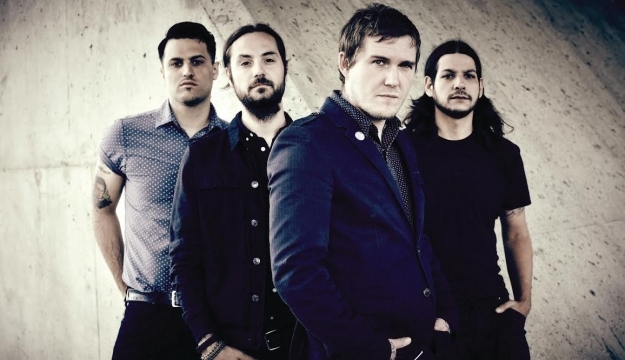
All things considered, Levine’s pretty affable about the interruption. It raises an interesting question though. The Gaslight Anthem’s frontman Brian Fallon is famous, or maybe infamous, for not boozing and getting high – he even goes to church. Given we’ve just pulled Levine out of a gambling den, is he on the opposite end of the partying spectrum? The answer is no: in fact, the whole band have cleaned up their act. “I got sober in recent history,” Levine says candidly. “I’ve cooled down a lot – I’ve got a family now. In fact, the whole of The Gaslight Anthem have kicked drugs and alcohol to the back seat.”
Same as the Boss, The Gaslight Anthem were born out of New Jersey. Keeping in tight with the locals, Springsteen’s even joined them on stage a few times. Levine describes the moment as the biggest ‘holy fuck’ moment in his career. “It was like being blasted out of a fucking rocket ship,” Levine hoots. “He was suddenly there and it was like, ‘How the fuck did this happen?’ That one is going to be hard to top.”
Even though Fallon’s voice is not dissimilar to Springsteen’s, traditionally the band sat more on the punk side of the fence. With that in mind, it makes sense The Clash holds a special place in The Gaslight Anthem’s heart. Even now, Levine holds Joe Strummer aloft as his number one singer/songwriter and veritably perks up with the mention of his name. “My father was into The Clash,” he recalls fondly. “He actually got to see The Clash and The Who at the Chase Stadium in New York back in the ‘80s. I just pretty immediately fell in love with everything about them – their style, their songs, their vibe, what they conveyed. Man, they are the greatest rock band ever. They’re always going to be an influence on us – it’s always going to be there, because they were a huge part of the reason that we wanted to play music in the first place.”
Thinking about the band’s beginnings, Fallon’s been known to say a sense of frightened urgency kick started the outfit and Levine doesn’t disagree. “We all had very humble beginnings,” he recalls. “None of us had a real way out, other than for doing this. We all fell on the same page – this was what we really wanted to do and we really wanted to make it. We weren’t necessarily the most talented, but we were certainly driven – it’s an important part of success.”
Going back to The Clash, one of the things Levine admires about Strummer was his ability to evolve. Guided by this ethos, there’s been a musical change in tack with Get Hurt, the band’s fifth studio album. It’s still very recognisably The Gaslight Anthem, but it’s different to prior releases – it’s more straight down the line rock’n’roll, no whiff of punk and the band have even gone a bit country on Red Violins. This shouldn’t be surprising – Fallon once said unless you invented a unique sound like the Ramones, you’ve gotta change at some point. “Well, that was a wise call,” laughs Levine. “I wish I’d said it – because you do have to adapt. It’s tough if you’re just regurgitating the same stuff and it’s not rewarding creatively.”
Part of what helped the band mix it up on Get Hurt was working with producer Mike Crossey – they sought him out specifically on the basis chances of him disagreeing with the band were high. Is that a weird call, picking someone with whom you’re destined to butt heads? Or was it because they had suffered previously at the hands of yes men? “I wouldn’t say that we’ve worked with yes men before,” Levine demurs. “We definitely wanted to work with someone this time who had a different style from us though. We’d never really explored before what it would be like to record with someone who wasn’t focused on the singer/songwriter aspect – Mike’s more focused on the sound and how it’s recorded and we wanted to have some fun with that.”
We’re glad there was some fun to be had, because it wasn’t the world’s happiest time when the band went into recording, particularly given Fallon had just divorced his wife of ten years. Fallon now speaks of the experience as being cathartic. Levine’s take on it is there’s an opportunity for air-clearing every time you play, not just when you record. “Yeah, I think that every artistic experience is cathartic,” muses Levine. “It’s always an escape from everyday life. Making music has absolutely always been my release and escape.”
As unlikely as it’d be, if the whole thing ever goes to shit for Levine, he’s got a job to fall back on: Levine’s a barber. “Yeah, I started out by cutting my own hair when I was a teenager, because I didn’t like how anyone else was cutting it,” he chortles. “I’ll cut people’s hair now when we’re on tour. I was thinking about setting up a barber shop too, but I haven’t had time to get around to that yet. I have set up my own clothing label though, which is kind of barber-shop inspired. It has that essence and vibe of how men used to dress.” Cool.
BY MEG CRAWFORD