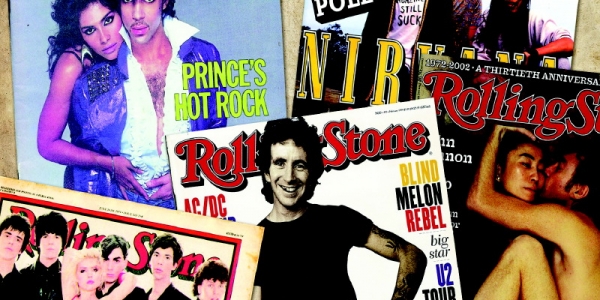
“There are 150, going from 1972, which was the first Australian edition of the magazine,” museum curator Megan Sheehy tells me. “The first ever cover had Jerry Garcia of The Grateful Dead, and the exhibition has covers going right through to 2010.” There are numerous iconic images in the collection, with a huge range of artists represented – everyone from Bob Dylan, Janis Joplin, Neil Young and Paul Simon through to Britney Spears and the Red Hot Chili Peppers.
There are many images, but Sheehy definitely has her favourites from each decade. “One of the most arresting images from the ‘70s is definitely the Patti Smith one,” she says. “She’s standing there in front of a fire, and it relates to the song that she’d just done with Bruce Springsteen, Because The Night. There are lyrics in there about fire and flames, and they’ve literally interpreted that on the cover of Rolling Stone.
“In the ‘80s, there’s a great one with Mick Jagger. It’s a striking image of him with the word ‘satisfaction’ underneath. It’s from 1984. It’s interesting, because the story goes that a few years before, he was going around telling people that Rolling Stone’s masthead had lost its character, so they redid it! He’s appeared on a couple of covers, but that 1984 one of him is pretty striking to me.”
One cover with very special significance features an image of rocker Bon Scott, of AC/DC. “He died years before, but Rolling Stone decided to feature him on the cover in 1994,” Sheehy explains. The issue featured a bit of a retrospective on his life, although its significance goes beyond that. “That cover is an interesting one to us here in Lilydale,” she continues, “because we have a mechanics institute attached to the museum, and Bon Scott played there in the ‘60s in The Valentines. There’s a guy named Darcy who lives out here near the museum who worked as a roadie for Bon Scott at that time, and he’s told us a lot about Bon Scott before AC/DC. We’re doing a bit of a display to go along with the exhibition.”
The covers on display feature a variety of well-known musicians, but the snappers behind them are often just as well-known. “Annie Liebowitz is Rolling Stone’s most renowned photographer,” Sheehy says. “A lot of the style of the magazine is thanks to her and a few other photographers, that idea of having the masthead, and then a single, striking image of one person. The idea is that it reflects the poster art of the tie – the huge, bold, slightly psychedelic poster art of the late ‘60s. It takes that and puts it in magazine form. The early ones are interesting. They’re on newsprint, so the photograph had to be really interesting in order to stand out. It’s easier now, with glossy print.”
Seeing all the covers in the one place, one becomes aware of changing trends – both in Rolling Stone and in the music business – over the years. “I’ve noticed that, today, there are more bands, whereas before, there were more individual artists,” Sheehy says. “I think that’s something we’re going back to – that single performer. Maybe that’s a reflection of the music industry. In the early days, they’d try and make one performer famous, then for a while, labels could afford to make groups famous. Now we’re going the other way, the record industry is sort of struggling to support full bands. They can’t tour them all the way around the world. They’re going back to a focus on single artists. I think there is a general feeling in the music industry that we’re going back to that a little bit, even if we don’t want to.”
The kinds of artists who appear on the cover have also changed since the early days. Whereas once it was scruffy rockers like Jerry Garcia and Bob Dylan, these days airbrushed pop stars like Katy Perry and Britney Spears are just as likely to appear. Sheehy, however, is no music snob, and says that one of the things she likes about Rolling Stone is the way that it always addresses the popular music of each particular era.
“We look at The Beatles and Dylan today and think of them as classics,” she says, “but in 20 or 30 years, we might think the same about the cover stars of today. I would think that the style of music has shifted towards a pop sound, but if anything, you could say that Rolling Stone has just traced the progression of popular music through the years.”
The exhibition itself has appeal right across the generations, and Sheehy says that anyone who grew up loving music from the ‘70s right through to today can get something great out of it. “I’m hoping that we get parents bringing their kids down and talking about the music they like,” she says. “It’s just as possible for kids to share their taste in new music as for parents to share their love of older stuff. You hear a lot of interesting conversations going on in the space, which is fantastic, but it’s also a lot of appreciation that everyone has different music tastes over time.”
BY ALASDAIR DUNCAN
IMAGE CREDITS: Prince, Rolling Stone Australia, Issue #365, June 1983. Nirvana, Rolling Stone Australia, Issue #470, May 1992. AC/DC (Bon Scott) Rolling Stone Australia, Issue #493, February 1994. Blondie, Rolling Stone Australia, Issue #294, June 1979. John Lennon and Yoko Ono, Rolling Stone Australia, Issue #600, April 2002.