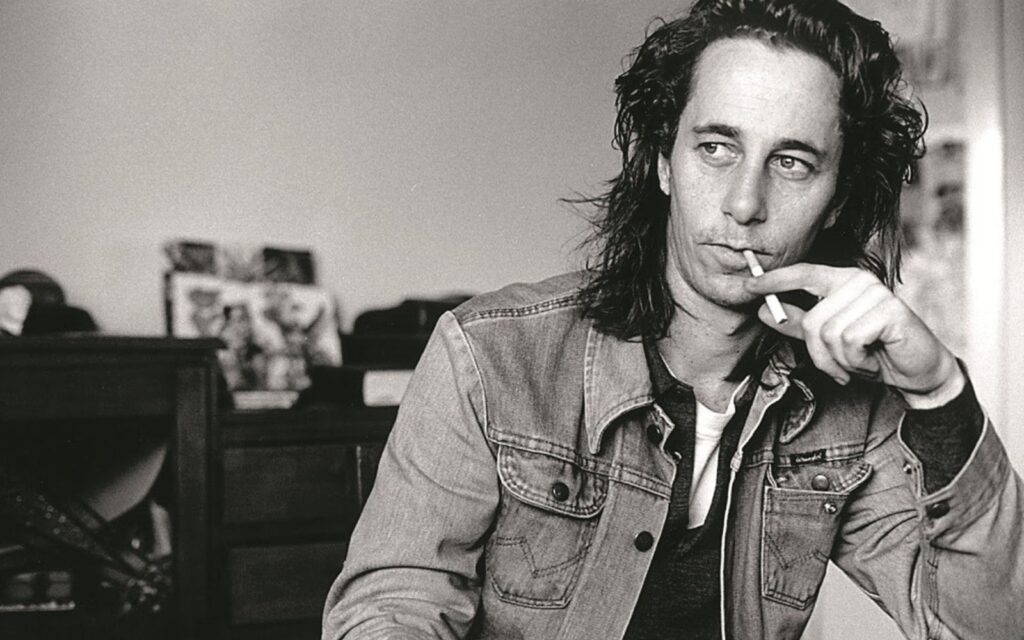
Though, notwithstanding that appraisal, the record’s first single Pretty Pimpin was something of an unexpected return. Released in July, the song surprised listeners chiefly for how much it actually sounds like a single. An upbeat folk number rooted in a memorable chorus melody and a tongue in cheek vocal stance, Pretty Pimpin could be the most concise pop song Vile’s ever written.
“The single situation – I feel like, at least the last two records, I got deep into the heavier songs or something. Heavy not as in heavy metal, but I got deep into the non-singles, and the singles seem to come later,” Vile says. “But [Pretty Pimpin] surprised me. Once I added the harmonies in there it was all over.”
Indeed, throughout the song’s second half, a high falsetto harmony clings to the main melody, adding to its striking distinction. Believe it or not, this is the first time vocal harmonies have made their way into a Kurt Vile song.
“I’m always into harmonies – my favourite songs have harmonies – they’d just never made sense to me in a natural [way for my songs],” he says. “But that harmony as a falsetto came into my head all intact. Maybe it was something I’d listened to. Obviously you just listen to all kinds of music and eventually you just accidentally rip everything off without knowing it. My friend [Jenny Lee Lindberg] from Warpaint, I was in LA and she was listening to disco-era Bee Gees. But I wasn’t like, ‘I want to put some Bee Gees harmonies in there’.”
Lyrically, Pretty Pimpin focuses on the difficulties faced grasping one’s sense of self, and brings the humour that’s always been present in Vile’s lyrics to the fore. Many similarly anxious reflections crop up as the album progresses, however they tend to lean towards either sobering rumination or absurdist imagery. As such,while Pimpin is a compelling way to begin the album, it’s not quite an apt overture for what’s to come.
“I thought Wheelhouse, where else could you put it but in the beginning of the album? But I mean the label definitely wanted some kind of [single], which is not why I did it, but ideally you want some kind of song that’s like a legit single,” Vile says. “And I wanted it, but it didn’t fall into that melancholy space-folky-blues thing that a lot of the record is. There’s nowhere else you could put Pimpin but first, because if you put it somewhere else it would sound insanely out of place.
“Then what I did was I put Wheelhouse second and that just didn’t make sense whatsoever. But I didn’t know any better because Wheelhouse is my favourite song, so I had to have outside people convince me to put Wheelhouse further. I was like, ‘All right fine, I’ll put it fifth, only because it’ll start side B’.”
On an album full of intriguing content, Wheelhouse is a major standout. Ittakes its time, scattering an aroma of melancholy, while the inclusion of a sustaining pillowy atmosphere prevents it from reaching the point of despair. Instead, the overall impression is of someone at peace with life’s ineradicable conflicts. This quality is also apparent in songs such as Life Like This and Bad Omens.
“All those songs, that just feels like my heart right now, it just feels like my psyche – that’s my ideal place,” says Vile. “It’s meditative, it’s a little bit sad, it’s a little bit hopeful, it’s a little bit realistic. It’s a lot of feelings at once, like opposing feelings even, just like life in general. That’s how I feel right now; those are like my spiritual sound or something.
“All three of those songs are moments captured in time too. It wasn’t premeditated at all – they’re pretty new sketches. Bad Omens, I had that piano thing for a while, but it was an afterthought after we recorded Lost My Head There, which was the new jam. They were all just naturally captured moments, but all recorded in the wee hours and gone back into in the wee hours. So I just think they’re the realist things I have.”
Lost My Head There essentially serves as the album centrepiece. Lyrically, it alludes to the process that generates Vile’s songs – he starts out feeling a bit lost (“Buggin’ out about a couple-two-three things”), before a song “walks out” of him, leading to “sweet relief”. Then Vile and his recording band – drummer Stella Mozgawa (Warpaint), guitarist Farmer Dave Scher (Beachwood Sparks), and bass player Rob Laasko – spend the song’s final four minutes grooving on a basic repeating chord progression. Pop convention would advise against extending it for so long, but by doing so Vile makes a concrete demonstration of how relaxing and nourishing playing music can be.
“The second half is also an example of those other three songs we were talking about – just like feeling it in the moment and just fucking grooving,” Vile says. “We all did that live and then there was one round of overdubs for backing vocals, but the idea was we all did it at the same time again. You don’t just layer it, because that’s unnatural. If you just build a song up one track at a time, it’s cheating. I get a little bit more cynical now, because you could really just cheat and make a song perfect, or try to. But reacting off of each other live, that’s like real music. The least we can do is try to do it live and get some kind of spiritual release or something.”
On paper, Vile’s fifth LP, Wakin On a Pretty Daze, was a very bold release, with the majority of its songs sitting in between six and ten minutes. Despite this, it was a major success, elevating Vile into the top tier of the globe’s indie rock artists. Nevertheless, he felt no compulsion to repeat past glories. As a result, despite being unmistakably the work of Kurt Vile, B’lieve I’m Goin Down journeys widely in terms of tone and instrumentation.
“I had four outlets that I wanted to actively use. It felt really good to play banjo songs. It’s a really ethereal thing. I grew up playing banjo, and I would pick it up and I would get more lost than I would with the guitar. It’s got the high drone string and I was writing certain songs, like I’m An Outlaw, but I also had five other banjo songs that didn’t make the record. Then there’s the piano side of it, which comes from my influence of people like Randy Newman. I’d just been paying attention to the piano a lot in general – it’s not like I just picked it up, but I focused on it more. Then there was of course the acoustic folk thing that I’ve always had, but then there’s the electric guitar thing.
“My basic theory was like this sort of spaced out blues record and this sort of dreamy record. I said at one point I wanted it to be a modern version of an authentic folk record. But because it’s 2015, or whatever it is, today’s folk. It can be anything – it can be rock’n’roll and stuff as long as you’re following the true roots. That was part of it. There’s all kinds of blues and folk references, and not all mapped out in this premeditated way, and just things that were important in my life or influence from certain books and music. There’s nods to all kinds.”
BY AUGUSTUS WELBY