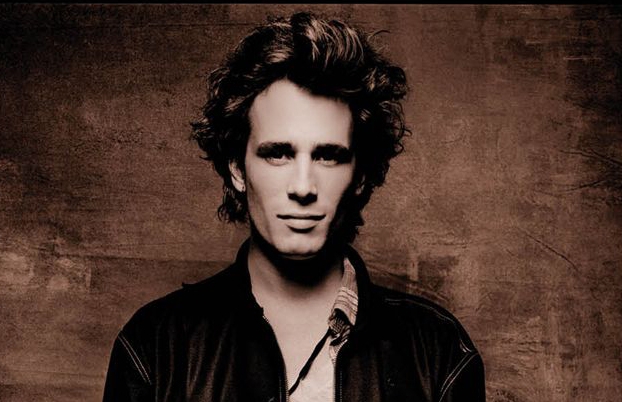
Berkowitz first heard Buckley sing in New York at a tribute concert for his folk-singing father, the late Tim Buckley. He knew right away he was listening to something extraordinary. “Jeff was a lyre bird who goes his own way,” Berkowitz says. “He could imitate anybody but he chose not to. Musically he had no limitations. He took influences from Count Basie to Debussy; he could do anything. He could have been a jazz great. The hardest thing for Jeff was that going one way musically meant not going other ways. He played good and he played better than good. He always played real music with real commitment.”
Jeff Buckley only met his father briefly when he was eight, but his step father and mother were both musical. Buckley took up the guitar at the age of five and was blessed with a multi-octave voice. However, Jeff wasn’t trying to sound like his famous and accomplished father. “There were hints and motifs and he alluded to him, but his work was not an homage to him,” Berkowitz says. “There were little visitations of the original.”
Jeff Buckley is most famous for his cover of Leonard Cohen’s Hallelujah. Like every other cover he performed or recorded, he made it entirely his own. “Leonard’s version of Hallelujah is anthemic, biblical, sonorous,” says Berkowitz. “Jeff’s version is more intimate. It’s the one people in New York wanted to listen to after 9/11. It offered solace.”
In some ways You and I is the result of an informal recording session for the young singer. The choice of songs – including covers of Bob Dylan, Sly & the Family Stone, Led Zeppelin and The Smiths – was to some degree spontaneous. “The most important thing was to have Jeff record,” Berkowitz says of the original intention behind the session. “We wanted him to create a table of contents so we could pick one or two to begin that journey towards making an album. The second reason was to get him to feel as comfortable in a recording studio as he was in lounge rooms and small clubs; so that his playing was as natural and organic as it was in those environments.
“Jeff being comfortable meant he could branch out, burst out of his own mindset around the process of recording for a big studio. He himself was left of the underground, he was alternative and independent – working with a studio like CBS for him was like selling out to The Man. He thought of it as ‘the big red machine.’ CBS had Michael Jackson, Barbra Streisand and Billy Joel signed to them.”
In contrast to other artists on the Columbia roster, Buckley and his manager signed a contract where they maintained artistic control. “This wasn’t an everyday occurrence,” says Berkowitz. “When studios invested in recordings, they wanted to know what they were getting for their investment. With Jeff they didn’t know what he was going to do. There was no formula for Jeff; he was a loaded gun that could just go off. No-one could dictate what he could or couldn’t do. He had to do his own thing.
“The reality of what I heard in him was there, that talent, to begin with. The pathway needed to be made open so it would let him come to fruition. It was clear to me, and it was agreed to by the powers that be, that everybody needed to support him in this. We knew to leave him alone. That flower needed to bloom in its own time. Even my boss at the time, Don Inner – a super powerful promotions guy who worked the machine like a fighter pilot – was so supportive of Buckley doing it his own way.”
As far as Berkowitz is concerned, You and I marks chapter one in the Jeff Buckley story. “You’ve already got chapters two, three and four. Now we’ve got chapter one.”
Along with several unforgettable covers, You and I comprises two Buckley originals: the first-ever studio recording of his signature song, Grace (co-written with Gary Lucas),and the unreleased Dream of You And I, which includes an interlude of him talking about the song. Despite nearly two decades having passed since Buckley’s death, Berkowitz still feels a closeness. “I’m happy to talk about him, happy to share his music with people. There are still some days when I wake up and have to remind myself, ‘Fuck, Jeff’s not here.’ I’d much rather this was album number 12 I’m talking about. People talk about Jeff Buckley as having a voice like an angel. It’s not a just a coy little quip. And he looked like that.”
BY LIZA DEZFOULI