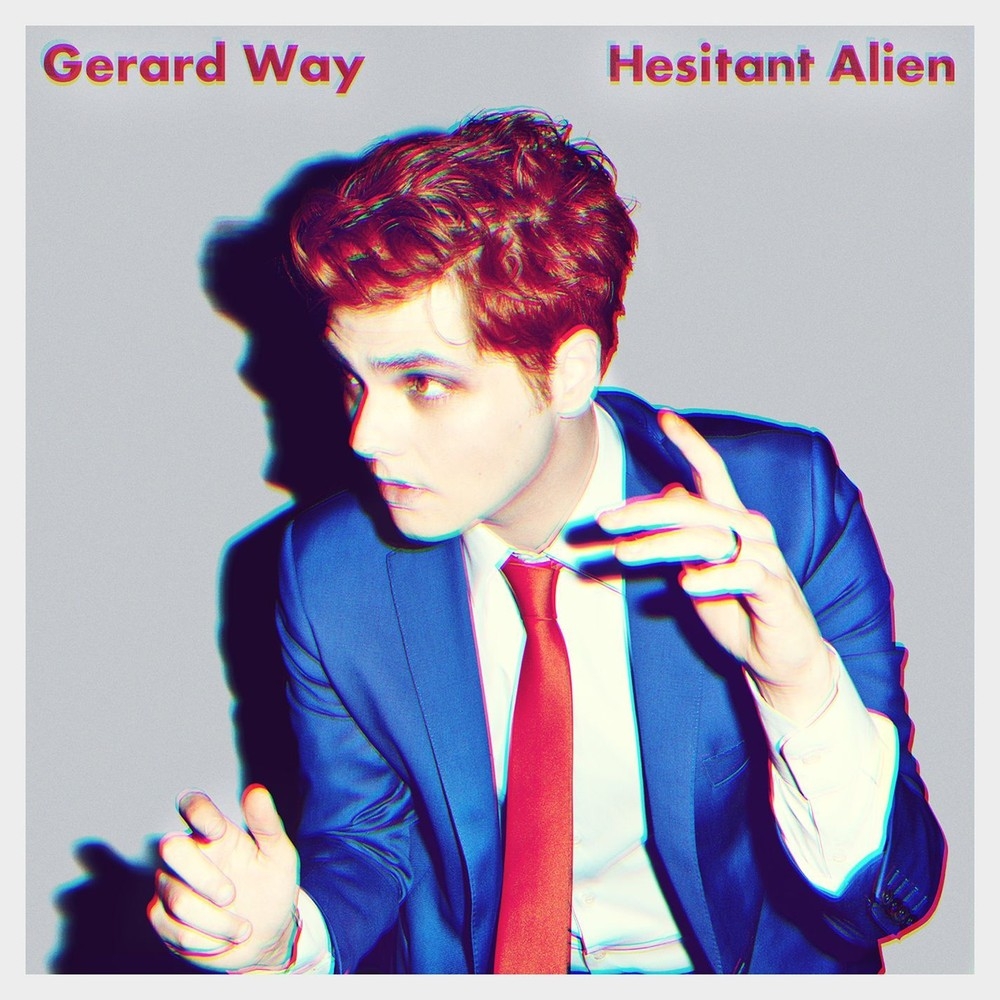
“It took me quite a while to get to the point where I realised there was going to be a solo album,” he explains. “The initial plan was to run as far away as I could, erase my identity and change states, play guitar and sing and not talk to the audience in a small fuzz-rock band… But time passed, the songs started to feel more ambitious. I didn’t even know I was making an album until around six songs in. I was just making music for the sake of making music, which is something I had not done in a long time.
While he initially suggests he felt he didn’t have anything to prove with this new project or with what he’d achieved with My Chemical Romance; that feeling still tends to persist.
“There’s an invisible, imaginary resistance you can create for yourself by feeling there’s something you need to prove, even if you’re fighting against yourself,” he admits. “It’s a crutch you can fall on. But if you don’t have that, you’re not angry about anything. I was out to share. When you’re out to prove something, it becomes calculated, you use your art as a weapon. I wasn’t trying to do that, I was simply trying to share, pieces of me that I’ve never shared, sonically, before.”
In creating a solo album, Way wasn’t so much emboldened by freedom, but guided by a maturity within his own constraints: “Anyone can put themselves in a prison pretty easy, is what I’ve learned,” he says. “One of the biggest points of maturity for me in this whole process was truly understanding that I was my own jailer. My Chem wasn’t a prison, it was maybe part of the problem and maybe what was suffocating me creatively. But you put yourself in that jail. I could have easily done it again with this album, and put myself in a prison again. I had to face that. Freedom was always up to me, and I came to realise that. That’s when I began to have fun.”
The final two My Chemical Romance albums were defined by sprawling, character-rich, conceptual narratives. Though the title Hesitant Alien might invoke sci-fi visions, the album presents itself as a grounded rock manifesto. “It was super challenging,” Way states. “There was no concept, there were no strong characters – the character ended up being myself. The only thing I felt like a created was a visual language for this record; I don’t think I created a character. Or in the end, I created myself. I put pieces together to make myself. Not having a story, not having a title long before the album was finished, not having any of that stuff in mind was extremely challenging. And that’s what I wanted. I was challenging myself sonically, trying one vocal track instead of quadruple harmonising. I was very resistant to harmonies on this record.”
The foremost influences found on Hesitant Alien pertain to strains of early ‘90s alternative rock, venturing into vivid Britpop territory at times, which are signifiers not exactly present in the My Chemical Romance back catalogue. “They were always on my mind, I was always listening, and every now and again they would pop into My Chem songs,” he says. “I had a tremendous understanding and respect for what we did in My Chem, that I was always fully aware that this is our sound. I’m not gonna’ resent it, I’ll bend it to a certain point, but I’m not going to break it past that. Even if I had a strong desire to write a Britpop song, it was never going to be that. So this was always in my repertoire. Stuff you listen to when you’re 12 years old, stuff you listen to in your formative years. Luckily it was a sophisticated type of music, Britpop is extremely complex, so it stuck with me, even when I’m nearing my 40s.”
Recent sets, including festival appearances at Reading and Leeds, have strictly focused on Hesitant Alien, with material from My Chemical Romance nowhere to be seen, and don’t expect that to change by the time Soundwave rolls into Australia next year. “It would have to be some time passing, it would have to be years, to the point where I truly miss the songs and they mean something to me again,” he considers. “When the band ended, I was at a point where the songs still meant something to me. But if I were to go one minute more they would stop. To play them again, firstly, I would need to reimagine them completely into whatever I’m doing at the time, even if it’s freeform jazz. On top of that, I need to have a strong desire to do them. The desire just doesn’t exist. It might take years.”
BY LACHLAN KANONIUK