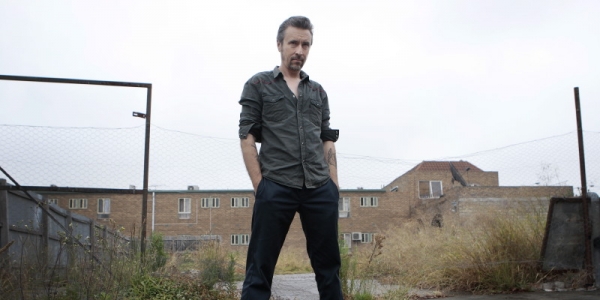
If Stockdale has found contentment in her personal life, he also seems to have found it in music. His old band, the gnarly blues rock outfit known as Wolfmother, went through various lineup changes over the years, reaching the point where the singer, for the sake of his sanity, decided to go it alone. His new album, Keep Moving, is a line in the sand – it features members of various past Wolfmother lineups, but is credited to Stockdale himself.
“I’ve seen a lot of bands who’ve continued with only one guy from the existing lineup, and there are a lot of expectations placed on that guy,” he says. “I don’t want to be that guy, and I don’t feel like I am that guy, so I stopped being that guy, you know what I mean?”
The level of expectation attached to a solo album is different, Stockdale insists. “When we started Wolfmother, we were really happy that we had a sound and a style,” he says. “We had fat guitars and cool drum fills and I was singing in a high register and things seemed to gel. That sound became Wolfmother – that was the brand, and that was what people expected.” In recent times, the idea of writing songs in the trademark Wolfmother style lost some of its lustre. “I’ve moved on,” Stockdale says. “I don’t want to be a slave, creatively speaking. I don’t want to go into a record thinking, ‘Well, the songs need to have these certain ingredients in order for them to work’. I don’t need to pull out by big red stamp and go, ‘BANG, this is a Wolfmother song.’”
Keep Moving is a big, sprawling album, featuring everything from heavier, psychedelic rock tracks to more laid-back acoustic jams. The songs are immediately recognisable as Stockdale compositions, but the atmosphere is a lot more relaxed than either Wolfmother album. Take a song like the acoustic Suitcase as indicative of this new approach. “I really love playing that song,” Stockdale says. “It’s got a really relaxing quality to it. I’ve found that I really like writing songs without expectations places on them,” he says. “I don’t need to get out the big red stamp and go ‘BANG, Wolfmother!’ when a song’s all done. It doesn’t need those specific elements – I can open up the spectrum a bit.”
This freedom, in part, this came about because Stockdale produced the songs himself. He has spent a lot of time in big L.A. studios with big producers, he says, and there’s a certain high-pressure mentality that goes along with that. There’s a right and a wrong way to do things, a feeling that the decisions made in the studio will determine your success of failure.
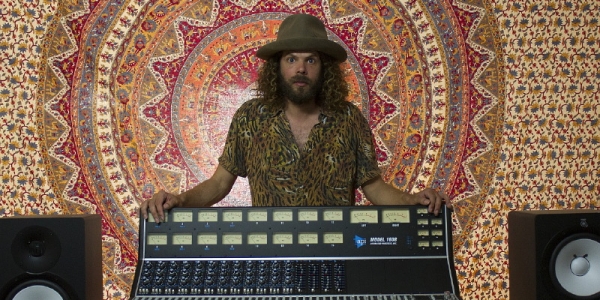
“That’s how we walked into the first Wolfmother record,” he says. “That’s how I learned to be in a studio.” Since then, it’s fair to say Stockdale has … chilled out. Much of Keep Moving was made in his home studio, and he tells me that the sessions were all about capturing the energy of playing live.
“Going into this, we thought to ourselves, ‘Let’s be spontaneous’,” he says. “Let’s set up some lights and some incense and dress up in some cool clothes, let’s be actors in our own movie and make it up and break the rules.”
This set-up, which conjures up visions of Russell Brand’s Aldous Snow in Forgetting Sarah Marshall, made for a far more fun and creative recording experience. “We had a massive producer lined up to do this record, re-record it and do it properly,” he continues, “but I just said to my manager, ‘I’ve got to be completely honest with you, my dream is to self-produce this and put it out as Andrew Stockdale’. Luckily they gave it the green light.”
With the imminent release of Keep Moving, Stockdale feels he’s landed on his feet as a solo artist. “With the old Modular thing where, the idea was that you’d make a record for three months, you go on tour, you take a break and then you make another record,” he says, of his old label’s regime. “You’d have to be creative, stop being creative, and be creative again.” He was no fan of this approach. “I feel now like I can be creative all the time, continuously,” he says. “All our gear is set up right here. I could start writing the next one right now. I feel like I pretty much already have. I feel like recording music is a continual part of life, and I’m just like …” he pauses. “I’m at one with it, y’know? Songwriting and recording should be like a continuum.”
BY ALASDAIR DUNCAN