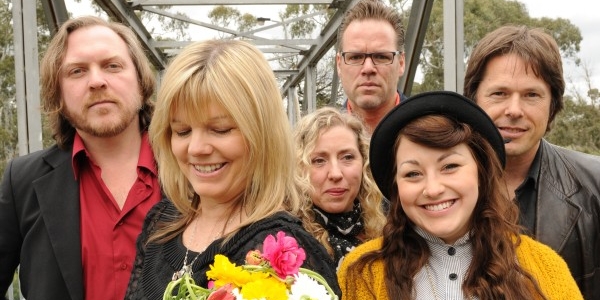
The Killjoys formed from the splinters of Wild Science. While the other members of Wild Science went onto form the darker rock outfit Violet Town, Pilkington and vocalist Anna Burnley chose a more pop-oriented format in the Killjoys. In the late 1980s and early 1990s the Killjoys were a staple of the Melbourne pub rock scene, performing regularly in the venues of the day. In 1991 the Killjoys released its debut album, Ruby, to widespread acclaim, the album’s sound showcasing the blend of Pilkington’s pop melodies and Burnley’s lilting vocals. The Killjoys received an ARIA award for Best Independent Release, and it seemed the band was destined for bigger and better things.
Twenty years later, and Pilkington says it’s hard to decide if the Killjoys could have managed their affairs differently and achieved greater commercial success. “It’s a tricky thing to look at in hindsight,” he says. “Over the years I’ve realised that the music industry is more a ship of fools than a rigid infrastructure. I suppose we seemed to elude the commercial success that the record company was looking for. We did get a lot of play on Triple J, but maybe the music wasn’t right for the time,” Pilkington says.
The Killjoys did, however, find itself the beneficiary of record company largesse when the members of the band were flown across to the UK to record the Killjoys’ second album with noted producer Craig Leon. “As far as production and recording goes, that was an amazing education,” reflects Pilkington. “We learnt so much from working with Craig Leon. That recording took place in the last era when the record company would ship you off overseas to record. And having recorded Ruby on a tight budget, having the luxury of five weeks in the studio, where you had to justify everything to the producer, having the time to do that was really great,” Pilkington says.
Having spent many years honing its music in the local pub scene, The Killjoys were well placed to showcase their music to English audiences. In fact, Pilkington says the band’s live experience highlighted the gulf with English bands who’d been signed before walking on stage. “As far as playing live, we were received really well,” Pilkington says. There was a tendency in the UK at that time for bands to be signed in the studio, but because we’d come from a pub rock background, we were already very well practised in a live setting,” he says.
The Killjoys went onto release its second album, A Million Suns, in 1994, an EP [Love And Uncertainty] in 1995 and a third album,Sun Bright Deep, in 1998. Save for the odd single and compilation, nothing substantial was heard from The Killjoys until 2007’s Stealing Horses. “We were still playing and writing,” Pilkington says. “So it never came to a point when it wasn’t practical to keep going. And we also never had the external pressure to say ‘what are you doing now?’ I think we’d spent so long between 1988 and 1995 where everything seemed so urgent that it was a relief not to be rushed,” he says.
Pilkington says the Killjoys’ songwriting process has remained largely consistent over the years, the only significant change being the medium by which song ideas are exchanged between himself and Burnley. “The method between Anna and I hasn’t changed a lot – I do the music and she does the lyrics,” Pilkington says. “But the way we exchange music has changed a lot, with developments in technology. And I suppose the fact that we’ve worked with a lot of other people tends to have an impact, though maybe not directly on the music we write,” he says. Featuring contributions from former Killjoys members, Pearl was written progressively over the last year or so. “Some of the songs were written very quickly, while others came from demos we did in early 2010,” Pilkington says.
To coincide with the release of Pearl, The Killjoys will be re-releasing the band’s award-winning debut album, Ruby, on a special double-disc format. “The main purpose is that the original release hasn’t been available for 13 years – the only copy I’ve seen available was on Amazon for $250!” Pilkington says. Pilkington has taken the opportunity to revisit the original mixing, taking careful stock of any lingering ’80s production aesthetic. “There’s a tiny bit of the ’80s left in the mix, so I’ve tried to thicken it up a bit,” he says. The re-release will also include a number of bonus tracks written around the same time as the songs on Ruby. “It’s basically the body of work we had at the time of Ruby,” Pilkington says.