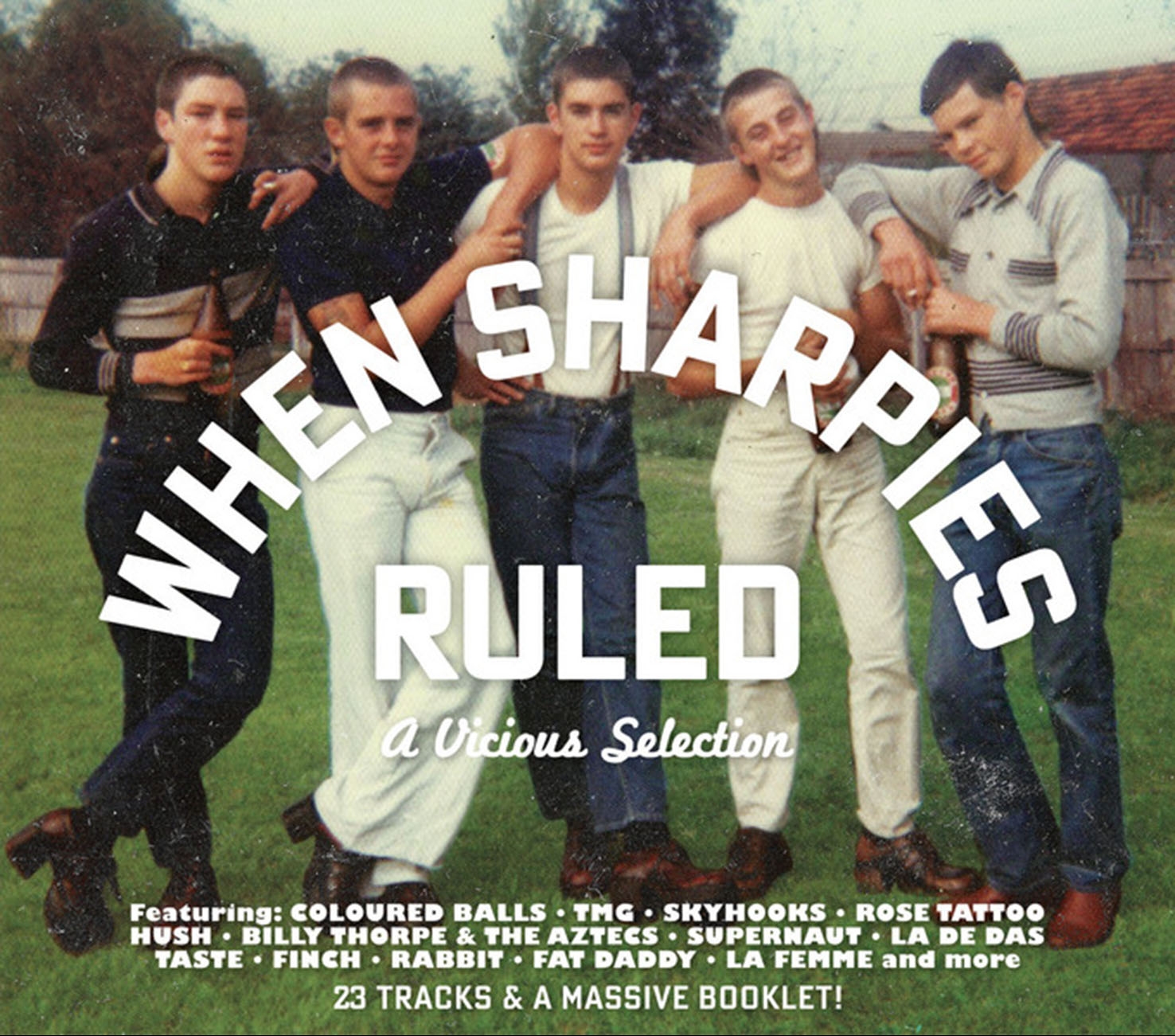
In the early 1970s, a unique subculture began to emerge in the Australian suburbs: sharpies. According to the frontman of Buster Brown and Rose Tattoo, Angry Anderson, the term came from the sharp dress sense of the constituents – Cuban heel boots and platform shoes, Italian-style cardigans, Levi’s jeans and a distinctive haircut. Like previous subcultures (such as mods, rockers and Teddy Boys), sharpies became the subject of tabloid hysteria, with authority figures proclaiming the imminent end of law and order should these youths not be tamed. When Sharpies Ruled casts a musical lens over the sharpie movement and finds a classic Australian rock’n’roll style defined by dirty, blues-inspired rock’n’roll riffs.
Lobby Loyde started his musical career as a mod in the Purple Hearts; by the 1970s his band the Coloured Balls (featured here with Time Shapes and Love You Babe) epitomised the hard rockin’ aesthetic favoured by the sharpies. Like Loyde, artists such as former Easybeat Stevie Wright (Hard Road) and New Zealand-born Kevin Borich (I’m Goin Somewhere, and with the Le De Das, The Place) had evolved from mod R&B to bruising beer barn pub rock. With help from Harry Vanda and George Young, Ted Mulry ditched his acoustic folk for dirty rock’n’roll (Jump In My Car, Crazy), while Supernaut threw a homoerotic squib into the sexual market place with I Like It Both Ways.
In addition to more well known blues rock songs of the era (Skyhooks’ Horror Movie, Hush’s Bony Moronie), the compilation unearths a bunch of lesser known tracks: Fat Daddy’s Roll Daddy Roll, Bullet’s Rock My Lady, Fatty Lumpkin’s Movin’ and Rabbit’s Wildfire.
By the end of the 20th century, the emergence of social media and globalised online communities had radically changed the very concept of a subculture. Arguably, there will never be another subculture like the sharpies again, but the music lives on.
BY PATRICK EMERY