From Fitzroy Pool to Hanging Rock, Melbourne's film culture has played an unexpected role in preserving the places locals fight hardest to keep.
Autumn is creeping into Melbourne now, that particular kind of March melancholy where the mornings are still warm enough to trick you, but the writing is on the wall.
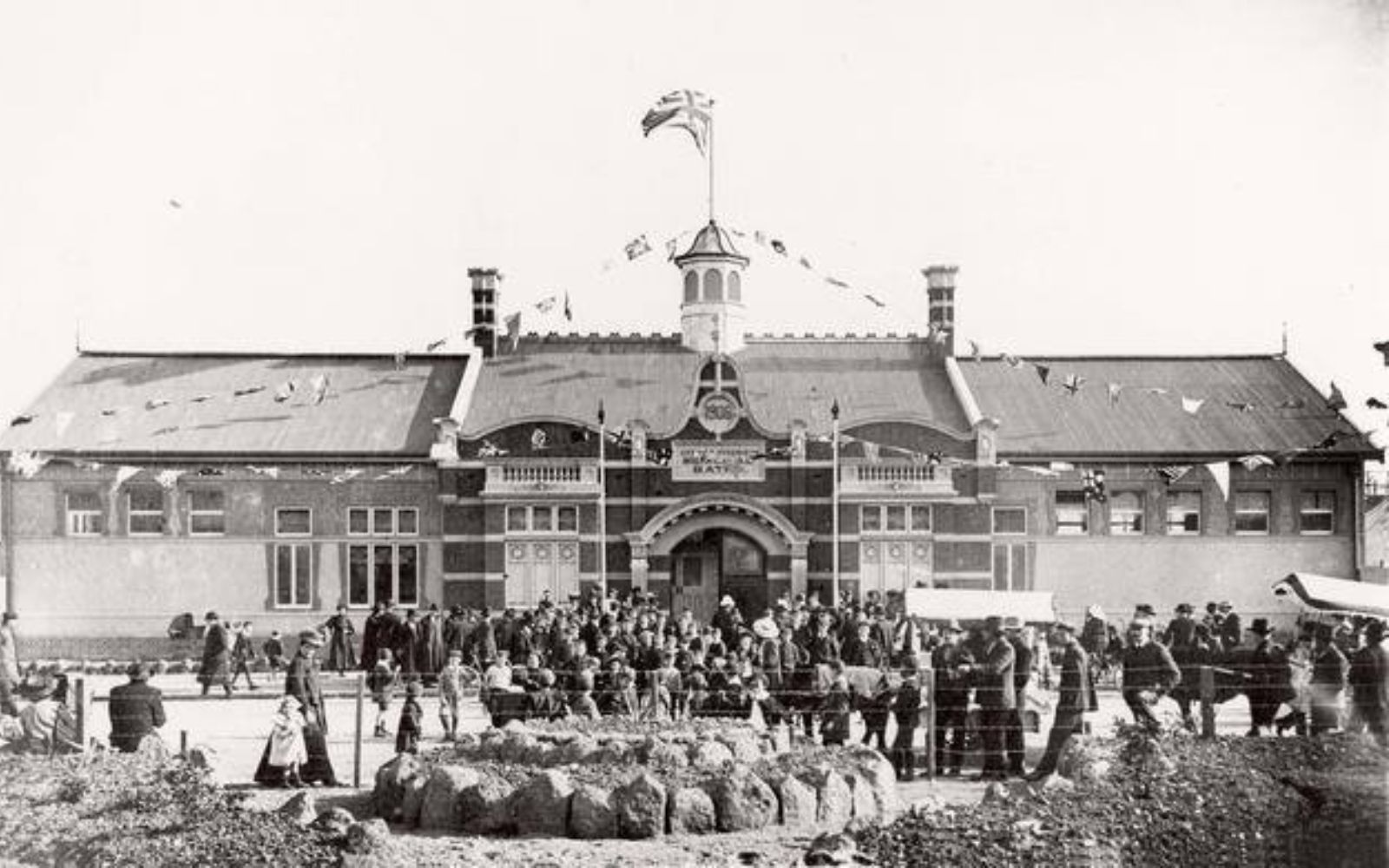
The swimmers are squeezing out the last of the season, goggle-eyed and reluctant, before Fitzroy Pool closes its gates for winter. It is hard to imagine, standing on the edge of that sun-baked concrete, that just over thirty years ago this urban oasis was destined for demolition.
It is an apocalyptic vision, yet one that continues to loom over the city. Too often, being a local icon is not enough.
Venerated venues like The Tote and most recently Fitzroy’s Night Cat, have all fallen under the shadow of the wrecking ball, threatened by soaring insurance premiums, restrictive liquor licensing laws, and the aftershocks of the COVID-19 pandemic. In the latter case, apartment developers were ultimately given the upper hand, with the venue ordered to undertake prohibitively expensive soundproofing or cease operations altogether.
Melbourne-shot films have long done more than document the city; they have helped protect it, keeping locations culturally valued and economically viable in the face of gentrification.
Through their afterlives in screenings, archives, and collective memory, these works have acted as informal heritage protection to the very locations they depict, and at other times, preserved them only as phantoms.
Read our interview with Monkey Grip’s cinematographer, here and our list of Melbourne’s best films of all time, here.
The Melbourne neighbourhood that refused to let go
Gus Berger’s 2022 feature documentary The Lost City of Melbourne immediately springs to mind, as does the wake of destruction left by Whelan the Wrecker.
Coincidentally, I live just a few doors down from what used to be the demolition company’s yard. I take some pleasure in the fact that it is now an extension of Austramax House, an assemblage of artists’ studios and independent businesses, rather than the graveyard of Victorian landmarks foregrounded in Berger’s work.
I am reminded, too, of another Brunswick share-house I once lived in, just a short walk from a residual Whelan the Wrecker sign I would often scowl at, ironically heritage listed itself, and located across from the former site of the Hoyts Padua Theatre on Sydney Road. Once a gorgeous Streamline Moderne cinema with a one-of-a-kind rotating screen, it has since long given way to what is presently an IGA.
Berger is also responsible for reopening single-screen cinemas across the northern suburbs, most recently Brunswick Picture House, the first new independent cinema in the suburb in forty-four years. Its inaugural screening? John Ruane’s Death in Brunswick (1990).
Screenings in a cult film’s locale often operate as the saving grace of a quite literal ‘death’ in Brunswick, or any other suburb for that matter.
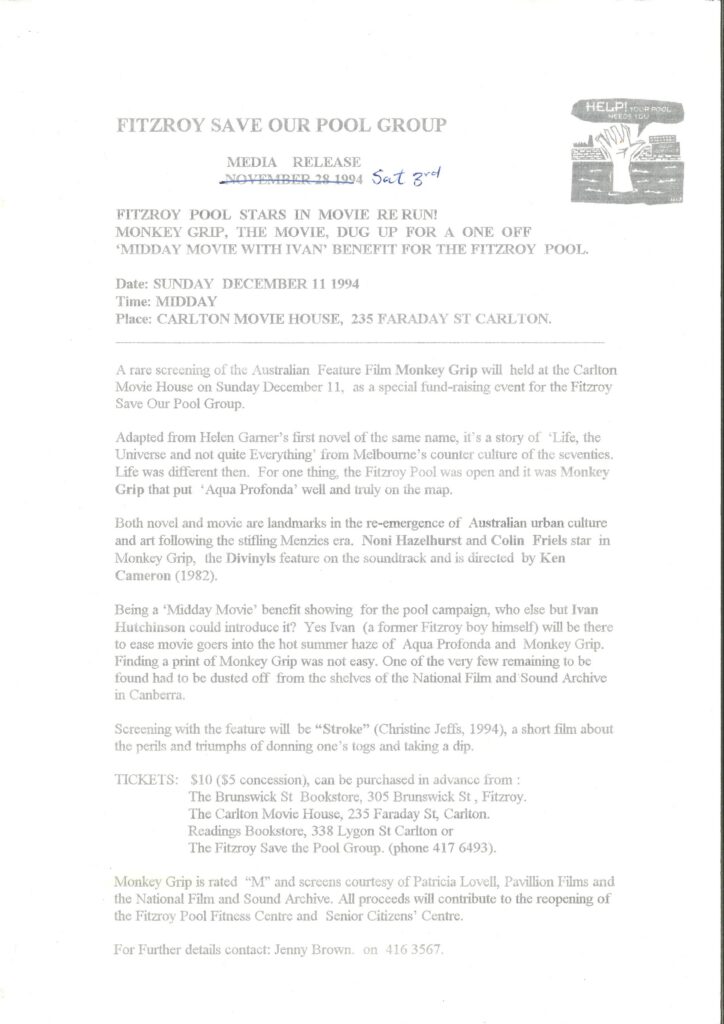
The campaign to save Fitzroy Swimming Pool in 1994 remains one of the clearest examples of screen culture translating directly into urban preservation. Among the campaign’s fundraising efforts was a screening of Ken Cameron’s Monkey Grip (1982).
As its promotional flyer declared:
“Life was different [in the seventies]. For one thing, the Fitzroy Pool was open, and it was Monkey Grip that put ‘Aqua Profonda’ well and truly on the map.”
The local film and novel mobilised memory, attention, and money in direct service of the threatened site. Tickets for the screening were sold through neighbouring businesses, including The Brunswick Street Bookstore, The Carlton Movie House, and Readings Bookstore, ensuring that cultural participation fed directly back into the surrounding suburbs.
In turn, local cafés nourished campaigners. Stores all along Brunswick Street participated in an hour-long vigil for the pool, lighting candles in support and placing them in their front windows. In the end, the Save Fitzroy Pool campaign saw 2,000 people march the length of Brunswick Street, as well as collectively filling and then draining the pool in protest. The site was occupied for six weeks.
View this post on Instagram
Art, community, and the places worth saving
As locations are essential organs for art, art is the life-blood of locations. It comes as no surprise, then, that local bands, comedians, cartoonists and film critics, including the late Ivan Hutchinson, became pivotal contributors. These creatives turned their respective practices into a tool, holding benefit concerts at the Royal Derby Hotel and surfing down Brunswick Street on a Friends of Fitzroy Pool float during the inaugural Fringe Festival parade.
Not only did the crusade to save Fitzroy Pool function as proactive grassroots action, but also as a launchpad for pupils of the arts. Local kids such as Ellen Connor, then fourteen years of age, experimented with public performance for the first time as part of the campaign. This momentum didn’t stop once the pool was saved, with celebrations paying homage to the camaraderie between creatives and the community.
A large party ensued, featuring bands such as the all-female folk trio Tiddas.
As Connor recalls in The Memory Pool: Australian Stories of Summer, Sun and Swimming: “…I became heavily influenced by their music after that gig…after that first year [in which the pool reopened] we decided to keep it an annual celebration, so the next year we did another one… and because I was doing music in high school I got to organise the bands, Sarah Carroll, the Cajun Aces, Joe Geia and Carol Fraser. One of my science teachers was in Cajun Aces.”
Much like film, music and performance, locales are a multifaceted passion project, the ultimate uniting force, and a means of being seen, heard and recognised.
Fitzroy’s sandstone cottages and terraces sit alongside Atherton Gardens, one of the largest public housing complexes in Melbourne. As community advocate Yusra Metwally notes, suburban pools are for the “…young, old and in between.”
Fitzroy Pool’s status as a melting pot epitomises Australia’s multicultural fabric, and the redemption of Monkey Grip’s setting became a way of reconnecting the neighbourhood’s cross sections.
Since then, Aqua Profonda, amusingly misspelt, has been further mythologised through songs by Courtney Barnett and Mick Thomas. The misspelling marks the phrase as something distinctively Melburnian, a cultural lineage that has grown beyond its Latin origins.
Subsequently, the pool has become an oscillating mirror to the novel and film it imprinted on, a record of one’s intense attachment, much like the particular bond we have with our suburban swimming spots.
View this post on Instagram
The connection extends into my personal relationship with Melbourne.
I bought my own copy of Monkey Grip at the beginning of the COVID-19 pandemic from a vending machine on Lygon Street. Operating under the initiative #AutomaticMainStreet, the machine became an inventive and essential tool, enabling local businesses to sell goods and vouchers during prolonged shutdowns. Even during this period of acute vulnerability, Melbourne’s cultural afterlife continued to support the city’s local economy.
That Monkey Grip had been chosen to represent Readings Bookstore, embodying its symbolic ties to the suburb and community, felt like a continuation of that breathing and miraculous cultural lineage. I’d inherited a kinship.
Helen Garner, the book’s author and longtime resident of its suburbs, later became a trustee of the bookstore’s foundation. Her reflection on the role is markedly similar to my own sentiments: “What I like best…is the new sense it gives me of an invisible, teeming, communal world out there, of people striving to be useful, to focus their energy in the form of highly practical projects.”
The places that appear on screen, in the purview of our windscreens, do not simply survive because they are merely loved; they survive because that love is repeatedly set into motion, long after the cameras have stopped rolling. At the core of everything? Community. It is all very The Castle-esque, the suburban citizen fighting to save their home, not just for themselves, but for their neighbours too.
Many of these stories would be lost entirely were it not for institutional archives.
I may never have learned of Fitzroy Pool’s near-demolition had I not been trawling the collections of RMIT’s Australian Screen Research Centre. Now home to the complete AFI Research Collection, the centre performs a quieter but no less vital form of preservation, one that remains free and publicly accessible, as our histories should be.
Production records, ephemera, scripts and media releases allow anyone to trace how localised films continue to shape public memory, inform policy debates, and reinforce the cultural value of physical sites. These collections not only act as time capsules, but also actively inform how we shape the city’s present and future.
Down the road from Fitzroy Swimming Pool stands The Tote. On a sweet and sweltering summer’s day, it is no stretch of the imagination to find myself humidifying there post-swim, aching for a pint as nippy as the Antarctic upswell that keeps Melbourne’s beaches bracing even at the height of summer. Yet in January 2010, the venue nearly announced last drinks.
Declared a “high-risk” venue under revised liquor licensing regulations that failed to distinguish small live music rooms from their larger counterparts, The Tote was rendered economically untenable. For then-licensee and Australian music industry legend Bruce Milne, however, the sense of despondency lay in the framing of music as a liability, rather than any actual disorder.
The response was swift. Much like its neighbouring pool’s campaign, a SLAM (Save Live Australian Music) rally drew 20,000 people onto Melbourne’s streets, not merely to save a pub, but to defend the conditions under which local music could exist at all.
Now, ‘pub’ may sound trivial, but Australians have long understood such venues as ‘an extra room in the home’.
Much like a city square, pubs have historically been among the few indoor spaces where working-class people could gather, organise, and build culture. It comes as no surprise, then, that The Tote served as a launchpad for countless punk, post-punk, metal, and hardcore bands, with The Birthday Party, The Drones, and Magic Dirt among their distinguished alumni.
In this sense, it is not merely a place to get sloshed, but a precious alternative ecosystem.
Pubs and politics have long been entwined, evocative perhaps of Bob Hawke himself (who even has his own beer brand). As put in the by-line of Natalie van den Dungen’s 2011 documentary Persecution Blues: The Battle for The Tote, “punk, passion, politics and public protest collide.” Released just one year after the rally, van den Dungen’s film exemplifies a broader pattern: films are love letters, keeping venues’ stories alive long before their fates are destined.
In 2022, The Tote celebrated forty years as a live music venue, only to be put up for sale the following year. Without a record-breaking crowdfunding campaign that secured the venue under the ownership of Shane Hilton and Leanne Chance of Last Chance Rock & Roll Bar, this iconic watering hole may well have shrivelled up once and for all. That The Tote could be put at risk again serves as a chilling reminder: cultural infrastructure remains structurally vulnerable, even when publicly cherished.
View this post on Instagram
What film leaves behind when the venues are gone
But what happens when community action fails, or loses touch with its roots?
In these cases, film footage itself becomes a placeholder, a Pepper’s Ghost of sorts, allowing lost or transformed spaces to persist as spectral presences. Richard Lowenstein’s Dogs in Space (1986) offers a striking example of incidental psycho-geographic archiving.
The film documents the real venues where Melbourne’s Little Bands scene briefly flourished, capturing performances before the beer even had time to go warm. Spaces such as the Crystal Ballroom, once a site for glamorous debauchery and now a prim-and-proper wedding venue, alongside the Champion Hotel, The Tiger Lounge, and the Exford Hotel, register as moments of déjà vu within Melbourne’s alternative cultural memory.
And as for the house the party-going punks return to come morning? It was Lowenstein’s real-life former share-house at 18 Berry Street, Richmond.
At the time of filming, the building was already recognised as one of the few surviving two-storey timber terrace houses, albeit partially defaced by later verandah alterations, a condition gleefully punctured in the film by a character yelling “SUCK MY MOTHERFUCKING DICK!” from its threshold.
By the 1980s, Richmond was rapidly shedding its slum reputation. As heritage restoration surged across inner Melbourne in an era shaped by renovation manuals and aspirational domesticity, the house required something closer to a “de-renovation” to reclaim its ad hoc, bedraggled character for the screen.
While the property was already protected on architectural and historical grounds by the National Trust, its association with Dogs in Space prompted further civic recognition. This sentiment extended to its on-screen background details: landmarks such as the Pelaco sign loom large, though no longer illuminating the skyline as it did in 1986. Both the house and sign were formally listed on the Victorian Heritage Register in the late 1990s, with heritage citations expanded to acknowledge their social and cultural values.
The result? Protection from demolition at both local and state levels.
The City of Yarra has continued to engage with the film’s legacy, with then-mayor Danae Bosler proposing a statue of Michael Hutchence in 2018. Commemorative gestures are just one way of expressing a film’s understated local impact. Through cinema’s images, a visual memory is sustained, actively reshaping how a suburb is understood, visited, and valued, long after its venues have changed or disappeared.
Peter Weir’s adaptation of Joan Lindsay’s Picnic at Hanging Rock offers a more ethically complex case. In January 2017, artist and researcher Amy Spiers launched the creative campaign #MirandaMustGo, using the film as a vessel to question which losses are remembered and which are ignored. With the film’s characters acting as conceited ghosts, the campaign exposed the discrepancies between popular memory and historical reality.
As the campaign’s website states, “the wrong losses and absences are commemorated at Hanging Rock.” For one, why, when visiting the site, is there more information about the fictitious school girls’ disappearance than on the real and ongoing legacies of dispossession experienced by the Woi Wurrung, Djaaram and Taungurung peoples?
The site and the film have become almost synonymous. Shoddy prints of the film’s poster are sold in the national park gift store alongside all-too-familiar bug-eyed marsupial plushies, visitors greeted by the tagline: experience the mystery. Yet, what of the so-called ‘mystery’ left by the loss of oral histories, the displacement of a ceremonial meeting place, the enduring effects of colonisation?
Even the name of the site has been overwritten: at least six European names have been recorded, with only one surviving name attributed to First Peoples.
View this post on Instagram
Films are reflections of our lives, yet also a means by which to romanticise the mundane. In doing so, physical space becomes more than a backdrop; it emerges as a lively participant in the mythology of our cities.
Cheesy as it sounds, we often forget we are the characters in our own independent movie. Set lists first orchestrated on sticky pub floors amid the percussion of tram bells and the brass section of car horns turn the city into a symphony, and the soundtrack to our lives.
Absence leaves a void, but also makes the heart grow fonder. I am the product of both bygone and breathing cinematic spaces across Melbourne and the East Coast.
The school in H2O: Just Add Water was the very one I attended; the final scene of Muriel’s Wedding (1994), as Muriel and Rhonda drive past The Pines shopping centre, unfolds along the same stretch of road I travelled on the way to Gold Coast Airport, the first soppy leg of my own journey to Melbourne.
I have wandered the contours of the University of Melbourne carpark as seen in Mad Max (1979), run to class along the same paths as Mia in Love and Other Catastrophes (1996), and glimpsed myself behind the cash registers of Takeaway (2003) and Idiot Box (1996).
These films were never just a tour guide to the city. Beyond the credits, they taught me what makes life here so magical, and what vanishes if we fail to pay attention in time.
For more information, head here.