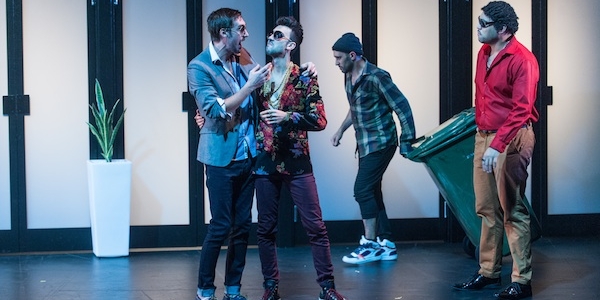
Taufa’s favourite aspect of this new production of The Comedy of Errors is the fact that he gets to play two quite different characters. “I change my voice, my costume of course; with one character I’m in drag, in heels. We establish a world which is the underbelly of society. The Duke has his hand in all the money aspects of the world. Balthazar is a trader looking for money. And there’s a corrupt cop – it’s a seedy world, like Sydney’s Kings Cross.”
Bell Shakespeare gives The Comedy of Errors a modern treatment. “It’s definitely a contemporary setting,” explains Taufa. “The story is of a character who is not allowed into the community. He’s not supposed to be there. He’s been brought in by border patrol…it’s very much in the now, there are links with current affairs. It looks at whether or not someone belongs, when they’re a fish out of water. It is relevant and contemporary, and very funny.”
Taufa says the expectation of laughs is built into the play. “It’s called The Comedy of Errors,” he reminds us. “It’s got to be funny. We do a lot of physical comedy. In parts it’s like Shakespeare’s attempt at farce, with doors, characters coming in and out. There are archetypes with the characters that people recognise, the nagging wife, the tough guy, the merchant. There are sight gags, fart gags and a memorable scene involving a washing machine.” Some of Shakespeare’s original jokes have been left out of the play that Taufa describes as a crowd favourite, as they no longer make sense to audiences.
With so many performances, how does the actor stay fresh, prevent himself from going through the motions on stage? This is something Taufa has thought deeply about; his commitment to his craft is evident. “Every show counts,” he answers. “Even if you’re only performing for 116 people. Every show will be new. You gauge the reaction of the audience, you pace up to make them laugh, or pace down.” One method of staying present and fresh involves the intensity of the interaction on stage. “You always make sure you’re affecting the other actors,” Taufa adds. “Sometimes the other players change something, emphasise something different, there’s a different nuance in lines. It changes from show to show; it changes from audience to audience. You send different information out to the audience, sometimes you break that fourth wall. You make sure there’s audience involvement.” Something else Taufa enjoys about The Comedy of Errors is the amount of feedback from audiences the actors feel during the play, which has become a favourite of his whereas it wasn’t before. “It invites audiences in. It’s more inclusive than some of Shakespeare’s other plays.” He goes on to explain that some of the tragedies, Othello, for instance, tend to produce more of a sense of passivity in audiences. “Othello is more about drawing in. The Comedy of Manners is more about giving out.”
Director Imara Savage has set the play from evening til morning instead of the dawn til dusk that the script describes. This makes sense, thinks Taufa; we are different versions of ourselves in the darkness. “Imara’s spot-on. It’s much more recognisable for a modern audience. We know what happens on those big nights out, those big benders when you go out at ten and stay up til the sun comes up. At night you allow yourself to do things you wouldn’t do during the day. You’re less inhibited. We’ve all had those weird nights out when you’ve been surrounded by all these faces but then in the morning you’re alone. You wake up not remembering everything. It becomes a bit warped.”
The Comedy of Errors uses the story of two sets of twins and inevitable plots involving mistaken identities to explore themes such as the yearning we experience for ‘the other half’, something Taufa sees as a universal human experience. “I don’t have a twin but it’s like we are all trying to find other parts of ourselves, looking for something to complete us. Not necessarily a relationship or a career but there’s that yearning for the other; we have our public faces but we are looking for something to make us complete. People can envy what someone else has but you don’t know what is behind the public face for someone else, what’s behind those yearnings. We all want to feel part of something bigger.”
BY LIZA DEZFOULI