The association between Dada, The Velvet Underground and Bakehouse Studios has some subliminal currency in the evolution of The Bakehouse Project; the new book documenting visual, sculptural and conceptual art project conceived by McLean and his wife and business partner Helen Marcou.
As a fine arts student, McLean developed an interest in Dadaism. He was particularly drawn to the work of Marcel Duchamp; the influential French-born artist at the forefront of the Dadaist movement who asserted the artistic potential of even the most banal found objects. “Anything could be art – it was more how the artist conceived it,” McLean says.
Inspired by this notion, McLean named his first band Scrap Museum, and the same name would eventually be used for one of the rehearsal rooms in Bakehouse Studios on Hoddle Street in Richmond. The building that now houses Bakehouse Studios started out as a furniture store, then a squat and a derelict rehearsal space before McLean and Marcou took over.
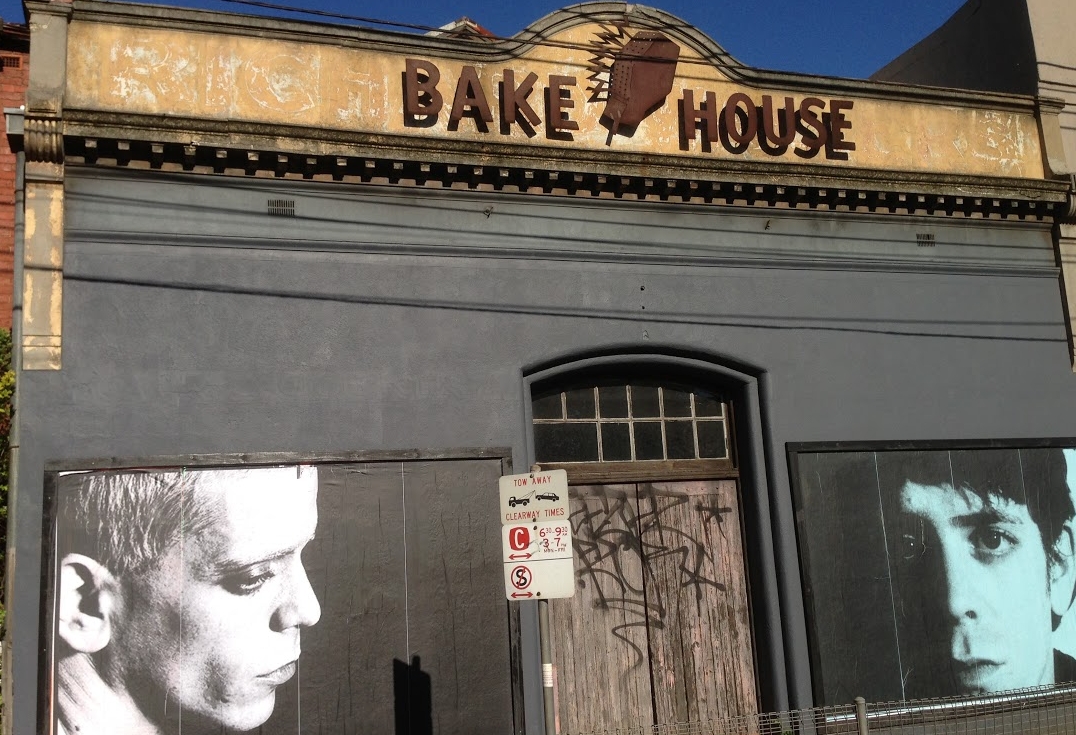
Although the studios have operated successfully for a couple of decades, it was the death of The Velvet Underground’s Lou Reed in 2013 that provided the catalyst for the evolution of Bakehouse Art Project. Shortly after Reed’s death, a Melbourne-based street advertising company pasted two posters of Reed on the external front wall of Bakehouse Studios. The visual tribute to Reed sparked an immediate reaction.
“Helen remembers Spencer Jones texting her to say how moved he was to say those images up there,” McLean says.
The giant Lou Reed poster sparked a bigger project, with the building gradually transforming into an arts space, featuring photos from Melbourne’s punk scene in the 1970s and artworks by such local artists as Mick Turner, Patricia Piccini, Julia deVille, the Hotham Street Ladies, Veronica Kent, Moya Delany, Stewart Russell, Adele Danielle, Garrett and Will Huxley and Brustman + Boyde (who designed the green room adjacent to the upstairs performance space).
The art project saw the various rehearsal rooms re-named to reflect a particular theme. Individual rooms and corridors are adorned with artwork showcasing various local artists, images of which are now captured in The Bakehouse Project, a hardcover book featuring art works in the studio art space and the stories behind them.
Turner’s inclusion is especially apt – in the early days of the Dirty Three he’d rehearse for hours on end at the original Bakehouse Studios in North Fitzroy. For his contribution, he decided to eschew the usual apolitical tone of his artwork to paint a picture highlighting the tragic plight of asylum seekers and the diffident policies of the major political parties.
As the art project evolved, McLean got the opportunity to indulge his interest in Dadaism, with the foyer to the Scrap Museum and the upstairs performance space including various sculptures true to Duchamp’s belief in the artist potential of found objects. “I’m big on rummaging through the rubbish bin and seeing what’s there,” McLean says.
McLean says the Bakehouse Project is ultimately about inspiration, both in the works created by the featured artists and for the musicians who come through the doors to rehearse and record. “We like the idea of not influencing what the musicians do, but inspiring them,” McLean says. “We’re really excited that we’ve created a space that somehow is giving ideas to musicians – they can discuss things from another perspective and then move on.”
BY PATRICK EMERY