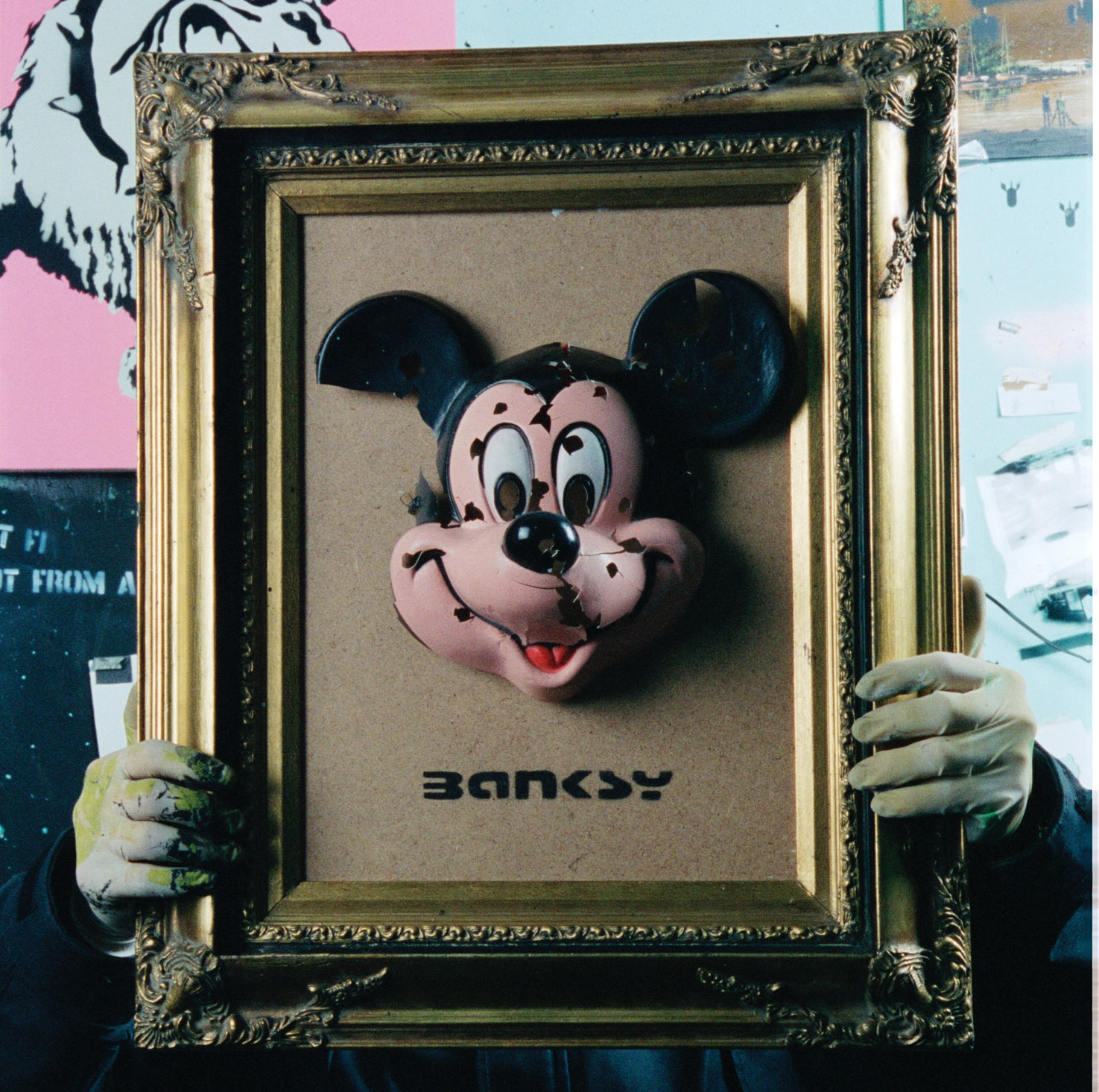
Although Banksy’s true identity remains a mystery (“I could tell you but it would just be a lie”) there is no doubt Banksy has risen from obscure, surreptitious street artist to house-hold-name type of famous, and in the process has become a darling of international art collectors because the value of his works keeps heading north.
Lazarides, former friend and manager, is widely credited for this. “If there had been one individual responsible for whipping up and sustaining the fever around urban art, and who stood to lose most from its demise, it was Steve Lazarides,” noted the Financial Times in Britain in 2011 and it’s a quote that looms large on the walls of The Art of Banksy exhibition, which opened in Melbourne last Friday.
The exhibition, which is touring internationally after its three and half month run here, is curated by Lazarides. “We met in 1997 when I was commissioned by a magazine to take his portrait,” says the photographer turned gallerist. “We mutually knew a couple of other graffiti artists in Bristol so they trusted me, he then trusted them and me enough to have a meeting and then the next 12 years was like being caught in a whirlwind. It was one of the best periods of my life. I loved every second of it. Would I want it back? I don’t think so. Do I regret it? Not a single bit, I had the time of my life.”
The Art of Banksy is being exhibited in The Paddock, a car park behind the car park at Federation Square, which has been transformed into a pop-up venue, with beer garden and a rotating roster of food trucks. Inside the exhibition space itself, the streets of London is the theme, with faux-asphalt and store front facades as a backdrop for the works themselves, which include iconic images such as Girl with Balloon, Flag Wall and Laugh Now.
With Banksy having such a large body of work, how does Lazarides begin to curate such a retrospective? “I picked stuff that I thought had relevance to now. I picked stuff from different periods, different styles of painting, so there’s this broader cross section of work. Quite obviously there’s quite a few works I wish had’ve been in here but you know, I can’t get everything. If someone doesn’t want to lend something, you just can’t talk them into it,” says Lazarides.
He did, however, manage to talk a good few collectors into loaning him the more than 80 works that are on display, which he admits was a challenge to “beg, borrow, cajole and get people to agree to loan us their works to come away for a year”. Some flatly refused. “The people who said no, generally said no because they can’t be arsed taking it off the wall or didn’t want to leave a big hole in the wall. But a lot of people are quite flattered that we’ve come back to them. Banksy is not the only artist I’ve sold them that is in their collections, so people trust me. I think that’s the other thing: this is a level of trust that you’re loaning a work that is worth hundreds of thousands of dollars and you’re going to get it back at the end of the stint,” says Lazarides, who estimates the value of works on display to be hovering around the ten million US dollar mark.
This was never the intention, back when the pair were working together. “Unfortunately what we started off – we were trying to make cheap affordable art for the masses – spectacularly backfired,” he says of pieces that he was once selling for £150 in 2003 that these days are “exchanging hands for hundreds of thousands of dollars”. Banksy sold works primarily to pay bills while the street art was always intended to stay in the street. “It’s a gift to the community and the city,” says Lazarides, who no longer has any relationship with the artist and doesn’t discuss publically the reason for their falling out.
“The thing is, I’d never studied art, I’d never worked in the art world, so we just made shit up as we went along and I think the thing I’m proudest about is that we did it totally on our terms, there was no subscribing to how things are supposed to be done or how things have been done in the past. We just did what seemed to make sense”.
BY JOANNE BROOKFIELD