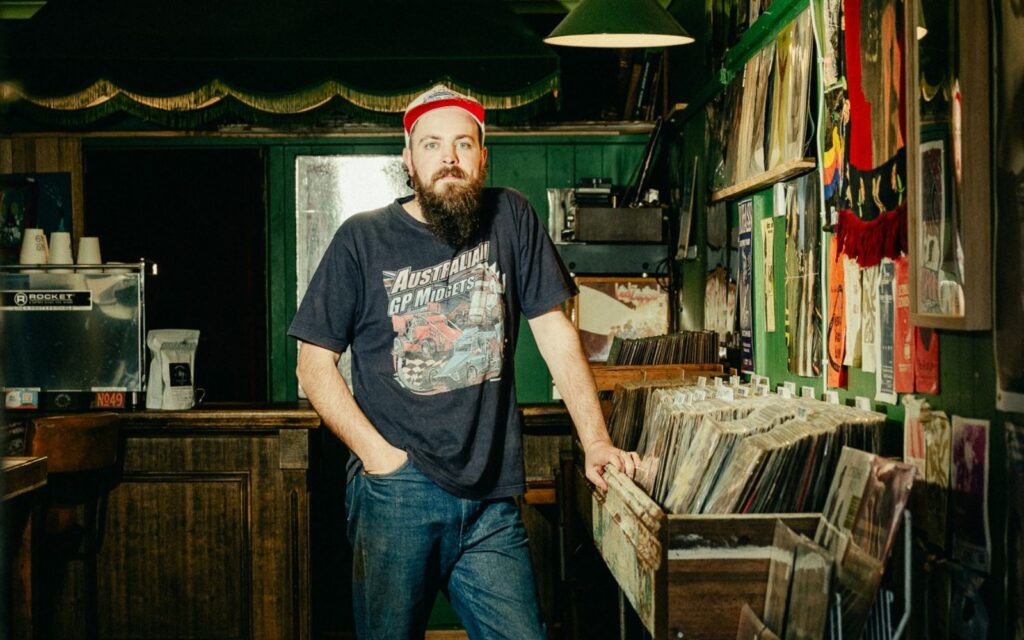
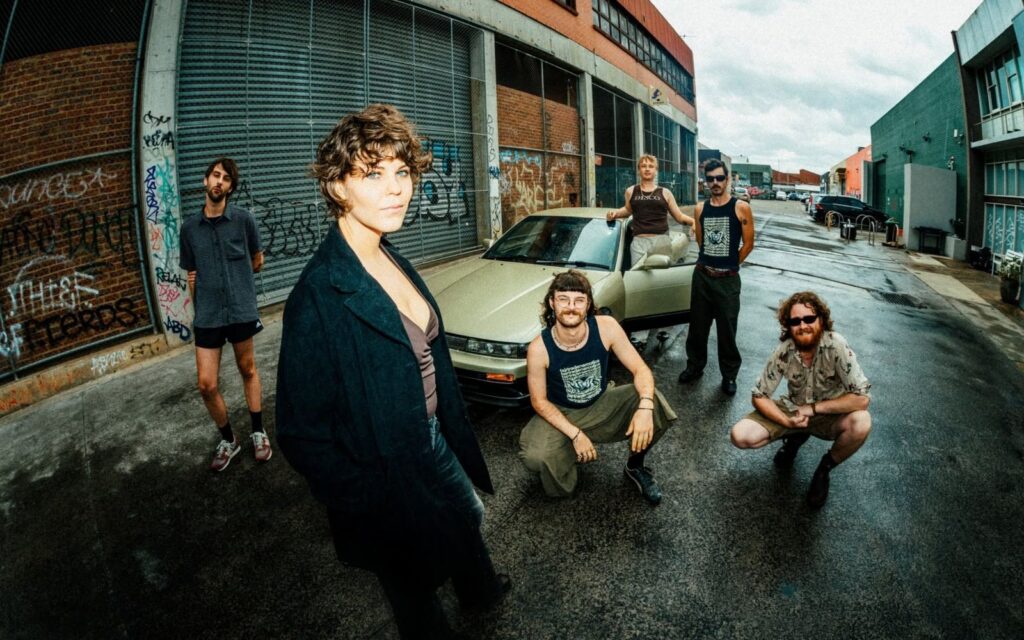
“Where I grew up, I was about a 45 minute walk from the nearest bus stop and an hour from the nearest town,” he says “My overriding memory as a teenager was walking to the bus stop and listening to music. It’s a serene feeling that you only really have the privilege of having when you live so far away from a major town.”
In fact, a simple walk is Watson’s tried and tested artistic panacea.
“Getting outside and clearing your head is amazing,” he says. “Lately I’ve developed the ability to be able to detach myself from music and do something like paint or other repetitive tasks that are just an alternative to writing songs. With anything you always hit a wall, but getting outside and clearing your head is simple and it works so well.”
Clear air is a consistent string on Slow Clubs newest album, Complete Surrender. The sound is stripped back and leaves you with a feeling like you’re wandering through the album, absorbing the music through your skin.
“We had no idea about the direct or texture of the sound before we started recording. We wanted to simplify things and make the album sparser,” says Watson. “I’m the kind of person who gets distracted by the possibilities of what you can do with a song, what you can add to make it bigger.
“The difference between this album and the last is that we’ve done this one in a home studio with a bunch of collaborators. We’ve brought in a range of different musicians and have the knowledge now of when to stop and go, ‘Okay, this song is finished’.”
Collaborative recording is an oft-used technique in music, since home recording equipment has become more readily accessible and available to anybody with a little cash and a little knowhow. For Slow Club, it yielded results.
“Collaborative recording is a very different recording process. Rebecca [Taylor] plays drums and some keys and I play guitar, piano, keyboard etc. The last record we had Rebecca on all the drums and me on all the guitars on keys,” Watson explains.
“To be able to bring in a bunch of different musicians allowed completely changed the way that the album was constructed. You can hear the difference in the drumming for example. Avon, who we brought in to lay down some drum licks, had a more technical and cadent style of drumming which sounds different to Rebecca’s less rehearsed but more natural sounding style.”
Writing as a two-piece can have its limitations. The most obvious being that two people trying to create a sound comparable to four of five musicians takes a lot of finesse with a lot more work, something that isn’t lost in Slow Club’s process.
“Rebecca and I write separately a lot since we’re not always in the same town,” says Watson. “If I feel like I’ve been couped up for a while, Rebecca could be having a much better day on her end. Distance allows us to express ourselves clearly as two different musicians, which I think is great because it means our sound stays active rather than us finding a middle ground between our two styles. Being a two-piece does have its stresses though. The best thing about a collaborative album is that we were able to split the workload across far more musicians.”
According to Watson, collaboration is just an extension of the sense of community present in a small country environment. Sheffield is notable for producing Arctic Monkeys, Pulpand one sixth of Iron Maiden, and it’s no wonder the music scene is alive and strong.
“London is considered to be England’s cultural centre, and there really is so much to do. But I find that in a way there is so much to do that no one really doesanything,” he admits. “The great thing about those northern towns like Sheffield is that you start out as a band and you know all of these people that come to your shows. I haven’t seen that in London yet.”
Fortunately for Watson, Slow Club has taken him across the world, from playing shows throughout Europe to repeat trips throughout the US, not to mention coming up on his third romp through the great southland.
“We can’t wait to come back to Australia in January. Last time we were in Melbourne we got completely blown away by the response. We didn’t really have high expectations for our music to have travelled so far, but the turnout was amazing. I feel like we’re lucky that we even get to come to Australia. Although the accent is as close as you can get to British so we feel fairly at home,” he says.
“The last time we came down we played a show in Adelaide and were surprised at how laid back it is or a major city. Especially when someone said that South Australia has the greatest number of serial killers per 100km in the world.”
If that isn’t the most punk rock statistic going around then I’ve lost hope.
BY JACOB MILLS