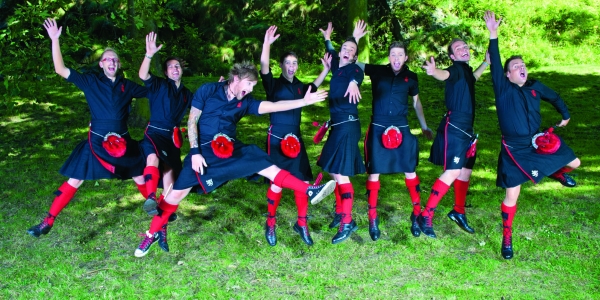
“It was originally a group of five mates just getting together and doing something with bagpipes,” explains MacDonald, in a thick Scottish brogue. “We were playing at corporate events, pretty much just in Glasgow and Edinburgh. Just on a small scale. Then the shows just got bigger and bigger – a few more pennies in our sporran and it grew, you know? Then we went and won the top award on When Will I Be Famous and we just exploded from there! We got opportunities you could only dream about, to be honest with you.”
Born and bred in Scotland’s north, MacDonald had played in youth bagpipe bands such as the 47th Culter Boys Brigade Pipe Band from an early age, up until his father got transferred down south to the Big Smoke of Glasgow. He continued to play in pipe bands, but when he moved into his new school, he found that none of his school-mates played the pipes – with the traditional instrument considered boring and un-cool, they all played guitars, drums and the like.
Years later, MacDonald and his merry music makers are proving to a new generation that yes, bagpipes can be not only cool, but downright awesome. I ask MacDonald if they feel that they carry a responsibility of sorts to introduce a younger, jaded generation to a traditional Scottish form of music. “Yes, definitely!” he exclaims excitedly. “It’s certainly a by-product of what we do. When we started out, we didn’t have any intent or preconceived ideas of what we could do or how we could do it, but through the immediate exposure we kind of catapulted ourselves into a situation whereby young people would particularly look at us and see us as role models.”
But not everybody was thrilled. Scottish traditionalists in particular were strangely sour on the prospect of somebody mixing traditional bagpipe music with more modern sensibilities. “Now, some traditionalists would argue that we’re taking the traditional element out of the music – but then it’s bringing more youngsters into becoming musicians and playing traditional instruments!” MacDonald exclaims, somewhat incredulously. He seems pleased that aspiring bagpipers can have a bit of fun these days – a luxury he wasn’t allowed when he was a wee one.
“One special element is the fact that [the children] can always have a bit of fun at the end of [bagpipe] practice; doing some rock numbers or doing whatever they want to do basically, and I think that’s the power of it. I never had that when I was a youngster, it was more like, ‘That’s what you play, that’s how you play it, and that’s it.’ I think when we got older and started the band, we got an opportunity to play things that nobody had ever played before.
“There tend to be three categories of people if you look across the board,” MacDonald continues, warming up to the idea of explaining the appeal of modern bagpipes. “You’ve got the old generation, who are in their 70s and upward who are like, ‘We don’t like it; it’s a sin to the bagpipes, and it’s not doing any good for the traditional bagpipes.’ Then you’ve got the middle belt, from 25 to 35 who will probably admit that it’s quite cool, but that it is what it is – and I think it’s more that they wish they’d come up with the idea! And then there are the youngsters under 25 – you know, they’ve grown up with what we’ve done, so they definitely see it as a reform. So hopefully, the band can take that energy and harness it and bring on a new breed of young bagpipers!”