“I’m not big on Batman,” Brown says. “I don’t really like superhero movies, but I’m a sucker for X-Men for some reason. I don’t know why. It might be because everyone has their own special power. And some people might have a kind of useless mutation. I like to think of all us artist types as being weird X-Men characters.
“I think that my favourite genre of film would be post-apocalyptic, sci-fi. Something like Children of Men, that’s one of my all-time favourites. So anything like that I’m drawn to – post-apocalyptic, or pre-apocalyptic. I’ve been thinking about Melancholia, the Lars von Trier movie. I love that one. I always love a movie that doesn’t have a happy ending. I’ve seen The Road a couple of times now, though I don’t know why since it’s such a bummer. No Country for Old Men is another favourite. Maybe I’m just really fatalistic? There Will Be Blood. God, as I hear myself saying all this I’m really starting to worry.”
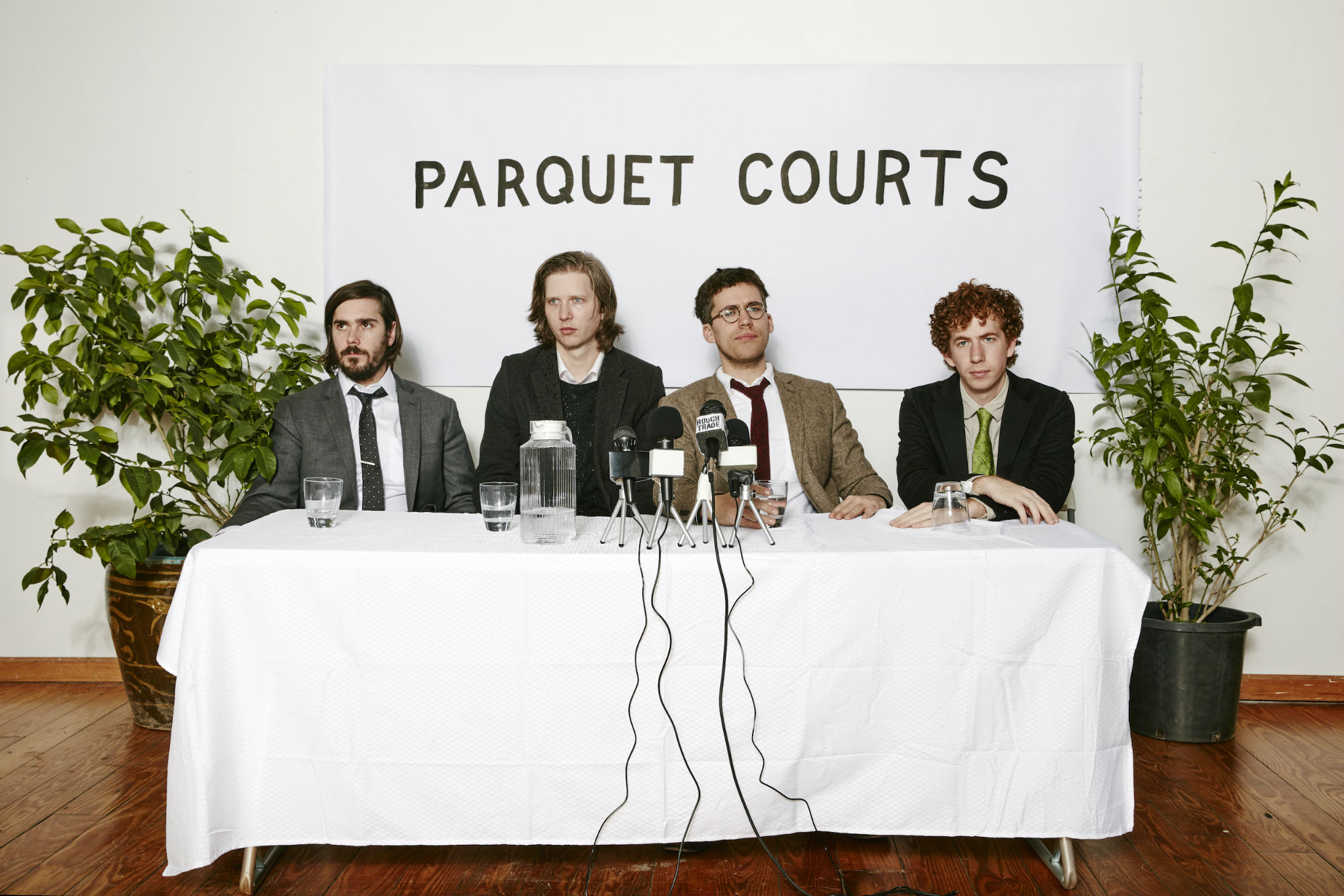
Bleak as his cinema taste may be, there is a thematic link here: faith in momentum, in adaptability, change and survival. Parquet Courts are in no danger of annihilation, but of all the topics touched on in our interview, we keep circling back to Brown’s refusal for the band to be left behind. Intriguingly, it’s only after the advent of an album – in this instance, the newly released Human Performance – and the subsequent media cycle that Brown starts to reflect on exactly what he was trying to achieve.
“There are certain questions I get a lot, and it’s not like it’s unfair to be asked them, but it’s also something that I never really think about until I’m asked,” he says. “I like that, reflecting back on something, wondering, ‘Well, what was that record about?’ There’s nothing that we do when we start making a record; no conscious decisions, we don’t talk about the concept. But as I start doing press, I draw lines and connect dots between songs. All our records do have an overarching theme to them that develops through the process of making them that I never really analyse until after it’s all said and done. And I really do appreciate that. It allows me to understand the narrative of my creative arc and the arc of the band. I think that’s important, because without that perspective you might not be able to get out of your box or move forward.
“We’ve done quite a lot of records, and I think it’s easy to get in that routine of writing a Parquet Courts song. But by now, this is our fifth record, we’ve been a band for five years, more or less, and now,” Brown breaks off and laughs in pleasant amazement, “now I’m starting to hear bands that sound like us. So when it comes to making Human Performance, it seemed obvious to me that if we were to make a Parquet Courts record as the band has existed, it would just be fine. And it’s a nightmare for me to make something that people listen to and just say, ‘Yeah, it’s fine. Kind of what I expected.’ That would be painful.”
Human Performance arrives roughly six months after the band’s previous release, Monastic Living, an EP that divided critics and fans alike with its largely instrumental and experimental content. Despite being unveiled half a year apart, Monastic Living was born in a single day of curiosity while in the studio for the album; a chance for Brown and co. to flex their creativity and find what other sounds might be lying in wait.
“I was so thrilled to see [Monastic Living] get completely trashed in the press. It was divisive, and I think that’s a good sign. It gave us that much more of a perspective of what we were doing. It was seeing what happens when we rattled our cage a little bit, when we turned the snow globe upside down. Making Human Performance, it was like we needed to prove we weren’t going to do the same thing over and over and hope people keep paying attention. We recorded 30 songs for this record, whittled down to fourteen, and the songs that sounded like routine Parquet Court songs were the ones that got cast aside really early in the process. Songs you wouldn’t peg as being a Parquet Court song, those are the ones I really carried the flag for. To me, those are songs that define not just the record but our steps forward. I didn’t want it to be a collection of songs that could have come from any of our other records. And I think we did that.”
BY ADAM NORRIS