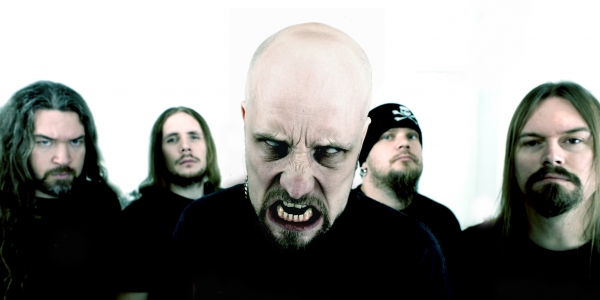
“We’ve done the Soundwave festival a couple of times and that’s a good thing to do because you get to play in front of a lot of people, but the sideshows have been really good, so we have only good memories of Australia,” Haake says. “We’ve never toured with Lamb of God before or did any separate shows with them. We’re good friends with them and we’ve been talking about it for a few years but we never really got around to it. They’re a great band and we’re expecting a big turnout of people.”
Townsend wasn’t wrong when he spoke of Meshuggah’s influence, but it goes even further than that: a huge number of modern metal bands and producers are using Haake as their drummer without him even knowing it, via software called Drumkit From Hell. It’s built around samples of Haake’s drum kit: 127 different hit strengths for each drum, through a multitude of microphones, allowing musicians to program drum parts in the computer and effectively have Haake playing on their album – even if it’s just him performing the individual hits that make up the programmed performance, rather than playing the rhythm from the ground up. Many other drummers like to use a real or electronic kit to trigger DFH sounds live and in the studio for sonic consistency.
“It’s been an ongoing process since the late 90s,” Haake says. “For us it was something that we wanted to do for ourselves as a tool for us when we write music. Prior to that we used drum machines. We all had the Roland R5 and we used to program drums on that, then use portable studios to add guitars to that, and it was kind of a hassle. But the mid to late 90s when we all started using computers we felt like we wanted to do things differently to make it easier for us. So that’s how it started, and by now it’s probably the biggest drum sampling program that’s out there, between all the different releases ranging from jazz to Latin to metal to pretty much anything you could possibly want in a drum set. It’s a really cool thing that the company grew big. And for us it’s an extremely useful tool. We use it every day when we’re writing, and for me as a drummer, sometimes I’ll just start programming from an idea I have in my head without even trying to play it. And sometimes it’s the other way around: I mess around on the kit and come up with something I think sounds cool then I go off and program it. When it comes to the odd cycles that we do it’s way easier to do that in the computer environment. I don’t even think that we would be the same band we are now if we didn’t have that tool because it definitely opened up avenues for us to create our music.”
Meshuggah has their own studio, which used to be shared with the band Clawfinger. It’s now shared with a few other bands. “It has a couple of different recording rooms and a mix room in an old industrial building,” Haake says. “It’s kind of beat up but it really works for us, for what we’re doing. There’s plenty of space, and since the I EP in 2004 everything we’ve done has been recorded here. It definitely works for us, not just as a demo studio.” Haake has his definite favourite albums in terms of mixing and production, although you might not necessarily hear their influence in Meshuggah. “There’s a few maybe obvious ones, like the first Bob Rock-produced Metallica album – the Black Album – and Motley Crue’s self-titled album from 1994. That’s the most brutal drum sound I’ve ever heard to date. There’s a couple of really, extremely well-produced albums. I mean, there’s different ways of looking at it but to have that modern kind of sound in the early 90s is mind-blowing. If you listen to it now, it’s still up to date and it’s still accurate as far as what people are aiming at now, 20 years later, so that’s crazy! I’m not a Motley Crue fan but that album, as soon as you hear that burst of drums kick in on the first song you’re like ‘Ho-ly shit.’ And I still feel like that about that album.”
BY PETER HODGSON