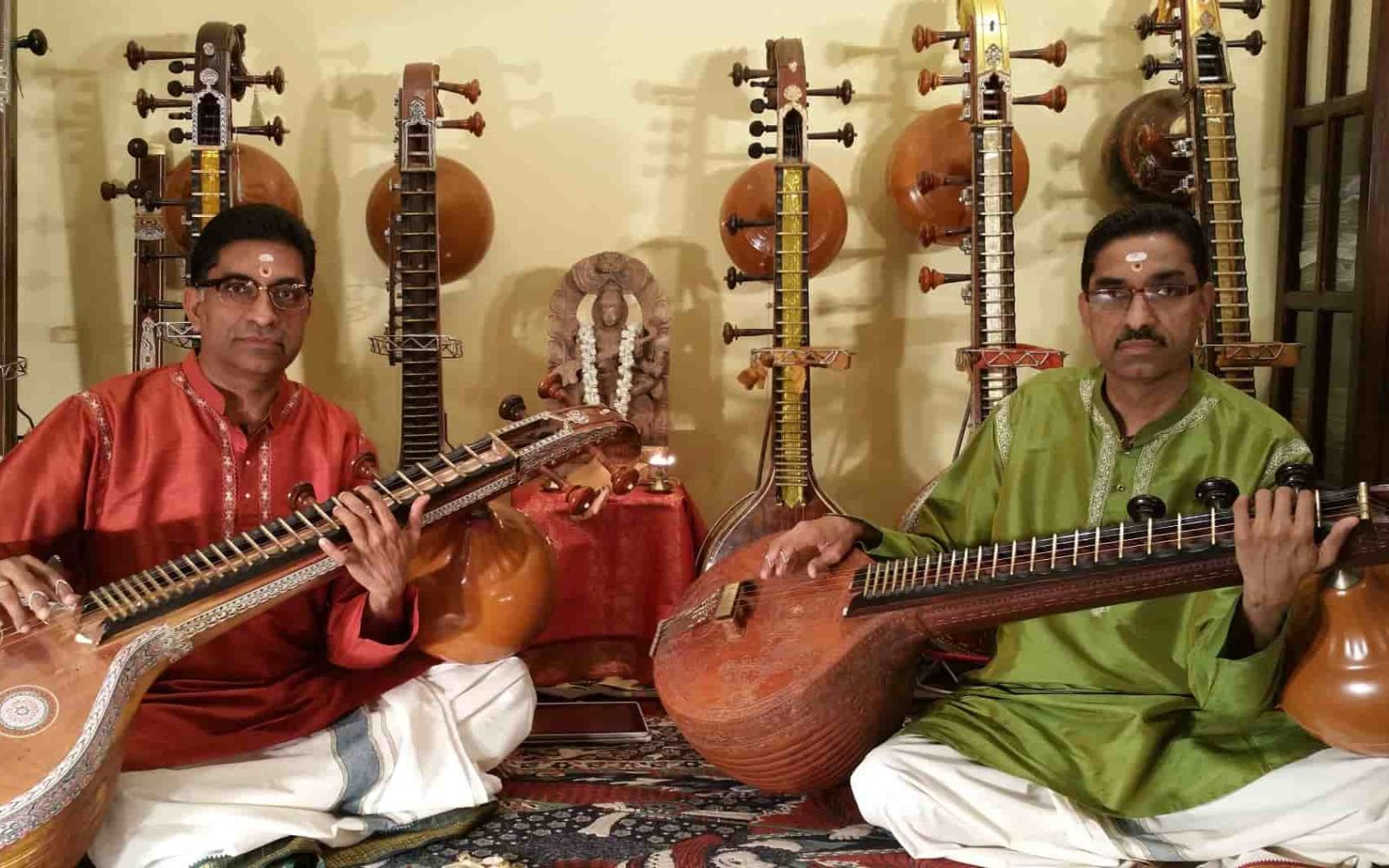
Twin brothers and veena virtuosos Ramnath and Gopinath Iyer have performed as the Iyer Brothers for 50 years.
Their mutual love for the Saraswati veena – the Indian stringed instrument named after the Hindu goddess of knowledge, music, art, wisdom and learning – is immediately palpable.
“The Hindu Goddess Saraswati is known to have played the veena,” says Gopinath Iyer, as he shows me a picture frame of the goddess holding a veena. “In every Hindu household, the veena is a revered instrument. It’s a godly instrument.”
Keep up with the latest music news, features, festivals, interviews and reviews here.
The veena is intrinsic to the rich culture of the Carnatic and Hindustani classical music of South India. “The veena is the reference instrument for Carnatic music,” says his twin brother Ramnath Iyer.
“In the 1300s and 1400s, the veena was used as the reference point for defining and coming up with the system itself, where music colleges relied on the veena because the notes are very scientific. From then on, they were able to invent ragas, so the root of Carnatic music is from the veena.”
“It’s only now that it’s hitting us that it’s been 50 years,” Gopinath laughs. “It’s really exciting to be now thinking about that journey and that’s what we’re celebrating. It’s a blessing that both of us took interest and passion in the same art form. I think by God’s blessing we were both blessed with that talent, so when we play together, we complement each other.”
The brothers discovered the veena from hearing the beautiful sounds of the instrument coming from their neighbour’s house in the early 70s. That fateful experience led to the twins learning from three Gurus, including Indian maestros, Sri R. Pichumani and Shri R. Venkataraman, from whom they learned for at least a decade each.
“It was a lot of hard work,” says Gopinath, as the rhythmic patterns are very complex. “The teachers were very hard taskmasters, so what you learn in one class, the next class you need to produce it properly or they won’t progress you further. We used to get up at 4am to practise.”
The Iyer Brothers have performed around the world at beautiful venues across Australia as well as in the US, New Zealand, Singapore, Malaysia, Sri Lanka and the UAE. Gopinath recalls particularly special performances at the Sydney Opera House, Melbourne Recital Centre, Port Fairy Folk Festival, Canberra Folk Festival, and the Chennai Madras Academy.
“The first one that comes to my mind was the WOMAD in Adelaide,” says Ramnath. “The highlight was at the end of one of the performances, this elderly Australian gentleman came over and he asked us why we didn’t perform a particular raga, that is very rare.
“We were actually perplexed by the question because even most of the Carnatic musicians don’t know that raga. It’s a very ancient raga. It turns out he listened to our Guru’s guru who was in Perth for a conference. This gentleman said he fell in love with the veena, bought a veena from India and worships Goddess Saraswati. Since then, we learned the raga and we are actually performing that piece in our concert on the 26th of September.”
Since 1990, the Iyer Brothers have run the Pichumani School of Carnatic Music. “We always had a passion for teaching,” says Ramnath.
“At university, a couple of interested people wanted to learn from us because we used to practise in our room. In Australia, the environment is different to India where the music is part of the culture. For the Indian children who grow up here, it’s not part of the culture for them.
“We found there’s more of a challenge to teach them everything, but we especially enjoy teaching the little children who get excited by the sound of the veena because it’s a very unique sound and they take pride in the culture, especially if they do a three-minute performance in their class and the rest of the class appreciates it, then they’re very happy they’ve taken this route.
“The students of this generation are very inquisitive and they’re very smart,” says Gopinath. “They’re tech-savvy – they ask interesting questions and it makes us think more, so we actually learn from it. As you teach, you also learn more.”
At the Melbourne Veena Festival on September 26, the Iyer Brothers will be accompanied by Melakaveri Balaji on mridangam (the South Indian two-headed drum) and several other veena musicians – Nisha Iyer, Mahita Iyer, Priyadharshini Raveendran, Pramodh Sri and Tharyny Sri.
“This concert is our journey through the 50 years – we wanted to weave the story of how we started in 1973 to where we are now through music,” says Ramnath. “Each of the pieces we’ve selected has some significance to that journey.
“One of the things we want the audience to take from it is ‘don’t look at it as something exotic out there’,” says Ramnath.
“It’s a beautiful instrument – you can enjoy the music and that’s why we have five of our students, who are Australian kids who grew up here, playing with us and they’re going to tell a little bit of their story as well in the concert. It’s actually bringing the audience close to us and us closer to them.
“Ultimately we want the audience to enjoy the music, savour it and have a taste of what veena music is about and share our happiness on the journey,” says Gopinath.
“The veena is not an easy instrument to play as you can see and it does take lots of years of hard work and perseverance to get the right sound, feeling and emotion. We’re happy and blessed to have come this far and we really want to continue the work and also impart the knowledge to the next generation.”
Experience the joyous mastery of the Iyer Brothers at Melbourne Veena Festival: Our Journey at Melbourne Recital Centre’s Elisabeth Murdoch Hall on September 26 at 7:30pm. For tickets, visit Our Journey (melbournerecital.com.au)
This article was made in partnership with Melbourne Recital Centre.