“It goes back to Sunday and John Reed, who were the original founder of Heide,” Lynch says of the museum’s beginnings. “While there have been several generations of artists involved with Heide, I guess the most prominent is the second generation which included artists like Sidney Nolan and Albert Tucker. What’s particularly remarkable about the Heide Collection is that John and Sunday were huge supporters of Australian modern thinking and Australian culture. They really supported artists who worked with abstraction, modernism and ideas focused around ‘the new’. Forever Young really ties into those ideas and what those ‘new’ ideas meant in terms of artistic practice. John and Sunday were very original and went out of the way to look for new ideas and new ways of working. They celebrated the avant-garde and when they passed away at the start of the ’80s, Heide started up as a museum with a number of people continuing to donate to the building in order to continue that very important legacy.”
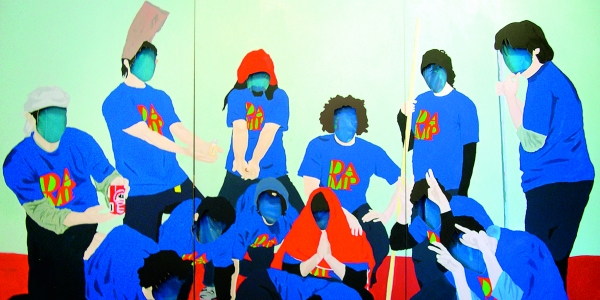
For Lynch, being able to participate and showcase his own piece of art in such a unique and special exhibition has been “a privilege” and “an honour.” Testing the boundaries between artwork and viewer, Lynch says his group piece Scene 1 was donated to Heide in 2007 and approaches art in a more fun and light-hearted way.
“It resembles a traditional Nativity scene but the faces are cut out,” says the founder of the DAMP art collective. “It’s kind of a group self-portrait and basically people can come up to it and insert their own faces into the tableau and have their picture taken. It’s a very simple work in a way that it’s not dissimilar to what you would find at a sideshow or something like that. It’s a simple way for an audience to be able to interact with us as a group of artists, but not us in ‘real-life’ per se, rather a representation of the group. We’ve done lots of works so far that deal with such relationships between artist and audiences. It’s just fun more than anything because it holds a lot of meaning to us. It’s not your usual way of interacting. Art is usually viewed in a much more critical or academic way, a much more serious way, so this is another kind of relationship people can have with art. You can actually participate yourself in the work in a fun and humorous way.”
Originally commissioned for an exhibition at Gertrude Contemporary in 2001 by former curator Russell Storer, Lynch claims that Scene 1 was something of an experiment at the time, employing the talent of 12 people to work communally on one painting at once. While these days such a way of working is no longer uncommon, Lynch claims at the time, DAMP was a group unique in its working approach.
“Russell is now based in Queensland, but at the time he invited us to be a part of the Gertrude Contemporary exhibition and he thought he’d set us a bit of a challenge. And it was a challenging project. He commissioned us to make a painting-based work even though we were a large collaboration of artists – we had over 12 people in DAMP at that point. It wasn’t common at all back then for a large group like us to make a 2D work in that way. This was one of the two works that we ended up presenting at the exhibition Russell curated in 2002 and which was part of an ongoing series [where] they had to commission new works of emerging artists in Gertrude Street. DAMP had initially been just a class of VCA students in the early ’90s and after we graduated we just decided that we wanted to keep making art together, so we’d meet up independently every Monday until we started getting invitations to participate in exhibitions.”
So far, DAMP’s inclusion in the Forever Young: 30 Years Of The Heide Collection exhibition has been a major highlight for the group, according to Lynch. Being one of the more recent acquisitions at Heide, Scene 1 represents the new generation of Australian artists and newer approaches to art in general.
“Heide is just now starting to think about the next generation of art and it’s catching up on a lot of the works that they hadn’t had a chance to collect in the last ten years,” says Lynch. “Our work represents how artists of my generation are interested in socially-engaging practices and working directly with the audience. That’s quite a different approach to the works from the ’70s and ’80, I believe, so it’s an enormous privilege to be able to contribute to the works from this millennium.”