Sick of brain rot and rage bait? You’ll be in good company at NCM’s next collaboration with the Pseudo collective.
Beat spoke with Emily Siddons, Co-CEO and Artistic Director of the National Communication Museum and Mat Spisbah – one of the founding artists of Pseudo, about NCM’s program for 2026.
The theme for this year’s exhibition is what Siddons called “alternative networks”.
“It broadly recognises that bot activity and automatically generated content guided by algorithms has saturated the internet and rendered it generally meaningless.”
“We are asking, if we had the chance to rebuild digital infrastructure what could this look like?” she said.
NCM X PSEUDO: Stigmergy
- National Communication Museum (NCM)
- 4 June – 9 August
- $18–$24
- Tickets available through RISING
Stay up to date with what’s happening in and around Melbourne here.
View this post on Instagram
NCM has created the exhibition in collaboration with Pseudo, a collective of artists who work across all creative mediums: performance, expanded cinema, sound and digital infrastructure.
“For the community, it’s an invitation to think about coordination differently.”
“Most of the platforms we live inside are top-down, they govern our daily lives but we have no idea how they work or what control they influence over our lives.”
“By exposing the seams of our digital and physical infrastructure, we want to make those systems visible, and start a conversation about what we might build if we weren’t living inside them,” Siddons said.
The exhibition is created by five artistic nodes. ‘Node’, referring to the intersections or connection points between systems over networking, biology and botany, are five separate artistic collectives.
“A node is a cluster. A group, a gathering, a few people who come together around a shared interest or community. Your group chat is a node. A studio is a node. Anywhere a small group has formed around what they care about.”
“In Stigmergy, instead of a museum or a single curator selecting everyone, we’ve handed that agency to other artists, studios and collectives. They reach into their own communities and curate the artists and works that resonate.”
“Each node leaves traces, media, artworks, signals, and the rest of the network comes along, finds them, picks them up, makes something new,” Spisbah said.
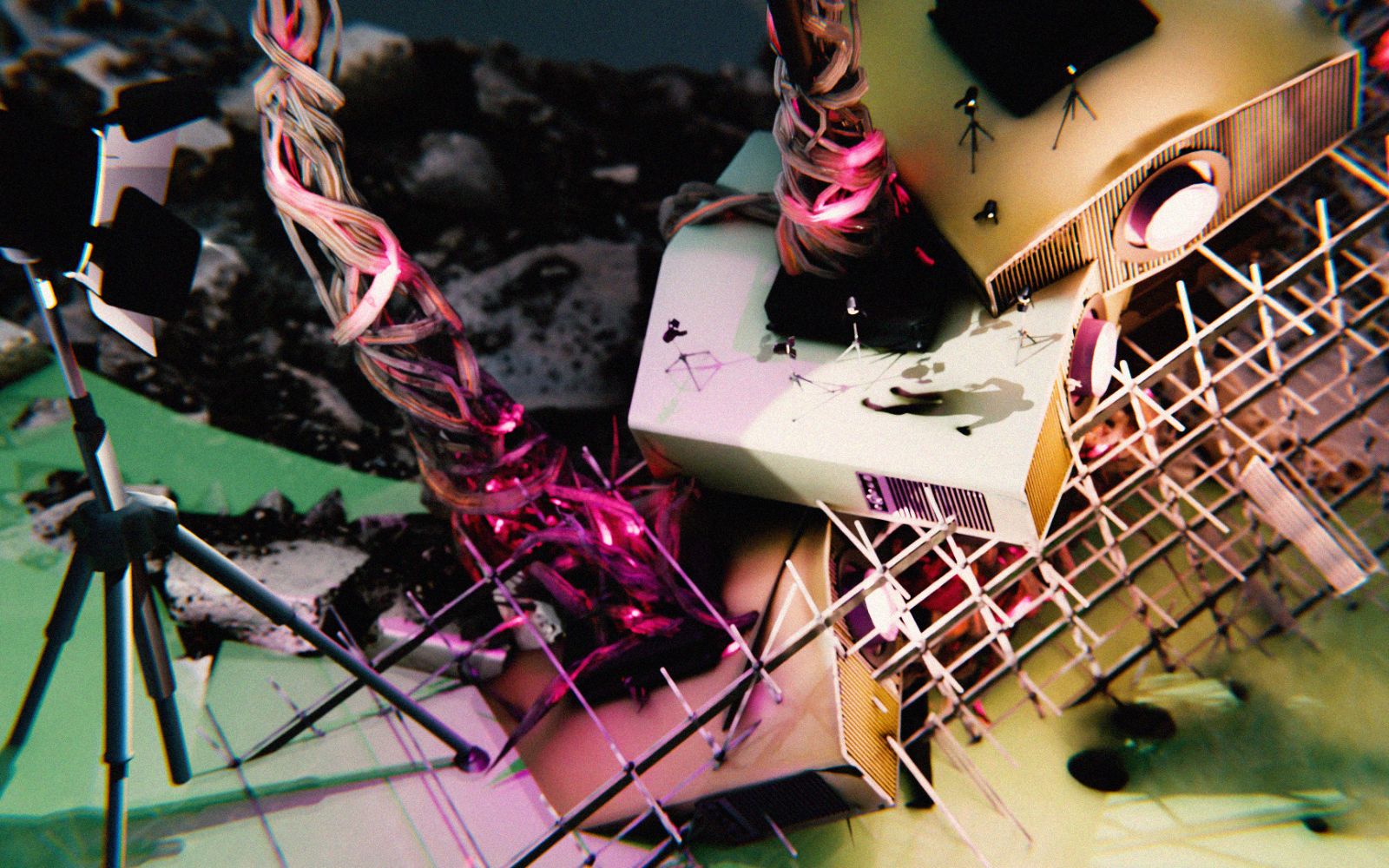
These nodes will collaborate with Pseudo by selecting works form their communities to feed into the network that Pseudo is building. The infrastructure of Stigmergy then morphs and changes these works whilst distributing them online and into the physical gallery space.
View this post on Instagram
“Stigmergy is a word from biology. It describes how ants coordinate without a project manager, how termites build cathedrals, how a forest organises and communicates. Each creature leaves a trace”, Spisbah said.
“No central command, just signals in a shared environment that build on each other until something larger emerges. For the exhibition, that is the logic.”
Spisbah said the exhibition was also inspired by the early internet systems of peer-to-peer networks like Napstar, Limewire, and Soulseek, people logged into a “distributed but interconnected system” and left little traces of themselves, the music they loved, the films they were chasing, the culture they were curious about.
“It wasn’t optimised for engagement. It wasn’t about attention capture. It was organic, accidental, intimate in a way the modern internet has forgotten.”
“What Stigmergy is trying to do, is zoom out a layer and look not just at the content on the screen, the object or image, the rules governing this media.”
“What systems are we using to talk to each other? How does our media and communication move around these systems? How does it morph and mutate?
“What values, ethics and ideas can we imbue in these systems if we had intimate knowledge and responsibility for them all the way through?” Spisbah said.
As a visitor into the space, attendees will encounter digital works through video, image, audio that will circulate and mutate across the space sin the gallery.
Stigmergy follows NCM’s exploration if infrastructural independence and alternative frameworks in their previous installations.
“In our previous exhibition we declared that the Information Age is over and we have entered an Age of Noise”, Siddons said
“The internet feels like it’s at a tipping point and collectively we are at the mercy of Big Tech.”
“It’s important to show that alternative tools are there and we can uncover new ways of organising ourselves to find more meaningful ways to connect online”, Siddons said.
“I’m excited to see where this could lead and whether NCM can continue to grow and develop meaningful alternative networks this year”, she said.
“The idea is you experience something with your eyes, your head, your hands, your phone and hopefully leave some sort of trace at the end of it”, Spisbah said.
“Stigmergy doesn’t have any answers, it’s small, it’s janky, it’s deliberately unscalable. It won’t replace anything. But it sits in the gallery as proof that other shapes are possible.”
You can visit Stigmergy at the National Communication Museum from 4th June to 9th August 2026.
For more information, head here.
This article was made in partnership with National Communication Museum.