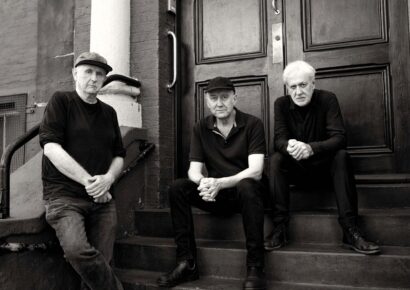
Electric Fields will headline Stonnington's Sunset Sounds later this month.
2026 marks ten years since Electric Fields released their debut EP, Inma. It’s been a decade of major achievements for vocalist Zaachariaha Fielding and keyboardist and producer Michael Ross.
They’ve performed sold-out theatre shows with the Queensland, Sydney and Melbourne symphony orchestras; represented Australia in the 2024 Eurovision Song Contest in Malmö, Sweden; and performed at festivals such as Harvest Rock, Woodford Folk Festival, Vivid LIVE, and Sydney’s WorldPride.
Electric Fields
- Sunset Sounds @ Malvern Public Gardens
- Sunday 18 January
- Free
Stay up to date with what’s happening in and around Melbourne here.
On Sunday January 18, Electric Fields will headline Sunset Sounds in Malvern Public Gardens, supported by Parvyn and DJ Lyndelle Wilkinson.
But there is one thing that Fielding – a First Nations artist from the Mimili Community in the Aṉangu Pitjantjatjara Yankunytjatjara Lands – and Ross still haven’t done: release a full-length studio album. In fact, Inma is their only EP to date.
“The main focus at the moment is we’re working on our debut studio album,” says Ross, who’s chatting to Beat from his home in Adelaide/Tarntanya.
Several singles have trickled out over the last half-dozen years, including the duo’s Eurovision entry, One Milkali (One Blood), which is one of several Electric Fields songs to feature lyrics in English and Yankunytjatjara language.
The duo also contributed more than a handful of originals to the soundtrack for Baz Luhrmann’s mini-series, Faraway Downs, several of which also appeared on their Live in Concert LP, recorded live at Hamer Hall accompanied by the MSO. In other words, they’ve been incredibly active, and their output has been consistent.
“I think that’s actually why [the album has] taken so long,” Ross says. “It’s because I’m like, ‘OK, all right, let’s dive into it,’ and then something will literally come up that will just absorb all of the energy that we’ve got.”
Electric Fields also aren’t the sort of group to do things by halves. Ross and Fielding specialise in anthemic, vocally gymnastic electronic pop. Their music is big on feelings and dripping with vocal hooks. But it also contains curious intellectual details.
For example, the lyrics to One Milkali (One Blood) reference the reciprocal golden ratio. “I may be dreaming, but the atoms are awake,” Fielding sings in the pre-chorus. “Spill the tea on reality and the 0.618.” Meanwhile, the lyrics to Nina, track four on Inma, are direct quotes from an interview that Nina Simone gave backstage in the 1970s.
It’s a unique mix, but Ross says their heterogeneous songwriting style is simply a consequence of their two creative brains combining.
“We don’t have to necessarily aim or strategise for a direction when our natural workflow already naturally lands in its own unique point of view as it is. So, it’s not like we go, ‘Let’s do this genre’ or ‘let’s do an album focusing on this particular area of philosophy.’
“We’re so different and so similar at the same time that where we meet in the middle is always a fairly deep human truth, which is sort of our goal for art making – beautifying a timeless truth that our community can connect with.”
Indeed. For all its formal complexity, Ross and Fielding strive to make music that will offer listeners relief from the tangled mess of contemporary life and create a space for connection.
“If we can somehow find a medicine for polarisation between two people, there is the possibility that others can replicate similar bridge-building,” Ross says. “Whatever impact is possible on division and polarisation, which is nothing short of an aggressive cancer on our global family.”
Electric Fields will be performing in duo mode at Sunset Sounds, and the setlist will be a mix of cultural Inma songs and upbeat pop tunes. If all goes well, the performance will leave a unifying impression on all present.
“There is the lived experience of strangers bonding over their shared experience of particular types of music, but there’s also empirical research that shows that audiences’ heart beats sync up when all being in one place,” Ross says.
“We use sound to see through skin, we use sound to see unborn babies in the mother’s womb. We use sound to cook food. We use sound to connect between each other. And we use sound to even process our own personal emotions, and to change our energy.”
Find more details about Sunset Sounds at Malvern Public Gardens here.
This article was made in partnership with City of Stonnington.