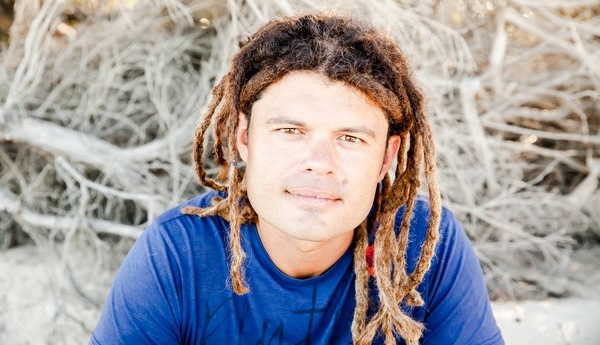
Grunwald’s loved the blues forever. While he’s not entirely sure what kick started it, he thinks it may have had something to do with his heritage. “Half of my family is from South Africa,” he explains. “The way my dad’s family looked, well they looked like black guys from America, maybe that was it. Although really, I’ve just always loved soulful, bluesy music.”
Grunwald also puts it down to location. “When I was learning the blues, Ian Collard and Chris Wilson were big influences on me,” he reflects. “That was great for me growing up and when I moved into the city, I could get a pot somewhere and watch one of my heroes.
“I was just on tour with Ian, who’s still a big hero of mine, and he was saying that in Clarkesdale Mississippi, which is probably the place where the deepest blues and a lot of blues legends come from, there’s a clock in the post office that shows the time in Melbourne. It’s just radical – Melbourne has and has had for a long time a strong blues connection. I live up around Byron now: I don’t know if I would’ve been into the blues if I had grown up there.”
Grunwald’s pretty stoked with the way things have unfolded. Not only has he been able to tour with Collard, he’s been able to support other musical heroes, including the one and only James Brown. “He’s absolutely amazing, but I was pretty intimidated by him,” Grunwald laughs. “I stood next to him before he went on stage, but I didn’t introduce myself. I can remember thinking, ‘Why do I have to shake his hand just so I can tell people that I have?’ and then here I am still boasting that I supported him and telling the story about how I didn’t shake his hand, which is one step worse. He was amazing though – I still think he mega cut the mustard.”
Grunwald’s prescription for the blues has evolved over the years into a heady cocktail of delta rhythms and electronica (check out his last album Gargantua for some beat-heavy, dirty, growling blues). Grunwald’s always said electronica was a neat fit for the blues and while that may not seem obvious on its face, he makes it work beautifully. What inspired this stroke of inspiration? “That was a very old idea of mine,” he recalls. “Before I was even on the scene, I’d already had little experimentations with that kind of thing. It’s the way that I think in all things that I do. I really love blending things that you wouldn’t think go together, but sometimes it’s staring you right in the face. To me it’s obvious: hypnotic, repetitive beats, which is what you get through looping things sits with hypnotic blues.”
Does that meld ever mean he gets stick from Delta blues purists? “Way less than I ever thought I would,” he reflects. “Actually, I’m not really sure that I get stick at all. A friend said to me years ago, when I was weighing up going in different directions and worrying about whether people were going to accept it, that, ‘You know the ones that don’t like it are going to bitch about you behind your back and you’re never even going to hear it.’ That’s turned out to be right. You really only hear the compliments. There’ll be one guy every four years who comes up and says, ‘Yeah, I don’t like it,’ but most people adhere to the saying that if you don’t have anything nice to say, don’t say anything at all. You don’t often go to a gig and walk up to the band and say, ‘You know what? I hate the direction you’re going in’.”
Grunwald’s starting to write again for his next album, which he expects will be wrapped up before the end of the year, although he doesn’t know when it’ll come out. He’s always maintained each album should be a different beast, so how’s this one shaping up? “It’s funny, because I’ve just spent a whole year going back to my roots and playing solo, especially in North America, and I really came to appreciate what was good about that. So, I was gonna’ go into the studio and do more of a solo sounding thing, but this always happens to me, at the moment it looks like it’s turned into psychedelic rock, with a modern spin on it, although still pretty bluesy, and I’ve got a really good keyboard player. I’ve given him my Moog synth to use, which is great for bass lines, and then I’ve got a great funky drummer and bass player, so I’m gonna’ see where that takes me.”
Grunwald’s already committed to the idea most of the next year will be spent on tour in the States with his family. That doesn’t sound like an easy call, especially not with two little girls in tow. Grunwald’s pragmatic about this; it’s not all beer and Skittles, but basically everybody’s looking forward to it and it’s important to him. “Sometimes it’s tough when kids are sick or you’re trying to get your kid to knuckle down and write some sentences in a café in LA, but it’s great. The rock‘n’roll lifestyle breaks so many families up, especially when you’re trying to take on a behemoth like the States, but I really don’t know how you’d do it without your family, especially not if you really want to keep your family together.”
In preparation for the States’ tour, Grunwald needs to sell his beloved old motor home, but the concept of a getting a bigger, brighter one is making him super happy. “I’m a bit of a frother on the old buses and motor homes. It could be because I half grew up in one. Bang for buck though, you can get an American motor home that’s doubly as good. If you just had 80 grand, which is not easy, you could get a pimping mega bus with everything that opens and shuts.
“For touring and holidaying, especially if I want to nick off for a surf, it’s more practical to get a caravan, but it’s just nerdier and we can’t come at it. Even when it’s impractical, there’s just something about a motor home speeding down the highway.”
Grunwald must sense some skepticism, because he then illustrates the beauty and versatility of the motor home. “I came back from a holiday in Bali for one gig recently in Bundaberg before flying straight back,” he explains. “I got my mates to come and pick me up in my motor home, but I hadn’t had much sleep, so I jumped straight in the back and snoozed all the way there. We parked at the gig, used it as a bandroom, and then cruised and partied all the way back to the airport.”
In parting, Grunwald passes on the secret of his enduring enthusiasm. “When I first left from Melbourne over a decade ago, I was surfing up and down the coast a lot and my now wife and I were living out of my transit van,” he reflects. “I made the decision then to make every day like a holiday, because then you couldn’t lose. If you treat it all like it’s work, and everything’s based on that, say a gig goes wrong, well you’ll get despondent so quickly, but if you make it an adventure it’s very sustainable.”
BY MEG CRAWFORD