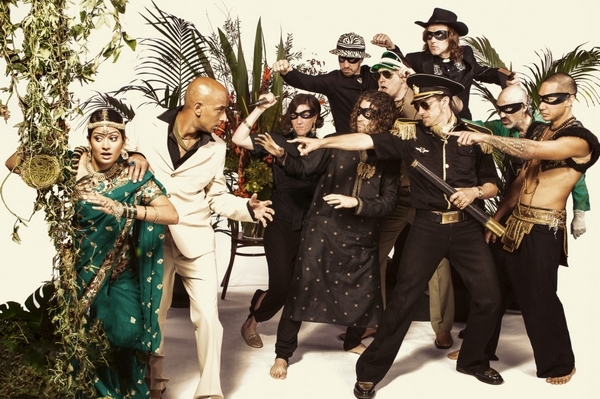
“It’s a double edged sword,” says saxophonist and band founder Andy Williamson. “We wear costumes, and it’s a very fine line between how you portray yourself. It can be very easy to put yourself into some sort of realm of cabaret or even just taking the piss out of the whole thing. But if you look at the original inspiration for the band, the music is really flamboyant and we just couldn’t have got up there in jeans and t-shirts and played. It just wouldn’t have had the impact.”
Theatrical considerations aside, when Williamson conceived the band his chief motivation was to introduce the masses to the strength of ‘60s/’70s Bollywood songwriting. “It was just such an awesome pool of inspiration, musically,” he says. “There wasn’t anyone live tapping into that – not that many musicians were even aware there was this awesome pool of stuff. However flamboyant or however you take the stage part of it, musically it was something I was very serious about. We all were.
“The songs we write are actually not particularly comedic. There is flamboyance in the delivery, but we do put a lot of care into the way we write the tunes. It’s not flippant.”
Indeed, following on from their 2012 debut, You Me Bullets Love, the diversity on The Island of Dr. Electrico is quite staggering. The band channel their undeniable technical prowess into a stylistically intrepid collection of songs.
“We’re really happy with how that came out,” Williamson says. “We had to follow up the first one, which was a good record, but it was a development and there’s more co-writing going on. 80-90 per cent of [Dr Electrico] is live. We did as much as we could live, so there’s warts on it as well.”
Given the specificity of the band’s founding inspiration, it’s important for them to honour and respect the past. However, purely nostalgic tributes are often either superfluous or dull. But, in spite of paying homage to the likes of R. D. Burman and Kalyanji-Anandji, Williamson was always confident The Bombay Royale could bring something new to this style of music.
“The thing that got the ball rolling was I did arrangements of 25-30 tunes and then went hunting for musicians,” he says. “Some people were friends I’d played with for years, other people I had to really hunt for. By the time we got to the first proper record, there were only two covers on that record anyway. We’re using those guys as an inspiration, but what we’re producing doesn’t sound like that either exactly. An Indian audience will hear the reference, but at the same time if you put it alongside the old material it doesn’t sound like that either.”
While they’ve long since moved beyond cover band territory, The Bombay Royale are generally thought to exist separately from much of the live music in Melbourne. However, Williamson feels an affinity with the local scene.
“I don’t know whether we’re shooting at the same things other people are shooting at, but we are all from that scene. All I’ve done for the last 20 years is play live, so I do feel like I’m part of it. I guess what we’re shooting for might be a bit different from some bands. We’re obviously not really going for top 40. It’s a different thing. In a sense, we’ve made a niche for ourselves – a small one. But I see us as part of the music scene.”
BY AUGUSTUS WELBY