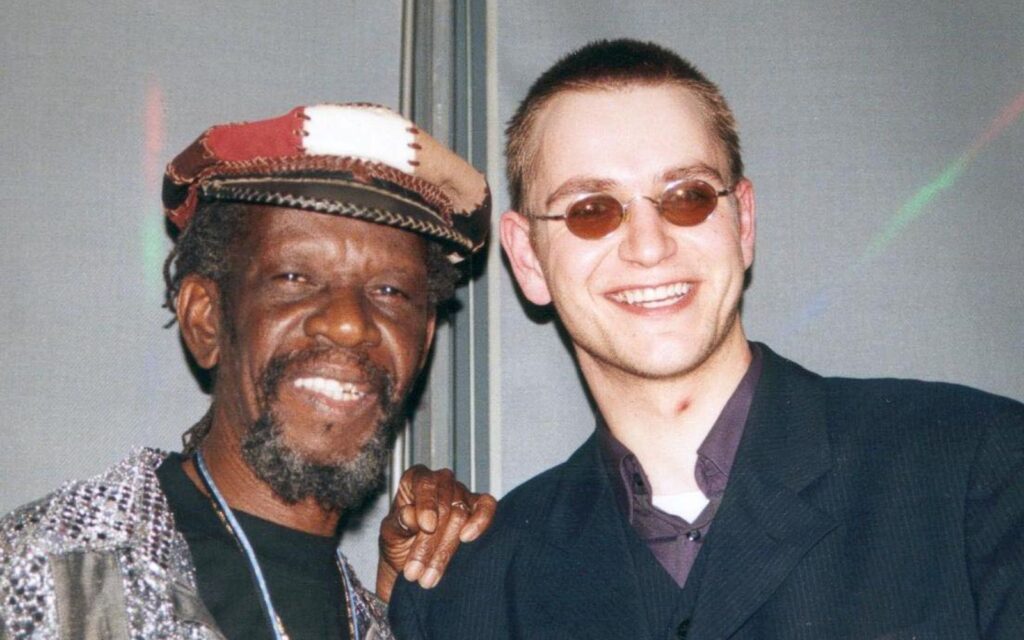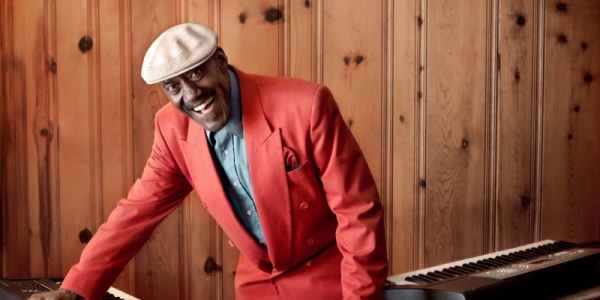
Ironing Board Sam was born Sammie Moore in 1939 in Rockhill, South Carolina. He spent a year and a half in college but had to drop out after he got married. Sam learned to play on his father’s pump organ and joined several groups around the area as a teenager. Sam’s confidence grew to the point where he formed his own group and worked small clubs around South Florida. In 1959, he moved to Memphis, where he picked up his colorful nickname. Sam didn’t have the regular legs to support his electric keyboard, so he improvised and used an ironing board stand, which he hid with a drape. Club patrons began looking behind the drape and teasing Sam about the ironing board. He didn’t like it at first, but he was tagged Ironing Board Sam, and the name stuck.
With a brilliant mind for self-promotion and a gift for gadgets, Sam designs and sews his own intricate stage costumes. His inventions run from a baby bottle holder to his famous button keyboard. He says he can convert an automobile’s gas engine to a diesel engine (and vice versa), and can produce free electricity for an entire apartment complex with a machine that has only five moving parts.
“When I built the button board I didn’t know exactly what I was doing,” Sam explains. “I couldn’t afford any organ so I made me an instrument that would play four octaves. I didn’t think much of it but later I began to realise what I had done in making the button board.” This instrument had two keyboards. The main one looked like a regular organ keyboard, but underneath it had been fitted with guitar strings. The keyboard was fed through a wah-wah and then into an amplifier, which would then produce the sound of guitar, organ, piano or a combination of the three. The bass keyboard was made with 60 stationary upholstery tacks connected to electronic sensors. Sam ran a wire down his arm to his fingers, which conducted electricity to the buttons.
Commenting on Civil Rights, Sam says, “I was there and I saw it all happen. I stayed at the same hotel where they shot Martin Luther King. I noticed musicians didn’t go through [segregation] as much. They got a chance to eat where they wanted and had more opportunity.”
In the mid-‘60s Sam tried to audition for both the Stax and Hi labels, but was told they had more than enough artists to work with and to try somewhere else. It was suggested Sam try Chess in Chicago. “I did one session at Chess. When I went back to find if they were interested in recording me, I was told the producer I’d worked with had been fired,” Sam says. “I was out in the cold. At that point I was totally discouraged with the record business. I knew I had what people wanted to hear, but the record companies wouldn’t let me prove it.
“Disco,” says Sam. “After it came in it was hard to find work. I drove 1,500 miles in one direction looking for a place that had live music but couldn’t find one. Then I drove 1,500 miles in another direction and couldn’t find one.”
Sam’s next piece of self-promotion involved a 1,500-gallon tank filled with water. He devised a way to play underwater, which totally amazed an enthralled audience. “I went on the road with the tank,” said Sam. “But I found out the tank was too big to get into a lot of clubs.”
By 1982, Sam was back in New Orleans but still finding it hard to find work, necessitating yet another interesting form of self-promotion. “People didn’t want to hear live music,” said Sam. “They just wanted to play records or the jukebox. I was hurting, so I decided to become the Human Jukebox. I built a giant jukebox that I fit inside with my keyboard and amplifier. I had slots built into it where people put money when they wanted me to play their request. The police were standing around and didn’t know what to arrest me for. In the end they took my jukebox and gave me a ticket. They never gave it back and I couldn’t be the human jukebox anymore. I was just trying to make a living.”
On Music Maker, Sam says, “They’ve been very good to me. They make sure that I have transportation, they help me with bookings and gigs and they make sure I’m healthy. They do this all for musicians.”
Looking forward to coming to Australia, Sam says, “I met a lot of Australian people in Switzerland and they always asked me if I needed help. I liked that. They seem to be nice people. Also they speak English so they know what I’m singing. I can get my message over.”
BY TAMARA VOGL