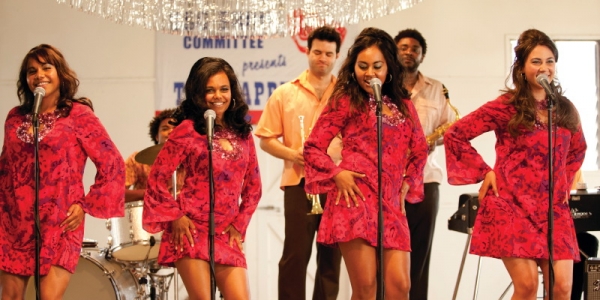
But The Sapphires always seemed destined for better things: based on a hit play drawn from true life, starring chart-storming former Australian Idol star Jessica Mauboy, lovable irish larrikin Chris O’Dowd (of Bridesmaids and The IT Crowd) and a slew of irresistibly catchy soul classics, it had all the signs of picking up where Rachel Perkins’ hugely successful musical comedy Bran Nue Dae left off.
Screen and stage actor-director Wayne Blair had an instant reaction to Tony Briggs’ play about four girls from a remote Aboriginal mission in the ‘60s who went on to tour Vietnam singing soul for the soldiers. He starred in Melbourne Theatre Company’s premiere season in 2004, followed by a remount at Sydney’s Belvoir Street in January 2005 (although not in the 2010 touring revival).
Around the same time, Blair took his film Djarns Djarns to Berlin Film Festival, where it won the Crystal Bear for best short film. With Briggs acting in his film, and Goalpost Pictures producing it, it didn’t take long for all three to come together around the idea of a screen adaptation of The Sapphires – with the final ingredient being Logie and AFI Award-winning actress Deborah Mailman, who had played one of the soul sisters in the 2005 stage production and returns in the film to star as ‘mamma bear’ of the group, Gail.
On the big screen, The Sapphires has lost none of the feelgood fervour that made the play such a smash success across the country. “The story came from Tony’s mum and his family, and he wanted it to be a story for everyone; he wanted it to be a story that has humour,” explains Blair. “And we wanted a film that could travel around the world. Another version of the film might have gone darker and deeper, but there’s always been a sense that The Sapphires was a celebration of these four black women. So it wasn’t a matter of ‘keeping it light’ or ignoring [the darker issues] – it was about being true to the original mission statement: to make a story for everyone.”
Consequently, even as difficult issues such as racism and the Stolen Generations arise in the film, they’re ultimately transcended by the power of good humour and good music; and the mission on the Murray river where the girls grow up is portrayed as a place of laughter, community and natty dressing, rather than a place of poverty and isolation.
Blair cites Steven Spielberg’s The Color Purple as a touchstone for representing the mission – “You know, what it looked like in the kitchen or in the lounge room of The Color Purple – because we think of it as a very dismal film, but it’s actually quite beautiful. So it was similar to this Sapphires story.”
For the film’s overall tone, he was inspired by The Commitments and Brassed Off – both period dramedies about the transformative power of music within a working-class community, the former in Northern Ireland, the latter in Northern England. “They’re films that have a sense of team, or a sense of family; and they’ve all got their wants and needs, and they’re fractured – but as a team and a family unit they get through each day.”
On set, Blair’s foremost collaborator was director and cinematographer Warwick Thornton, who had his own success story a few years back with Samson & Delilah. “He’s a good friend, so that was cool; we just got on – he’s a Leo I think and I’m a Sagittarian, so it could have been like two roosters in a hen house (laughs) but it was the opposite, we just worked so well together. I think that had an effect on the crew – they just wanted to achieve the day for us.”
The biggest challenge on an otherwise blessed production was the hectic shooting schedule, which allowed just six weeks to cover five lead-actors across as many locations, including never-before-filmed parts of Saigon. “We just had to be very, very prepared as a team, to get things right every day,” Blair admits. “And you have to break the film down into [smaller tasks] – everything had its place, and we looked at things in isolation: ‘Okay, we’ve gotta shoot this moment before this moment to get to that moment’ – and that made it easy. You start very slowly at first, and just work your way up.”
Having trained in theatre at QUT, and with the bulk of his career thus far spent in the theatre, Blair credits a slew of television gigs with honing his on-set muscles. “I think to be a good filmmaker or just a good storyteller of any sort, it’s important for me to do it again and again – to learn your craft, make mistakes, so you know what to do next time. So [directing TV] has been the biggest thing for me over the last five or six years.”
Off the back of a triumphant screening at Cannes in May (where it was announced that king-making distributor Harvey Weinstein had bought the US rights) and on the eve of The Sapphires opening Melbourne International Film Festival, Blair sheepishly admits, “I had a realisation just three weeks ago, on the set of [TV mini-series] Redfern Now, and I actually thought on the second or third day, ‘Yeah, I’m going well. Now I can finally call myself a director,’” he laughs. “It was seriously only three weeks ago.”
BY DEE JEFFERSON