Orchestra Victoria is bringing three unmissable nights of chamber music to North Melbourne for its 2026 season.
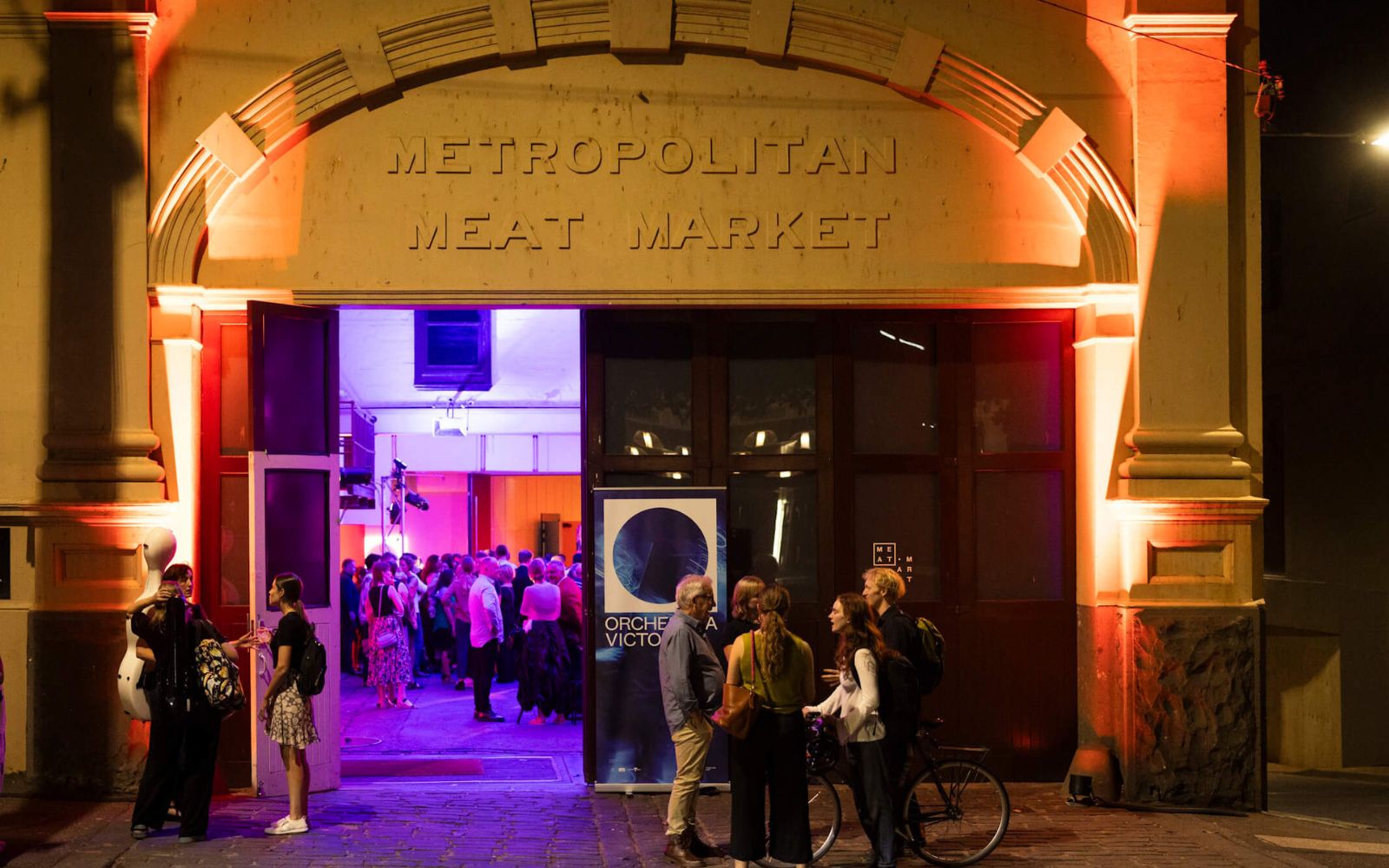
Orchestra Victoria’s Meet @ the Market has carved out its own thing at North Melbourne’s Meat Market.
A concert series that goes deep on programming, pairs each night with custom cocktails from Brogan’s Way Gin, and brings ABC Classic presenter Stéphanie Kabanyana Kanyandekwe in as guide to the stories behind the music.
It’s a complete night out: world-class chamber music, a considered cocktail menu, and programming rich enough to keep you thinking long after the bar closes.
Doors open at 6pm, atmospheric lighting design by Alex Nguyen sets the scene, music runs 7–8pm, and the bar stays open until 9pm after each performance. Musicians tend to stick around too, which makes the post-concert social less of an afterthought and more of the point.
Meet @ the Market – Orchestra Victoria
- Where: Meat Market, North Melbourne
- Session 1: Friday, 10 April, 7:00pm
- Session 2: Friday, 4 September, 7:00pm
- Session 3: Friday, 4 December, 7:00pm
- Tickets: here
Check out our gig guide, our festival guide, our live music venue guide and our nightclub guide. Follow us on Instagram here.
View this post on Instagram
Orchestra Victoria – Meet @ the Market
Session 1 — 10 April
Opening night threads together questions of family, legacy, and mythology.
Gustav Holst’s The Planets anchors the evening, and George Morton’s chamber arrangement for this production strips it back without losing the scope: from the quiet luminosity of Venus through to the full-hearted sweep of Jupiter, it will fill the Meat Market in ways that feel spatial. Alongside it sits a quieter discovery: Imogen Holst’s Suite for Strings, written during World War II and, for a long time, largely ignored in favour of her father’s legacy. UK conductor Alice Farnham, who has done considerable work bringing Imogen’s music back into circulation, joins to conduct the program.
John Psathas’s Djinn rounds out the night, a marimba concerto drawing on jazz, global rhythms, and something harder to name. Djinn are spirits from Greek and Arabic mythology, and the piece has that quality: restless, shape-shifting, impossible to pin down. Orchestra Victoria’s Section Principal Percussionist Mathew Levy performs, and it’s the kind of piece that makes you reconsider what a percussion instrument can do in a concert hall.
Session 2 — 4 September
The September program is built around a single idea: composers at their most self-assured. Each piece captures an artist who has found their voice and isn’t being quiet about it.
Conductor Umberto Clerici leads a program that moves between sharpness and warmth without losing either. Stravinsky’s Danses Concertantes opens, compact, witty, rhythmically restless, music that knows exactly what it’s doing. Nielsen’s Flute Concerto follows, charming and a little mischievous, with Orchestra Victoria’s Section Principal Flute Lisa-Maree Amos taking the lead. Paul Stanhope’s Apollo sits in the middle of the evening, nodding to the Apollo space missions and to Stravinsky’s cleaner compositional lines, grounding the program in something more contemporary, but no less assured.
Beethoven’s Symphony No. 1 closes the night. Written when he was still finding his voice and already refusing to be subtle about it, this is Beethoven before the weight of his later reputation, playful, confident, and a little bit argumentative. A good way to end an evening.
Session 3 — 4 December
Norwegian conductor Eivind Aadland brings the year to a close with a program built around memory, what we inherit, what we carry, and what we pass on.
Strauss’s Metamorphosen, for 23 solo strings, was written near the end of World War II. It doesn’t announce itself dramatically, it builds slowly, and the grief in it is quiet rather than operatic. In a small room like the Meat Market, that restraint lands hard. Missy Mazzoli’s These Worlds in Us came out of conversations between the American composer and her father, a Vietnam War veteran. Memory and love are the material here, rendered in something luminous and unhurried. Mendelssohn’s Scottish Symphony finishes things off, starting in the shadow of Holyrood Chapel’s ruins and finding its way into something far more open and alive.
A fitting end to the series, and to a year of music that kept asking what we owe to the people and places that shaped us.
For more information, head here.
This article was made in partnership with Orchestra Victoria.