Foreign musicians don’t tour Ukraine. Ever. Until a rock band called Hardwicke Circus felt that it was the right thing to do.
This is a firsthand account of a band braving the Ukraine war (Russian invasion) to bring music to its people.
They needed someone to fill in on keys, and they found me. I’d never met them. I listened to Walking on Broken Glass and Night Train to London. I thought about it, and said yes.
Ukraine War – Hardwicke Circus tour
- June 2025
- Two week band tour through Ukraine
- A crew of passionate musos from Dublin, Carlisle, London, Devon, Texas, Melbourne and Kyiv
Check out our gig guide, our festival guide, our live music venue guide and our nightclub guide. Follow us on Instagram here.
Meet the band
I was greeted by Dave, Johnny and Tommy at the airport in Krakow.
We picked up Joe and Adrian, and drove to Ukraine in the bulky, navy-blue van that would become my home for the next two weeks. The van is the real thing; the sliding door won’t open if you don’t give it a rough kick, then it falls off its hinges.
The floor is covered with some secret radioactive compound that burns holes in fabric. There’s a broken snare, empty water bottles, phone chargers that don’t fit. And that’s showbiz, baby.
The brothers
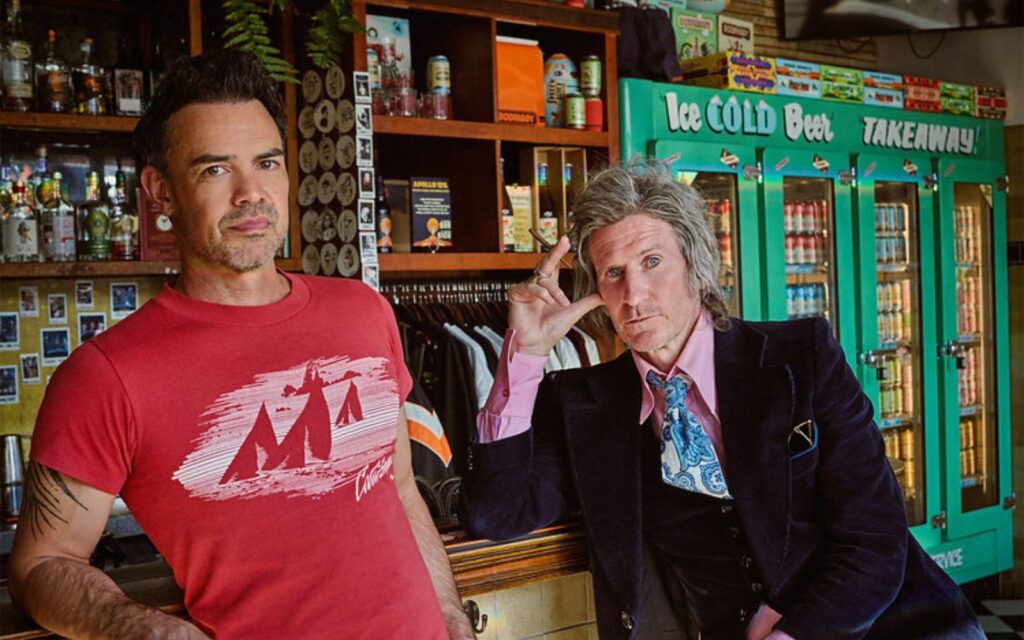
Jonny and Tom Foster are brothers from Carlisle. They have presence, hair, and distinctive accents; they carry themselves as rockstars effortlessly. Hardwicke Circus is their band. This tour is a product of their values and commitment.
They didn’t want to feel sorry for Ukraine from afar. They wanted to get in there and do something about it, whatever anyone else had to say about the idea, and people back home had plenty to say.
I was invited, my flight was paid for; whereas they fought to make it happen. They both write; they adore music. With typical lack of self-aggrandising instinct, they revere Bob Dylan, tuneful songs that are thoughtful without pretension. On stage, they can rock. Jonny plays guitar, and Tommy drums. Jonny sings lead, with a deep voice, but the pair also harmonise brilliantly together.
They are insightful and intelligent, but they don’t carry on or try to impress you. They have wry senses of humour, and if you get them going they are brilliant to talk to. Jonny absorbs so much stress to ensure things get done, without complaint. There’s always another video to edit, another promoter or sound engineer to contact. While Jonny is the public face of the band after the gig, Tom loads the van; which takes serious precision.
View this post on Instagram
The more the merrier
The rest of the band have been called in specifically for this tour. Our saxophone man, Roman, is a native Ukrainian. He lives in Kyiv, studying, caring for his mother, and always playing his treasured saxophone, Esmerelda.
Roman is the nicest musician I have ever met. He politely kicks my arse in chess, twice. Knows Lord of the Rings almost as well as I do. He plays the national anthem to the crowd every night, to great reverence.
Ben is also from Carlisle, like the brothers, but now lives in London, like me, and is the band’s on-again, off-again bass player. Despite his boring-sounding, well-paying finance job, he’s a good musician and a very fun guy to be around.
The music legend of Texas
Joe King Carasco is a music legend of Texas. Joe is 65 years old, but he’s not really. He plays his light-hearted rock songs, he leaps down from the stage and runs through the crowd with his guitar every night and plays solos rolling around on the floor like Angus Young. Crowds love him.
20-year-old goth girls, tough middle-aged men with tightly cropped hair, his manic and goofy energy seduces everyone. He can namedrop with the best of them – he has a story about everyone from Miles Davis to Michael Jackson. A dozen times he looks out of the van at an indistinct piece of landscape we happen to pass, and remarks, “oh wow man, this really looks just like Texas!”
The band manager (the boss)
Dave is the band’s manager. He has been on the road with idiots like us for 60 years. He was the road manager for Jimi Hendricks in the 1960s. Earlier in his life Dave may have once possessed the patience required to avoid potholes in the road, but he doesn’t possess it now. He’s hilarious. If a sound engineer tries to take charge during soundcheck, it doesn’t work.
“I’m the boss!” the eager young sound guy insists.
Dave leans back, hands behind his head, and drawls in his deep Irish voice:
“That’s fine. You be the boss. I’m God.” He gets his way, and that’s the right way.
Adrian is from Devon in England. He is our jovial, enthusiastic security escort and his presence is crucial. A former paratrooper who now does voluntary work with his organisation, Mission Aid, delivering vehicles and medical equipment to the Ukrainian front lines. He has driven the length and breadth of the country, he knows it like the back of his hand.
We were supported by a Ukrainian band called Okazia, and they were as much a part of our merry gang as anyone. They are legends. I’ll discuss them soon.
View this post on Instagram
The Aussie import
Then there’s me: a blonde Australian who everyone asks if he surfs. Me, living in London for the past year. Me, trying to learn the set, and the order of how to pack the van. Hunched over my phone watching Collingwood v West Coast as the van drives smack bang through a monstrous thunderstorm outside Kharkiv.
Sending Dad furious Whatsapp messages from my Ukrainian burner phone about a free kick paid against Liam Duggan. I come from a family of Magpies but I inexplicably support the Eagles.
Me, behind on sleep from day one because the night before I left London. I had stayed up all night, alone and lonely, watching a live stream as my family buried my most cherished friend – my beautiful Gran – without me. Me, who bawled my eyes out when the classical music of the funeral gave way to the jaunty Good Old Collingwood Forever and my cousins carried her coffin away.
That was us: a rag-tag team, meeting each other at the 11th hour, sourced globally from Dublin, Carlisle, London, Devon, Texas, Melbourne and Kyiv to bring music to people who need it most.
All the funds we were able to generate are for Adrian’s Mission Aid. If we wanted money for ourselves we’d all be somewhere else.
Our lives – Ukraine War tour
Between Adrian, Roman, and the girls from Okazia, we were well instructed on safety during our time in the Ukraine war. We performed in underground venues. Each hotel we stayed at had a shelter, and was in a particular area of the city that Adrian said was less likely to be bombed.
We were not to be separated from our passport or phone during an air raid. Even on the street. We didn’t want to be stopped by a soldier without identification – they conscript men our age. We turned our phones off: the Russians would notice a group of seven active UK sim cards buzzing around the country. All of us were given burner phones with Ukrainian sim cards to use instead.
The bombs fall at night. There is a curfew from midnight to 5am. We did not want to advertise our presence online, so the size of the crowds relied on the venues and good old-fashioned word of mouth.
If we heard something that sounded like a moped in the sky, we were to throw ourselves flat on the ground, covering our heads. Two walls is better than one when hiding from bombs and chaos, so corridors are good places to be in an attack. Bathrooms are also good.
The realities of the Ukraine war
We heard about 15 sirens while we were in the country. We checked our phones regularly. The regions that were being bombed were coloured red on the air alert app. The app says what particular weaponry is being used in which places.
Roman told me which threats were worth going straight to the shelter for, and which could be cautiously monitored from above ground. Some nights we slept in the shelter from the start, in anticipation it would be a heavy night.
It must now be said, having finished the tour, that our group was lucky.
We left Kyiv at last on Wednesday July 2. On Thursday July 3, Russia bombed the bejeezus out of Kyiv.
This was the pattern. The bombs fell, but not everywhere, and they didn’t really fall wherever we happened to be on a given night. Then we left. We had the luxury of knowing we were leaving.
We could prioritise discipline over sleep for 10 days when we knew we would then leave to safety and comfort. And we didn’t mind that being our day-to-day life.
Ukraine War – The lives of the locals
The locals’ day-to-day lives during the Ukraine war are different. Most Ukrainians don’t have easy access to shelters like we did, and they have been living this hell every night for three years, with no end in sight.
They feel they would go insane if they took every precaution every time. So they don’t take as much care of themselves as we did. It’s not laissez-fair, it’s a pragmatic mental health choice. In order to enjoy their lives, they can’t value them too much. It’s admirable. It’s also so sad.
People still have jobs, the shops are still open, public transport still runs. If you’re late for work, the excuse “I couldn’t sleep last night because of the sirens” will not fly. People go out, while curfew allows. People date, teenagers search for the perfect camera angle as they shoot tiktok videos by the river in twilight. Military men don’t wear uniforms off duty. The ones that do are almost always internationals.
Independence Square
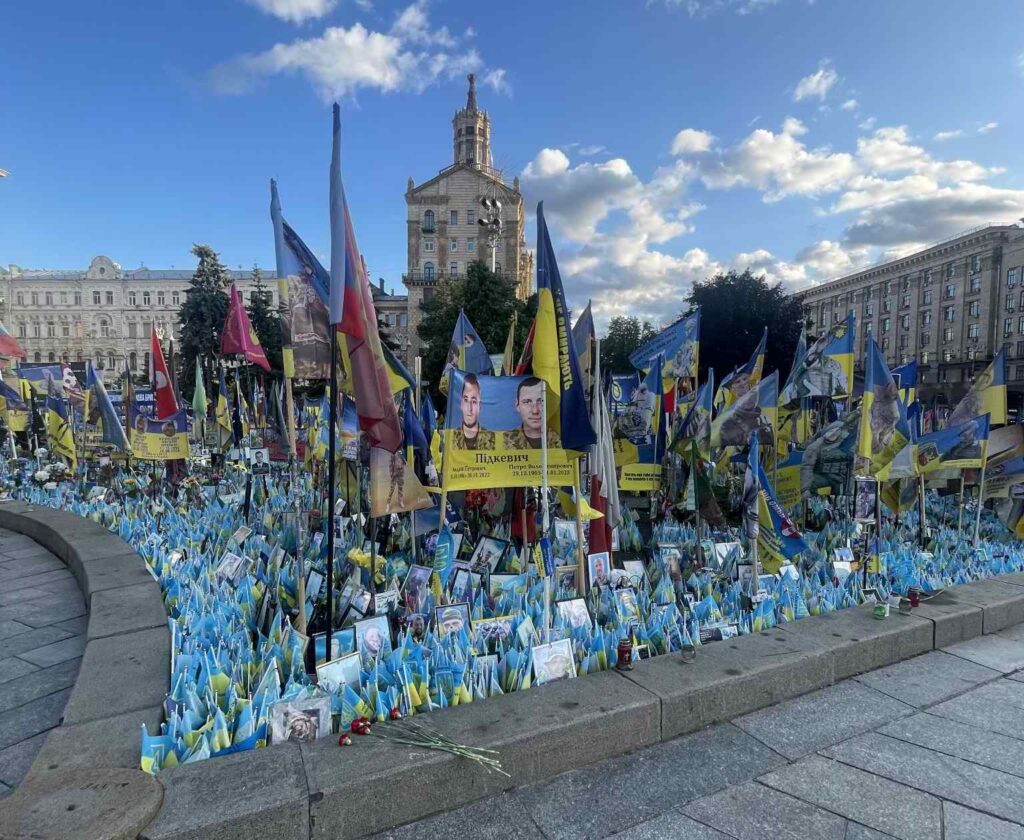
In the heart of Kyiv is Maidan, or Independence Square. There is a towering statue of Berehynia, a spirit that symbolises ferocious motherly protection, and Ukraine’s prosperity. Metres away is a sea of flags, one for every life claimed by this 21st century iteration of Ukraine’s eternal struggle for freedom.
Ben and I walked down what may have been the inner city’s busiest main road. Suddenly all the cars stopped. Big black vehicles drove down the middle of the road, one of them playing music. As far as the eye could see, cars were stopped. Most drivers turned off their engines, opened their door, and stood solemnly where they were.
The whole city stopped. Hundreds of people, thousands, brought to a standstill. In a couple of minutes everyone went on their way.
Living in the present
The Ukrainian people have had their future stolen.
One man we spoke to said he wanted to move in with his girlfriend of four months, but their parents would only allow that if they were married. “So will you marry her?” we chorused, half in jest. We are not the kind of guys to marry girls we’ve known for four months. “Probably,” he replied.
He doesn’t expect to be alive in 18 months. 26-year-old men are old enough to be conscripted, so they are not allowed to leave the country.
One of the girls from the band Okazia said it was nice that the tour gave them an itinerary: having purpose and immovable plans enforced to her: it’s important to be healthy and ready to go this week. Her life – like all of their lives, is a carousel of their countrymen dying, of seeing communities grieve and mourn but withstand the loss.
The sense that “me and my safety matter for the next eight nights” appeared a novel sensation thanks to the Ukraine war. Kids attend school via zoom links, and people are not as dedicated to realising future aspirations and dreams.
The future is a weird, vague, and irrelevant concept. The present may be treacherous, but it is to be lived in and enjoyed. People are friendly, and conversations are engaging. People want connection, and they don’t want life to be an exercise of survival. This rang true most of all at the shows.
We played for soldiers at a military rehab base and had lunch with them. There were about ten of them, guys who had spent years on the front line.
The power of music
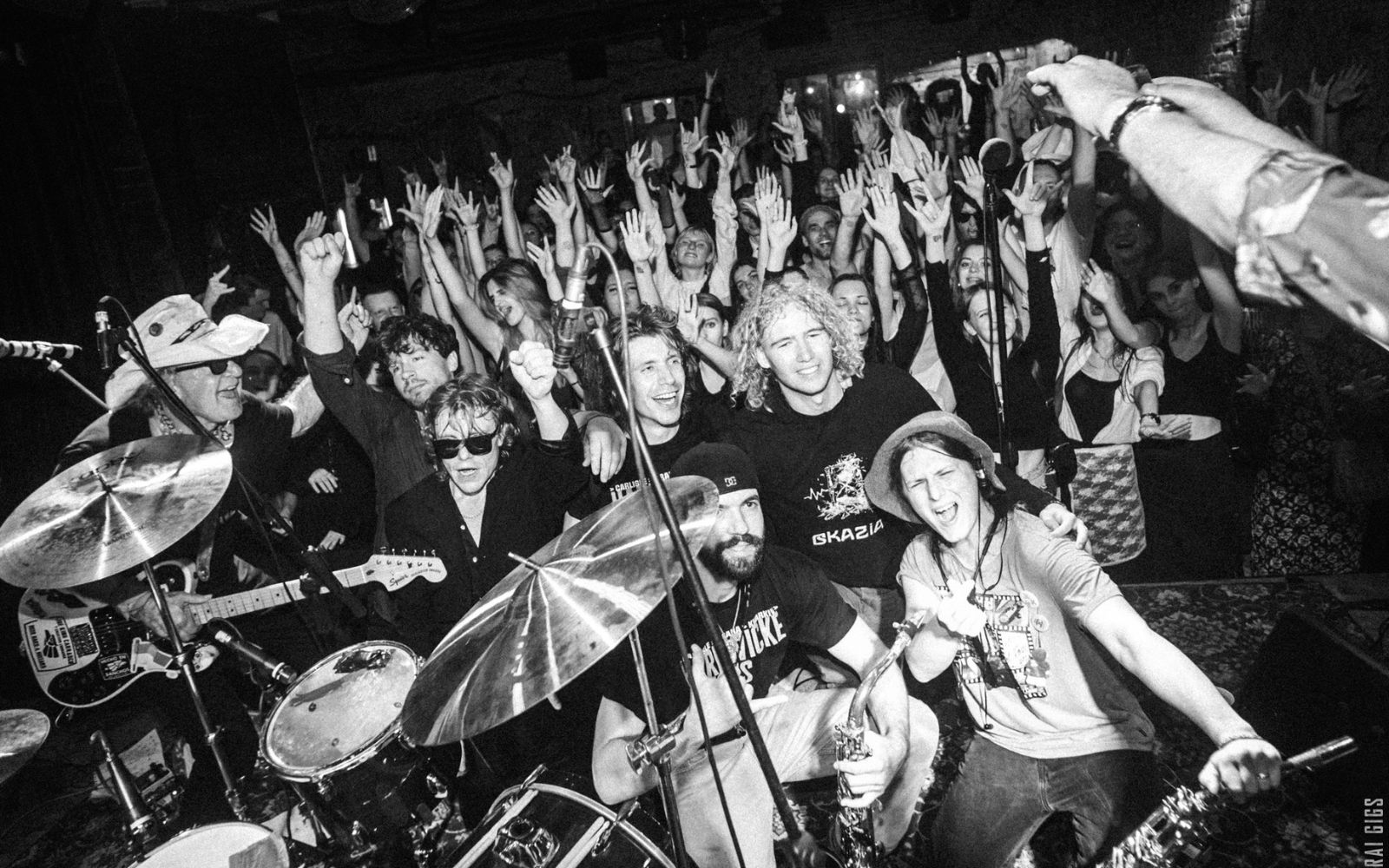
The point – for them and for us – was not to be the best band in the world. It was just to be there together. Music is a communal activity. At the gigs, people showed up in numbers, and they had an absolute ball. The crowds were so willing to laugh at the stage banter and dance and sing.
They posed for photos after the show, particularly with Jonny and Joe, but during the set, there was no thought of trying to capture any footage to watch in the uncertain future.
Why we came
They had come to enjoy themselves in the present. Their smiles, energetic dancing, and feverish singing were those of people hungry for music. “This is the best night I’ve had in three years”, was a comment we were all privileged to hear more than once. This is why we came. They can’t come to the UK, so we went to them.
We were in awe of them, but they were grateful to us. They felt so happy that we had come, that someone had traveled from afar to be with them and offer friendship. Their gratitude shone through in so many ways. They constantly gave us home-made ceramics, crocheted flowers, flags, bullet casings.
People with serious injuries tried to help us load equipment that I can barely lift. We had a hard time paying for our food because they wanted to feed us for free. The best gift of all was the smiles. I haven’t seen smiles like those at gigs anywhere else. I haven’t seen people so enlivened by music before.
As good as Hardwicke Circus is as a live band, the joyous atmosphere was a credit to the audience far more than it was to us or to our music. They were so happy.
They thanked us warmly and bought the merch. They were grateful to us. But they’re the heroes. All we could do was accept their kindness graciously, regardless of whether we felt worthy of it. Their humanity is unconquered. Their spirits live.
Okazia
Okazia is a band from the ravaged and beautiful city of Kharkiv. They were with us every step of the way. They are a dreamy, power-pop/folk group comprised of three women plus their manager Julia – or Jules Darling, as she successfully branded herself. Jules is the mama duck, and she holds everyone she meets in the palm of her hand.
Snishka, the singer, has awesome stage presence and a great voice. She writes lyrics derived from old Ukrainian folk stories about forest nymphs, and cultural philosophies about cycles of rebirth and self-destruction, I was already in love with the songs before she showed me the translations.
Alina and Maria play drums and bass. They are seasoned pros. Alina has a terrific sense of rhythm. She plays on beats you don’t expect and her grooves rumble with personality. Maria is the bass player everyone wants: strong, dexterous, melodic. She navigates and directs the beautiful chaos of the band’s songs effortlessly. She’s a ripper.
A bomb-shelter birthday
Outside Vinnytsia, our accommodation was very remote, so when the siren went off, we felt safe. But it was our first siren, and we all went down to the shelter. There we were, in a bomb shelter…sheltering from bombs!! Yet it was, without a hint of exaggeration, the best night of the tour.
We played cards, we played ‘Up Jenkins’, I played the tin whistle, we sang Dirty Old Town. We celebrated Snishka’s birthday. Guessed each other’s star signs. We talked about Squid Game. And we stayed down there having fun long after it was safe to come back up. I got to bed at 4am. This was it. This was what it meant to live in the face of the Ukraine war.
The girls called Tommy ‘Baby Shark’, because Jonny had introduced him as “my baby brother” on stage. They called me “McSparkle”, because Jules liked putting glitter on my face and sparkly strands of fabric in my hair before a gig. She fussed over all of us like this: applying face masks at servos on the freeway, or lending us hair serums.
It was always her idea, and we obeyed every time, whatever she suggested. Sometimes they also called me Kozac, after their great old warriors. I liked that a lot. We exchanged all kinds of gifts, and we spoke deeply.
The power of perseverance
They told me about the Executed Renaissance. 100 years ago a swathe of Ukrainians were leading a cultural surge of poetry, art and expression, but the Soviets targeted them and murdered them for their expression. Look at these girls now, creating distinctly Ukrainian art, 20 kilometres from the front line of a brutal invasion by the same country.
I’m in awe of Okazia. Hilariously, Snishka swears she will never come to Australia, because she’s afraid of the spiders, snakes and drop bears. With as much tact as I could manage, I pointed out her city was subject to regular bombing from Russia, but she is adamant that Australia and our wildlife terrify her far more.
Ukraine is not Zelensky, or a cabinet. My ancestry is Irish: the oppressors tried to eradicate Irish art, language, culture. I was born and raised in Australia: the oppressors tried to eradicate First Nations art, language, and culture. Make no mistake, Okazia are on the front lines of this war. Their battlefield is different, but their music fights to keep Ukraine alive.
Slava Ukraine
No one needs to be told by me how bad the invasion and Ukraine war is. There are people far more knowledgeable than me to inform you. Even as the van lurches through Germany on our way back to the UK, and even as I write this, Roman and Okazia remain in Ukraine where the situation is far worse than it was 48 hours ago.
But I am humbled to have the chance to tell people about the spiritual endurance of its people. Having been there and back again, we are better for the experience, and intend to return if possible.
We want to raise enough money to buy a vehicle that we can donate and deliver to the front line. We hope our story inspires more musicians to tour the Ukraine.
The West has grown fat on art. Music is a competitive fashion show, and our relationship with music becomes increasingly about streaming songs by autotuned Americans in our airpods on the train to work.
Our playlists become a private hollow in which we comfort ourselves, away from the mean and exhausting people.
But art still lives, music can still connect people, and it must be allowed to connect people in places like Ukraine most of all.
The whole adventure was so worthwhile because we made a courageous decision and it spread joy to people who are fighting like hell to still experience joy.
Music gave that to them. Not me and not even Jonny or Joe. Music did, and experiencing it together with their community, in the face of the Ukraine war.
I know Gran would be proud for me to live according to those values.
Carna Pies, Slava Ukraine.
You can check out Hardwicke Circus here.