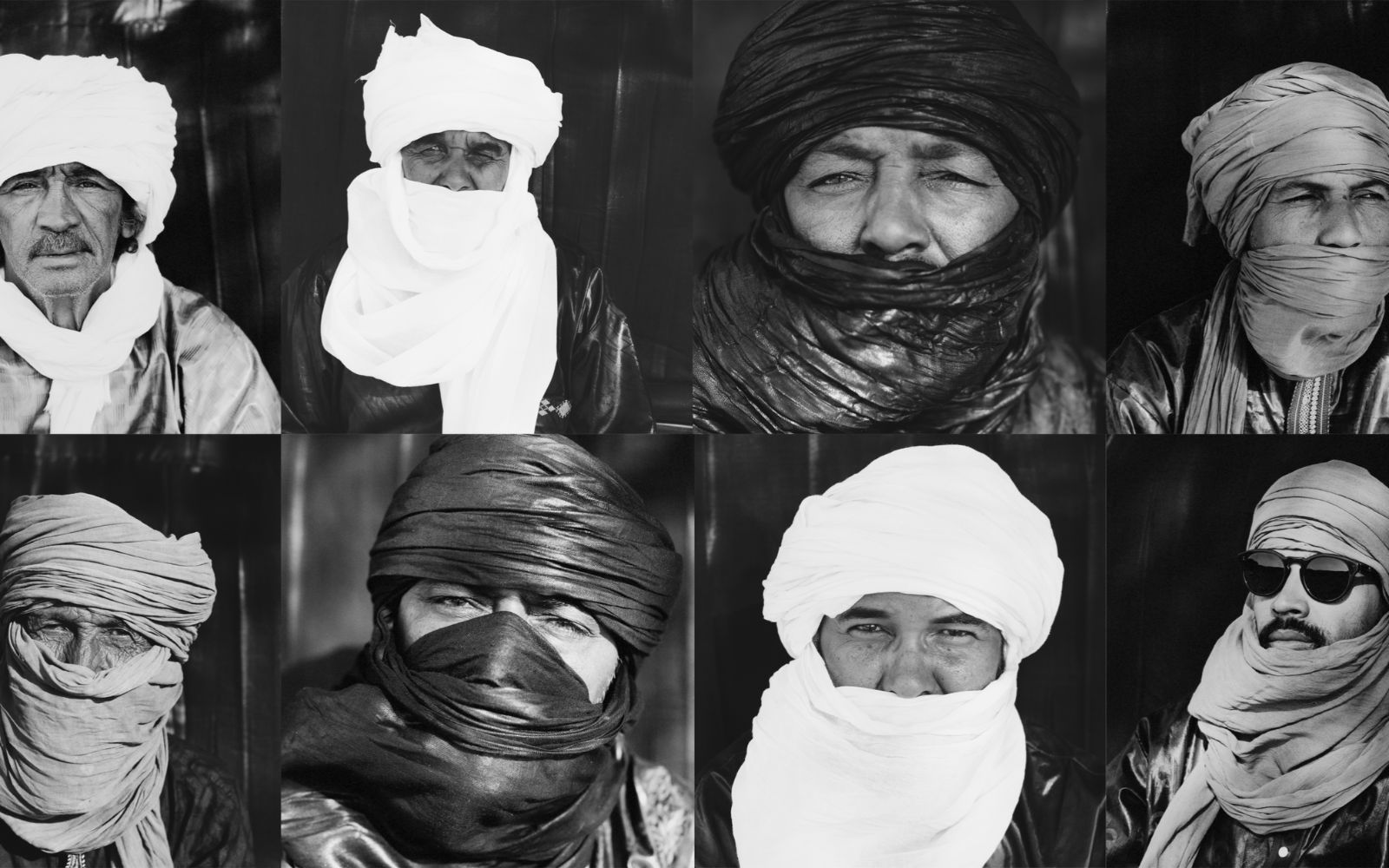
In 1989, in Kufra, Abdallah Ag Alhousseyni heard a song he couldn’t shake.
Kufra is a cluster of date groves sunk in a basin in the middle of the Libyan Desert, a stop on caravan routes far older than the borders around it. Abdallah was there with Mohamed Ag Itlale, a bandmate everyone called Japonais. The song was Sagherat Assan, a traditional Sudanese tune that had found its own way into the Sahara. “At that time, I was beginning to learn the guitar,” Abdallah has said. Japonais was the one who learned the song, and he played it for years.
Three decades on, a younger Tuareg band called Imarhan built a recording studio in Tamanrasset, their home town in Algeria’s Hoggar. They named it Aboogi, after the first half-permanent shelters their nomadic ancestors put up when they began to settle, and they made an album of the same name there. They invited Japonais to take part. They invited Abdallah too, and a Sudanese singer and oud player named Sulafa Elyas. Japonais died in February 2021, at 54. Aboogi came out the following January.
Tamanrasset is where Tinariwen began, in 1979, as a few Malian exiles playing weddings and parties for other exiles. The Trans-Sahara Highway reached the town a year later. It took the band until their tenth album, Hoggar, to make a record there, and when they did, they used the studio Imarhan built. Abdallah finally recorded the song from Kufra, and Sulafa Elyas sings it with him. “It’s actually a traditional song from Sudan that I had wanted to cover for a long time,” he says. A long time was 37 years.
Japonais isn’t on the record. His song is.
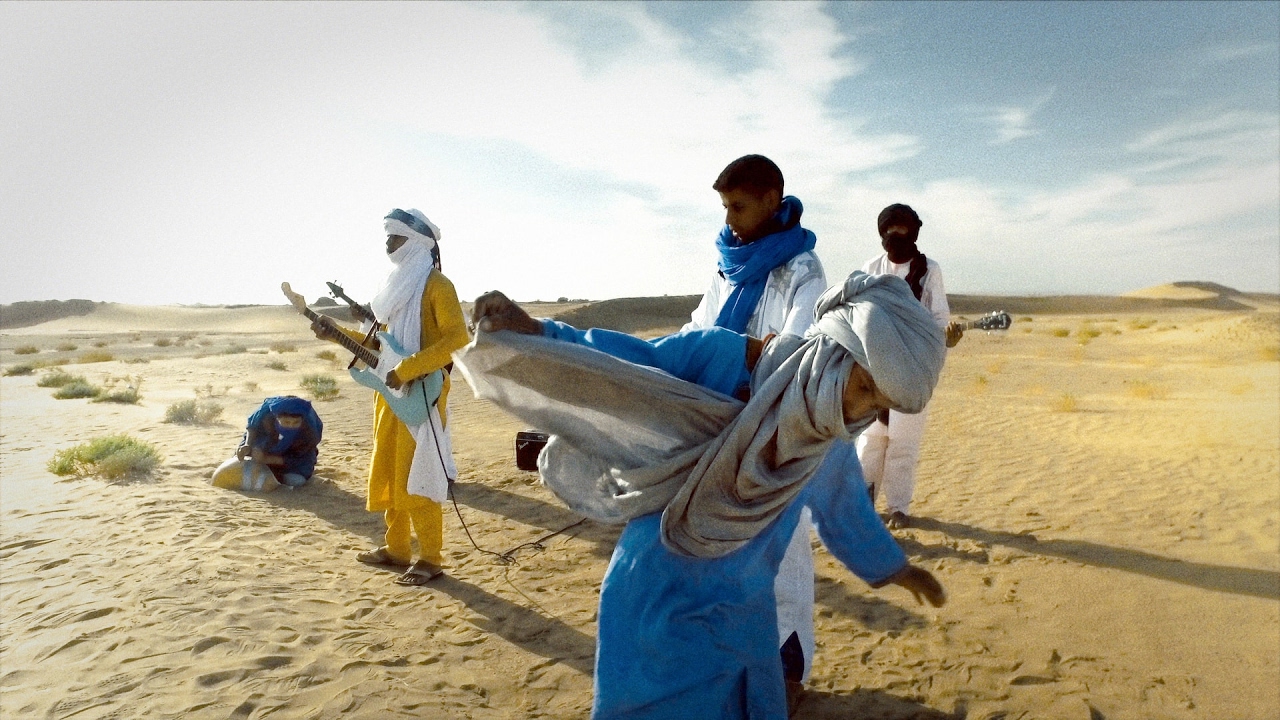
Abdallah was 16 when he left his family in northern Mali and went to Algeria to get away from the drought. He wasn’t the only one. The Tuareg had a name for young men pushed off the land by drought, conflict and poverty: ishumar, bent out of the French chômeur, the unemployed. In 1980 Muammar Gaddafi invited Tuareg men to join an Islamic legion in Libya, and plenty of the ishumar took him up on it.
“Like many other young Tuaregs, I eventually ended up in military training camps in Libya,” Abdallah says. “That’s where I met some of the members of Tinariwen and learned to play the guitar. It was a time of political awakening, but also of great musical inspiration. It was a very important period in my life.”
The band’s own history puts that meeting in 1985, at a camp near Tripoli run by the MPA rebel movement. “I wasn’t part of the band from the very beginning,” he says. “I joined around the mid-eighties.” By then Tinariwen were six years old. They’d started in Tamanrasset, where a Malian exile named Ibrahim Ag Alhabib fell in with Hassan and Inteyeden, two more exiles from the Adrar des Ifoghas. Ibrahim had watched his father’s execution during the 1963 Tuareg uprising, when he was four. He built his first guitar himself, out of an oil can, a stick and a bicycle brake wire. With Diarra, the group sang about homesickness and exile, and people took to calling them Kel Tinariwen: the people of the deserts.
The music moved faster than the men did. In a makeshift rehearsal studio in the camps, Tinariwen recorded songs and handed them to anyone who showed up with a blank cassette. Those tapes got dubbed, the dubs got dubbed, and copies of copies worked their way through settlements and camps across the Sahara.
“Those recordings were a big help in making the band popular among the Tuareg community in those early days,” Abdallah says. “The quality was very bad, most of them were recorded around campfires, but they helped spread our music, which was quite new at the time, as well as our political ideas. Our music was considered contestataire, and at some point the recordings were even forbidden by the Malian government.”
Contestataire is French for dissenting. The band’s history dates the ban to the end of the 1980s, when word went round that owning a Tinariwen tape in Mali was illegal.
Ask him what he makes of that era now that everything streams, and he goes straight past Spotify. “Today, you could make a comparison with WhatsApp and Telegram, which are very popular among Tuaregs,” he says. “A lot of music is shared between people through these platforms, sometimes outside official channels and regulations. At least, that’s how it’s supposed to work.”
The network he’s describing is the one the cassettes built 40 years ago: songs moving from hand to hand, outside official channels. Only the hardware has changed.
In 1990 several of the older members, Abdallah among them, joined the Tuareg rebellion against the Malian state. The Tamanrasset Accords were signed in January 1991, and the band committed to music full-time. They cut their first studio album that year in Abidjan, in Côte d’Ivoire, and it came out on cassette in 1992.
Europe took longer. In 1998 the French band Lo’Jo saw Tinariwen play a festival in Bamako and promised to keep in touch. In 1999 Abdallah, Kedou and Hassan played the band’s first international show, in France, billed as Azawad. In January 2001 the first Festival au Désert drew about a thousand locals and 80 Europeans to Tin Essako, a remote spot roughly 60km east of Kidal, and Tinariwen played it. The same year brought The Radio Tisdas Sessions, recorded at a Tamashek-language radio station in Kidal, and the band’s first international tour. In 2002 Robert Plant invited them to play the London Astoria.
The awards came: the BBC Radio 3 Award for World Music in 2005, a Grammy for Best World Music Album for Tassili in 2012, then nominations for Elwan and Amadjar. None of it made home any safer. In 2012 Islamist groups went after musicians in northern Mali and targeted Tinariwen. In 2013 Ansar Dine militants ambushed the band and abducted one of its members, who was later released. Through 2018 and 2019 they lived as nomads, moving through Morocco, Western Sahara and Mauritania.
There’s a word for what all that leaves in a person. Tinariwen are pioneers of assouf, a Tamashek word that usually gets translated as “nostalgia”. Abdallah doesn’t think one word covers it.
“Assouf is a feeling that is difficult to explain in one word,” he says. “It is the feeling of missing your home, your family, your friends, and the land where you grew up. But it is also about the life of our people, our memories and sometimes our sadness. When I play this music, I feel all these things together. It can make you sad, but it can also give you strength.”
The translation drops that last sentence. Assouf, the way he describes it, is grief you can stand on.
Tinariwen made Tassili in a national park in Algeria’s south-east, took Emmaar to a studio in Joshua Tree, California, and recorded Elwan in Morocco. Hoggar came out on 13 March this year through Wedge, the band’s own label.
Political unrest in Mali has pushed the founding members over the border, and they now live in Algeria. Tamanrasset has the biggest Tuareg population in the country, and the record is named for the Hoggar mountains around it. For a month the musicians turned up at Imarhan’s studio every day, and they recorded live, with few overdubs.
Abdallah calls it a return to roots. “It’s the first time we have recorded in Tamanrasset,” he says. The difference was who was in the room. “It was a very social experience, quite different from our previous albums, which were mostly recorded in remote places. This time, our family and friends were around, stopping by, having tea, singing backing vocals or clapping their hands. It felt like a big family reunion.”
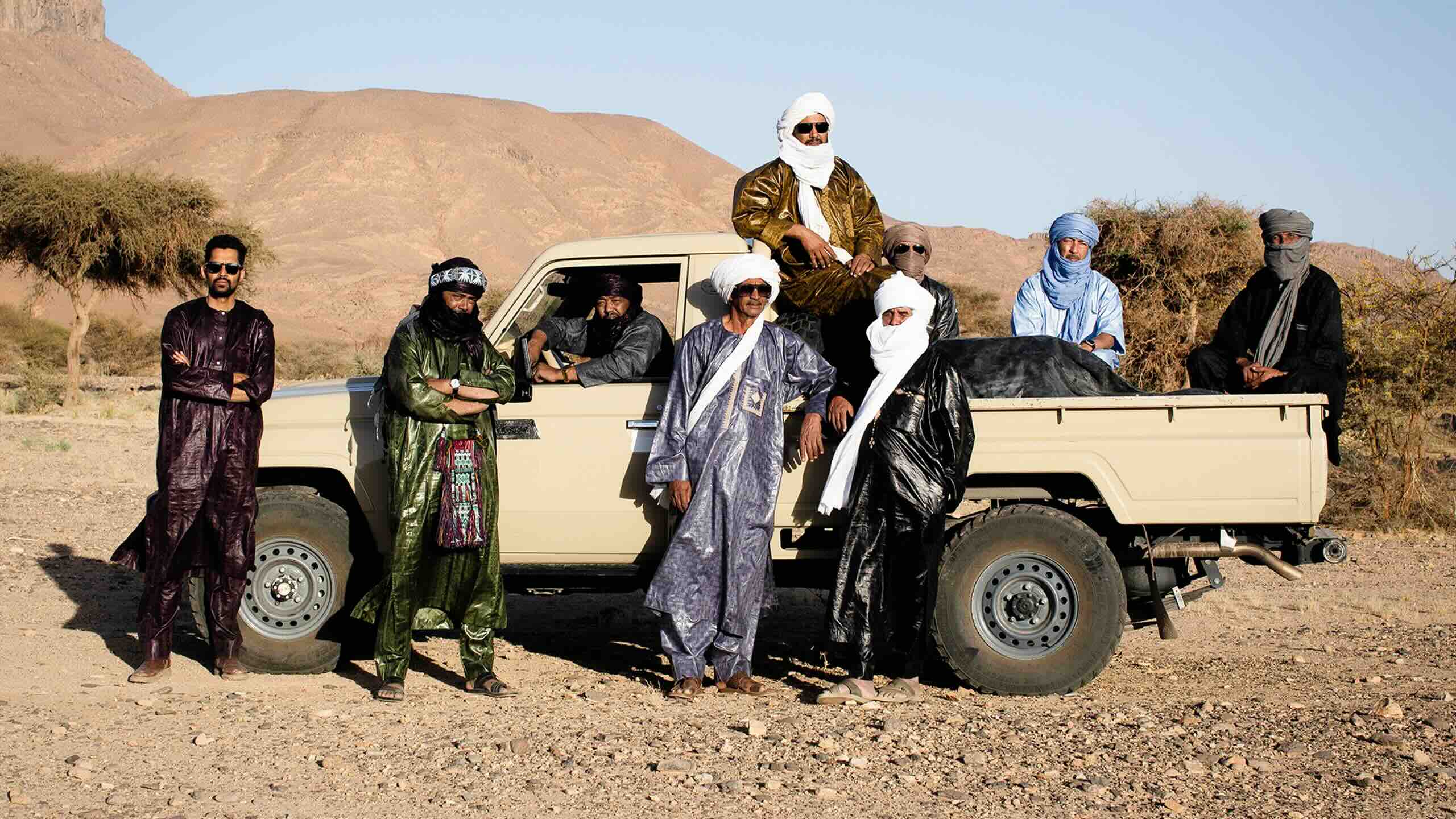
Some of that family hadn’t played with the band in a long time. Diarra, who co-founded the group in 1979, works with Tinariwen on Hoggar for the first time in 25 years. Wonou Walet Sidati, who used to record and tour with them, is back, alongside Nounou Kaola and Sanou Ag Hamed from Terakaft. Imarhan’s Iyad Moussa Ben Abderrahmane duets with Ibrahim on Tad Adounya, and José González turns up on Imidiwan Takyadam.
The biggest change is on Asstaghfero Allah. In Tinariwen, each songwriter sings his own songs. On that track Ibrahim and Abdallah sing together for the first time in more than 30 years. Patrick Votan, the band’s longtime collaborator and the record’s producer, sums it up plainly: Tinariwen “have always been poets of their time”.
Ask Abdallah about a collaboration that surprised him and he skips the rock stars and goes straight back to Sagherat Assani. “When I discovered Sulaf’s music, I thought she would be the perfect person to sing it with me,” he says. Sulafa Elyas, who records as Sulaf, is a Sudanese singer and oud player now living in exile in France.
The rest of Hoggar deals with the present. Abdallah’s Aba Malik goes after the Wagner Group mercenaries sent into northern Mali. Ibrahim’s Erghad Afewo takes on the divisions between Tuareg tribes. Asked how his sense of responsibility has shifted over nearly five decades, Abdallah says it hasn’t much.
“We have always wanted to speak about the life of our people, their difficulties, but also their beauty and their culture,” he says. “Today, the situation is still very difficult. These past few years, many of our people in northern Mali have lost their homes and have had to flee to Algeria. We have a responsibility to keep our culture alive and to make people understand what is happening in our land.”
By mid-2025 the UN refugee agency counted more than 330,000 Malian refugees living in other countries. In one week in November 2025 it logged 832 new arrivals in eastern Mauritania alone, mostly from Tuareg communities.
When WOMADelaide announced the band in September, the festival’s release carried a line from Tinariwen that explains why they’re still touring: until there’s peace, they have “no choice but to continue singing”.
Abdallah has no time for the idea that electric guitars and Tuareg tradition pull against each other. “For us, there is no contradiction,” he says. “We have our own music, our own rhythms and our own way of singing. The guitar is an instrument that we adopted, but we made it speak our language. The younger musicians bring new ideas and new energy. This is important because music must continue to live. We don’t want to change our identity, but we are not afraid of new things. Tinariwen must live on!”
That middle line is the best description of Tinariwen’s sound going. The songs get built the way the band does. “Usually, it starts with one person who has an idea, a melody and some words,” he says. “Sometimes it comes from something we have seen or experienced. We share it with the other musicians, and everybody brings something. We try different rhythms and different guitar parts until the song finds its own shape. It is a collective process.”
Nobody in that account owns the song. Set Hoggar against The Radio Tisdas Sessions and Abdallah hears the same band. “In terms of sound, I would say it’s not so different from The Radio Tisdas Sessions,” he says. “There is a little more production, but still quite subtle and raw, close to the way we sound when we play live. As for the lyrics, a lot has happened since 2001, but the Tuareg people are still facing great difficulties. We still have things to say about that.”
Twenty-five years separate those records, and the subject hasn’t moved.
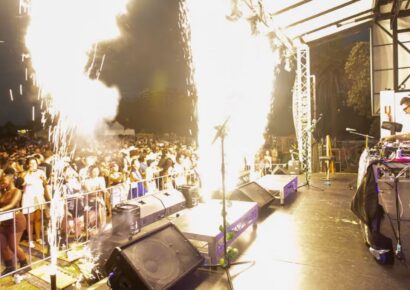
WOMADelaide first booked Tinariwen in 2004 and brought them back in 2018. In Melbourne, their RISING show at the Forum in June 2024 sold out. In March they return for WOMADelaide’s 35th year at Botanic Park/Tainmuntilla, billed as from Azawad, the name Tuareg nationalists use for northern Mali, before heading to Northcote Theatre.
“I remember the warm welcome we received in Adelaide,” Abdallah says. “It feels great to come back to a place where people know and understand our music really well. We played WOMAD in so many countries throughout the years, Gran Canaria, UK, New Zealand… People come from many different countries and cultures but share the same openness to different music.”
“I hope they enjoy the music and feel something from it,” he says of anyone seeing Tinariwen for the first time. “Maybe they will discover a little of our culture and our way of life. You don’t need to understand the words to feel the music. And if people go home wanting to know more about the Tuareg people and what is happening in our land, that would already mean a great deal to us.”
Get tickets to WOMADelaide here.