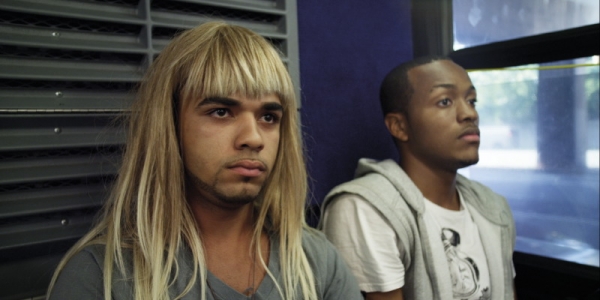
It’s daily dramas that dominate French director Michel Gondry’s The We and I, a dramatisation of the social intercourse between teenagers riding home on the bus from their last day at a New York community school. Seen through the eyes of the children on the bus, The We and I explores themes of bullying, identity, sexuality and community.
“It’s super fun, but also sentimental and moving film,” says ACMI Film Programmer Kristy Matheson. “He’s essentially looking at adolescence, and the ride home of the school bus. Lots of adults tend to look back on adolescence with nostalgia, and it just doesn’t ring true.”
The We and the I is screening as part of ACMI’s First Look program in June and July. “[First Look] provides another platform for audiences to see films that are coming straight off the international film festival circuit,” Matheson says. “That might mean that people are seeing films from established auteurs, or they might be getting to see brand new films from people just starting out.” Matheson is keen ensure the First Look program doesn’t become too elitist, while at the same time trying to ensure the program showcases works that “are a little bit more challenging”.
In creating The We and the I, Gondry used actors from The Point, a Bronx local community group. “Gondry has this whole interest in people telling their own story,” Matheson says. “When he was looking at this film, he wanted to do that on a more formal scale. So when he did this film, he found teenagers who were already getting together and doing artistic stuff, and got them to help him devise the script and the characters, and the dialogue.”
While The We and the I avoids the moralising and clichés of many other films exploring adolescence, the film does reach a level of closure after each of the characters leave the bus at various stages in its journey. “What’s really nice about the film is that Gondry gives you enough about each character to make you intrigued about what they will end up doing over the summer break, and in the future,” Matheson says. “But there is also a level of closure in the film, which is where the cinematic aspect of the film comes in. But because he’s collaborated with these kids, there is a level of vibrancy in the film that might not be there otherwise if it was just done with normal actors. Through the whole film, there are moments when you think the whole thing could just tip over into disarray, which I really liked.”
In addition to The We and the I Are, First Look features James Bennings’ American Dreams (lost and found) and Stemple Pass and Italian director Salvatore Mereu’s Pretty Bufferflies (Bellas Mariposas). American Dreams is a newly restored print of one of his older films, and uses political speeches, popular songs and baseball card images of American baseball legend Hank Aaron to look at American life between 1954 and 1976; Stemple Pass, Benning’s latest film, forms part of Benning’s Cabin Project, and uses text from Unabomber Ted Kaczynski’s journal to create an alternative, and somewhat disturbing of an ‘other’ America.
“James Benning isn’t that well known, but he’s a key figure in the American avant-garde,” Matheson says. “In the same way that Michel Gondry is quite famous, even though not as many people have heard of him.”
Pretty Bufferlies, which portrays the life of a teenager on a Sardinian council estate, is the only film on the program that doesn’t explore aspects of the American cultural fabric. Despite the obvious difference between it and the other films on the program, Matheson says it wasn’t chosen deliberately for that contrast. “I was just really immediately struck by that film,” Matheson. “It sounds like it could be quite dreary, in a Mike Leigh sort of way, but it’s actually super fun and made in this irreverent style, a bit like an early Pedro Almodavar film.”
In relation to the other films, Matheson notes that each represents a portrayal of America from outside of the mainstream perspective. “You have The We and the I, which is set in the Bronx, and the Benning films, which are made by an American but with Benning you have a director whose films have provided an alternate history of America. I’ve always been interested in film makers working outside of their home territory – which is what is so good about the Michel Gondry film.”
In Benning’s case, the filmmaker has become so interested in his Cabin Project, and the cultural milieu that he’s built a replica of Kaczynski’s cabin in rural Montana. Through entries in Kaczynski’s diary, Stemple Pass explores Kaczynski’s underlying philosophy, which eventually mutated into his terrorist activities. “He started out not wanting to be part of the rat race, so he’s very concerned about the environment and protecting the environment, he’s concerned about the role of government,” Matheson says. “You definitely get a better sense of what he was about, and obviously he dealt with that in a very destructive way, and Benning doesn’t condone that in any way, but I think we’re living in an era where just getting little grab of things, so this film tries unpack things beyond the 24 news cycle we seem to live in.”
BY PATRICK EMERY