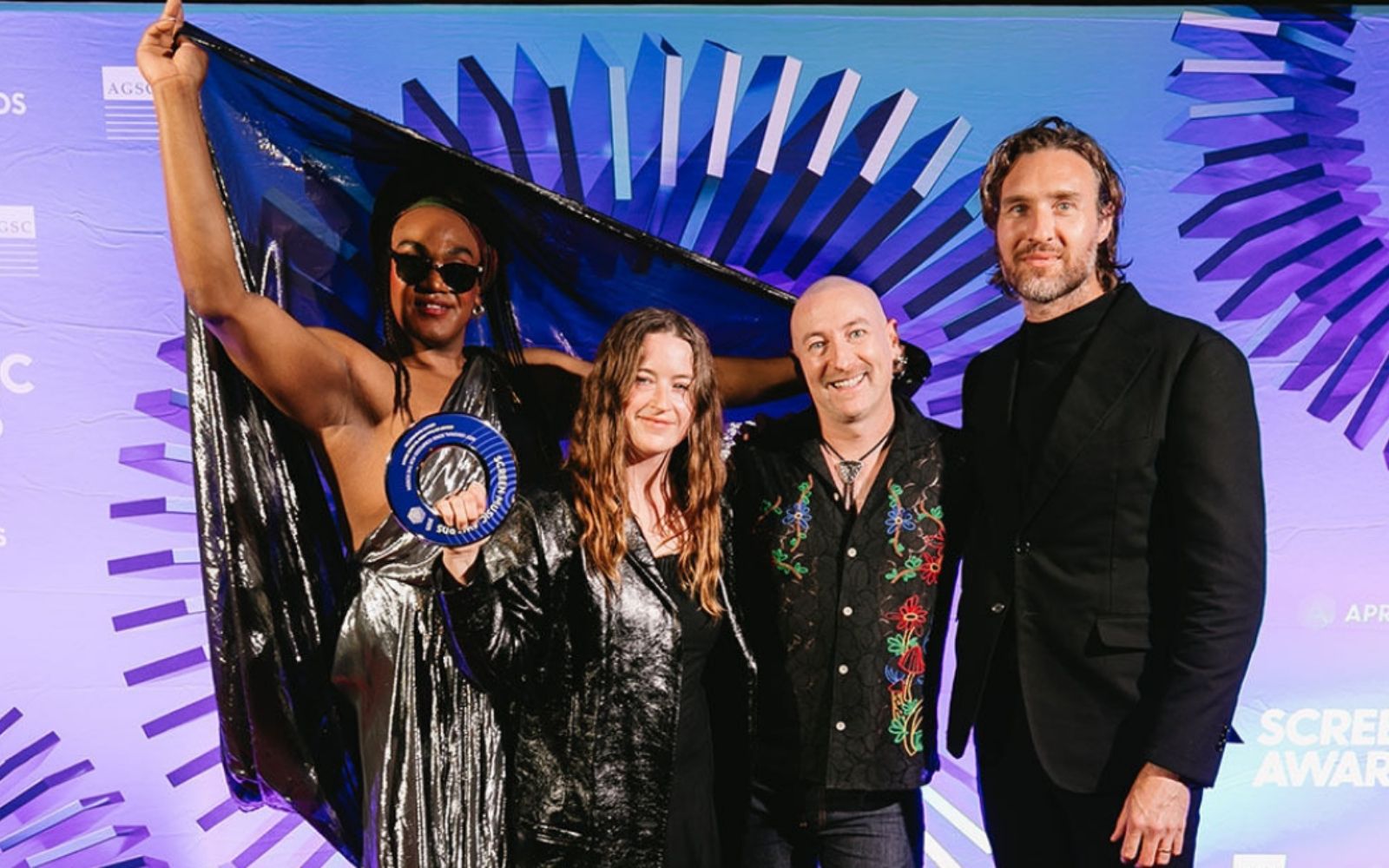
Presented by APRA AMCOS and the Australian Guild of Screen Composers (AGSC), the annual Screen Music Awards honour Australia’s leading composers in film, television and other visual media.
Across 16 categories, the 2025 Screen Music Awards highlighted musical excellence and innovation across a broad spectrum of visual media, from TV comedy, drama and children’s programming to short and feature length films, documentaries, TV advertisements and video games.
The awards ceremony took place at Brisbane’s Fortitude Music Hall in late October. One of the night’s big winners was Alex Olijnyk, who won Best Music for a Television Drama for Fake, which she worked on with Cornel Wilczek.
Stay up to date with what’s happening in and around Melbourne here.
“Day to day, I spend most of my time in front of the computer in a dark room by myself, so winning a Screen Music Award is so lovely,” Olijnyk tells Beat.
Olijnyk won Emerging Screen Composer of the Year at the 2024 Screen Music Awards. This year, the award went to Ayda Akbal, a Melbourne-born, LA-based composer whose growing body of work includes The Official Marvel Podcast, the short film Kuduz, and the documentary My Sister Liv.
“It is quite surreal for me and I am immensely grateful to and for our industry,” Akbal says. “It is not often that, as composers, we get that external reassurance that we are on the right path.”
Lance Gurisik, an established composer who won Best Music for an Advertisement at the 2025 awards for his work on the Toyota CH-R Diamond ad, echoes this sentiment.
“No one goes into a project thinking, ‘I’m going to win an award,’ but a lot of hard work goes into this job, so I’m genuinely grateful to have picked up a few [awards] over the years,” he says.
Screen composition veterans Adam Gock and Dinesh Wicks won Most Performed Screen Composer – Australia for the 11th time for their contributions to Farmer Wants a Wife, LEGO Masters, MasterChef and Travel Guides. Another past winner, Helena Czajka, took home Best Music for a Documentary for her work on Yaara Bou Melhem’s film, Yurlu | Country.
“These awards are judged by Australia’s top screen composers, so it’s the ultimate honour to be awarded Best Music by people who understand the craft better than anyone,” Czajka says.
The award for Best Soundtrack Album went to Finn Clarke for the feature-length documentary, The Raftsmen. While it’s a diversifying field, Clarke emphasises how hard it can be to break through as a screen composer in Australia.
“This industry moves slowly,” he says. “Relationships take years to build, and trust plays a massive role. It’s a long game, and you just keep showing up.”
Czajka underlines two key ingredients necessary for getting your big break in screen composition: persistence and a sustained willingness to learn.
“Once you’ve got the tools and skills, it’s about getting your first few credits,” she says. “This can be a challenge because getting your foot in the door requires someone to believe in you and take a chance on you. There’s an element of luck to this, but it also relies on you proactively searching for opportunities and showing people how you can add value.”
For Olijnyk, despite being honoured at two consecutive Screen Music Awards, the work of establishing herself in the industry is ongoing. “Talking to composer friends, I’m not sure that feeling ever goes away,” she says.
Gurisik agrees: “It’s competitive and you have to be relentless. A lot of this industry comes down to relationships with directors, producers and agencies. Building those long-term working relationships is what keeps you in the game.”
View this post on Instagram
As is the case in all creative fields, screen composers face a lot of rejection as they work their way up the ladder. To cope, Akbal says a confident attitude goes a long way.
“There are going to be a lot of rejections and non-responses in this industry, and as a creative, that can feel personal,” she says. “But it’s important to have that little light inside yourself that no one can turn off, and just keep on keeping on.”
Ultimately, there is a lot of satisfaction in working with other creatives and witnessing one’s compositions take on a new life on the screen.
“I love how music can enhance a film in ways that go beyond simply illustrating what’s on screen,” says Clarke. “And it’s so much fun collaborating with amazing creatives in a medium that brings together so many artforms.”
“Each project is different,” says Akbal, “and requires a specific sound palette and direction, which I think is one of the most exciting part of writing music for the screen.”
“In the end, we all want to serve the story, to help the audience get lost in the world we’re trying to create,” says Olijnyk.
For more information, head here.
This article was made in partnership with APRA AMCOS.