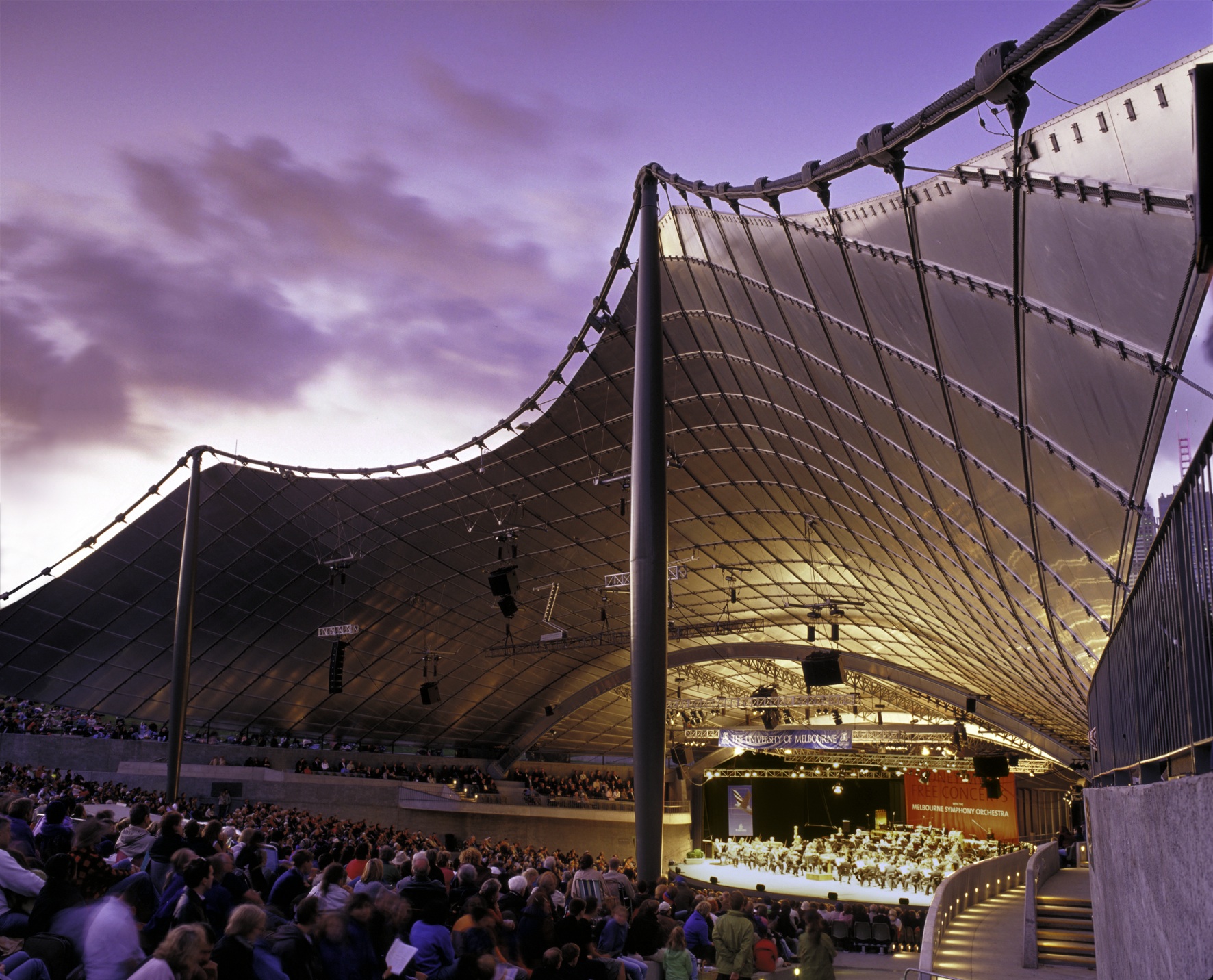
The interview coincides with the announcement of the MSO’s 2015 season – again, if you were inclined to think it might be stiff, think again because it’s looking better than hot. For a start the MSO’s running a series of free concerts again at the Sidney Myer Music Bowl during the balmy, early part of the year. It’s hard to beat a good picnic and beverage at one of the MSO’s outdoor concerts. Each event’s nicely themed too – for instance, the series includes A Musical Valentine, on Saturday February 14 for the romantically and/or musically inclined (featuring highlights from Romeo and Juliet, Ravel’s Daphnis and Chloe and Gershwin’s Porgy and Bess), and the Summer Nights in Budapest concert, which brings a bit of gypsy revelry to the Bowl with Brahms’ Hungarian Dances and Bartók’s Concerto for Orchestra, one of the greatest masterpieces of the 20th century.
Understandably, Northey is looking forward to the MSO’s 2015 season, which spans popular as well as more traditional choices – everything from movie soundtracks (Star Trek and Babe), a concert with Tripod as part of the Melbourne International Comedy Festival through to Ravel’s Bolero and Mozart. Obviously, Northey can’t conduct them all, but is there anything he wishes he was conducting? “Not out of any kind of resentment,” he laughs. “The people who are conducting all of these concerts are fantastic. Probably the ANZAC tribute though – I’d love to be conducting that. It’s going to be pretty special – Beethoven’s Symphony No. 9 as an ANZAC concert is quite exciting I think, but really I’ve got plenty of my own concerts to worry about.”
It’s pretty clear that Northey is extremely smart – he was some kind of child genius/prodigy (he could play the piano and violin at the age of five, when most of us are still learning to tie our laces). He’s musically unstoppable and is as affable as all get out, so no wonder he’s raced to the top of the pack, despite the fact that, conductor-wise, he started late in the piece. Northey was a freelance muso (of course, he was a multi-instrumentalist – flute, clarinet and sax), but it was no longer entirely floating his boat, so at the age of 29, he went back to spuni and started studying under the tutelage of John Hopkins (famous and fabled British born, but longtime Australian based conductor). Hopkins encouraged Northey to bat on and indeed he did. In fact, Northey went on to win the award for Young Conductor in 2001, then saw himself through a grueling two day audition process for the world’s most famous conductor course in Finland before moving back in 2006 to develop his career.
The fact that Northey started his conductor training at 29 and did so darned well is astonishing, but he’s a walking advertisement for following your passion, irrespective of years under the belt. “Once I started, I got the bug and when you get the bug for something, whatever it is, it becomes a calling. For me it became obvious that conducting was my ultimate form of artistic expression. For some people it’s playing, for some people it’s composing, but for me it’s this art of conducting. I felt like it just fitted my personality and skill set really well, and I really loved to do it. I couldn’t imagine doing anything else once I started – it was that obvious. I’d prefer to cut off a little finger than stop conducting.”
Similarly, Northey can readily articulate his love for classical music. “Classical music does this really well, it shines a light on us as human beings and is able to teach us something about who we are, where we come from and perhaps where we are going. That’s the interesting thing for me about the big master works. It doesn’t need to be in a modern context. Take Beethoven’s Ninth Symphony – it makes us feel something that is common to us all – this feeling of fraternity and this feeling that we are all together. Classical music and the orchestra have the power to make everybody feel the same thing at the same time and that’s what’s amazing about it.”
The other amazing thing is how Northey goes about putting his stamp on a score – he can visualise a work being played note for note from start to finish. How the hell does he do that? “It just comes from deep absorption in the score, the music,” he explains. “For example, when I did my first big professional concert with the Melbourne Symphony, Beethoven’s Symphony Number 6, for about four or five months before I literally went to bed with that score – I took it to bed with me every night and I feel asleep with it under my pillow. I just built up this very deep understanding of the piece and the structure of it.”
Northey has got to run. He waits until the last minute out of politeness before telling us that he has 10 minutes before a concert – shit, well, you better go suit and stick up or whatever it is that you conductor fellas have to do pre-gig. Northey bids us adieu, but then there’s a pause followed by a familiar roar: “Go Tiges.”
BY MEG CRAWFORD