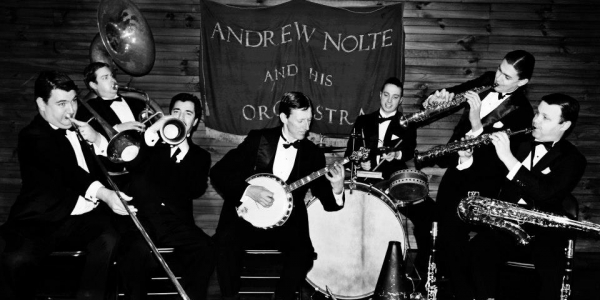
“I had a passion for 1920s music. I collected old records and I always had a fascination with the past; the music followed with that,” expresses Nolte brightly. Nolte is the frontman, clarinetist, and alto and soprano saxophone player for Andrew Nolte and His Orchestra and has been playing 1920s music for just over ten years now. “I couldn’t find any other existing bands to play with, so I formed my own. I spent years trying to find the original sheet music and orchestrations, then I put together a small orchestra [and] we started rehearsing frequently.” A small orchestra of eight musicians, including a trained sousaphonist. “Then we started doing gigs — [Andrew Nolte and His Orchestra] has been going for three years now [and] we’re all having a good time doing it.”
“Andrew is quite meticulous in his attention to detail,” explains Robert Rizzo, the resident trumpet player of the small orchestra. “[During performances] we’re all wearing 1920s suits, we’re playing off of 1920s nickel-plated music stands [and] a lot of guys in the band are playing 1920s instruments entirely. Even the suit I wear is made in Melbourne [during] the 1920s and the shirts are not collared shirts. We have to button them up and attach the collar like they did in the 1920s. So it’s really a snapshot of the period.”
It was back in 2006 that the pair first met, Rizzo detailing his first impression of Nolte as a memorable, eccentric man with bright ideas. Rizzo had been playing classical trumpet for 14 years by then, having started back in 1992.
“Originally Andrew [had] wanted me to play the cornet in the band, like Bix Beiderbecke,” reminisces Rizzo. Bix Beiderbecke was one of Rizzo’s inspirations alongside Louis Armstrong and Buddy Bolden, whose jazz revolutionized music. “He had an instrument from — it’s a Conn Victor 80A [cornet] — from 1923 or 22, which is the same type of model that Bix Beiderbecke played. Andrew handed that to me and I played that for the first few years with the band.”
“We’ve got the three main types of music that would’ve been popular in the 1920s,” continues Nolte, detailing how the soirée entertainment will unfold. “That would’ve been the dance music, which was mainly pop tunes” presented by Melbourne bandleader Michael McQuid in Mike’s Retro Five; “We’ve got a New Orleans marching band [New Orleans Pelican Brass Band], which plays all the New Orleans jazz and we’ve got a band that plays all the Chicago-style jazz from the 1920s and it’s got a retro vibe. So we’ve got all our bases covered.”
Andrew Nolte had played at the last Soirée, Winter Soirée, in the Cairo Club Orchestra. So, when Astor Productions were planning their The Gatsby Spring Soirée, they hired Andrew Nolte and His Orchestra as the headline act and enlisted the help of Nolte in selecting the support acts, who admits there’s “a somewhat limited range of 1920s music available, but these are the world-class bands that have toured overseas. They all have a pretty strong reputation.”
Nevertheless, reputation is not the only thing paramount to these bands, rather, it’s the entertainment they can provide and energy they rouse within the crowd, something that Rizzo confirms Andrew Nolte and His Orchestra has. “When we play it seems to create [a] real energy that’s not contained on stage [and] it seems to go down well with the audience,” answers Rizzo thoughtfully. “It’s really good because — I wouldn’t say we’re the wallpaper band — it helps to create a backdrop for the venue, for the people we’re playing for. It seems to complement the audience and what we’re doing.” However, the ex-cornetist reassures us that it’s also the luck of performance 1920s jazz. “Often many of the parts that the musicians are playing are virtuosic; they demand attention. The music is all original arrangement that were recorded in the 1920s. Most of the music we play is charted down [and] we source [them] from Isham Jones Orchestra, Paul Whiteman Orchestra Arrangements and we’ve got some Jelly Roll Morton arrangements in there — he was one the first to write jazz down. Even though the charts are written down, there is room for solos [to allow] the musicians of the band to express themselves creatively without the constraints of having to stick to the written part.”
BY AVRILLE BYLOK-COLLARD