AAO artistic director Aaron Choulai tells us about the diverse influences that inform the ensemble's latest live performance.
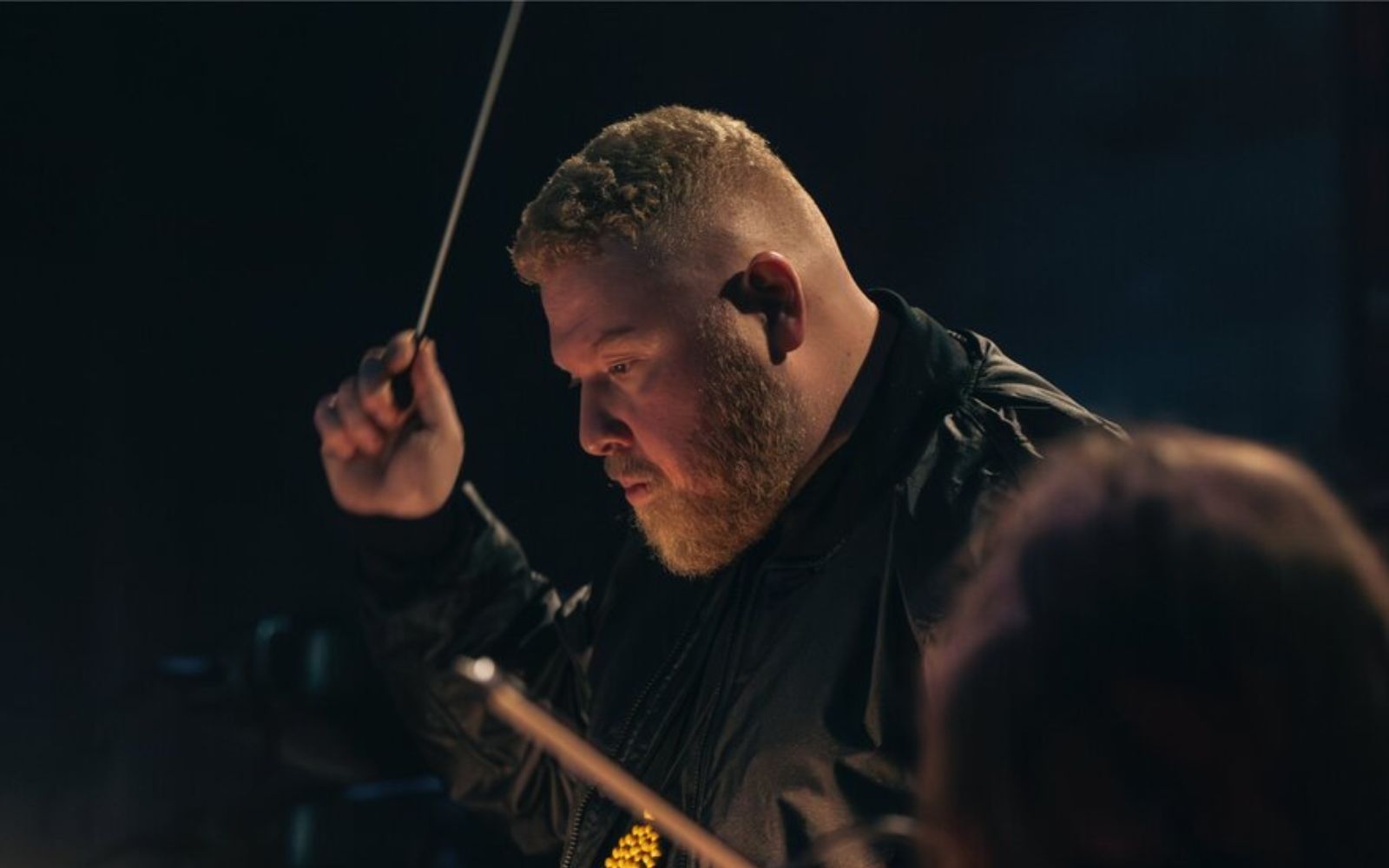
“At the heart of To Kill a Magic We Got Used To is a desire to celebrate the early artistic influences I inherited from my family,” says Aaron Choulai, artistic director of the Australian Art Orchestra.
Growing up in 1980s and 90s Port Moresby with a prominent Black artist mother shaped Choulai’s worldview from an early age. “Music, film and literature that was around me as a kid was usually political and spoke about the world from a Black and non-western perspective,” he says. “Watching Spike Lee movies and trying to unravel the wordplay from a Gangstarr album kept me in my room while family, artists, or just people from the neighbourhood came through the house daily to see what my mother was working on, smoke juju, play some guitar, and then be on their way.”
Check out our gig guide here.
But there was another formative influence – his maternal grandfather from German New Guinea. “Half Black and half Chinese, having grown up in a German orphanage, undoubtedly my grandfather was culturally German,” Choulai explains. “Through him I learnt all the Beethoven symphonies, the music of Wagner and the piano playing of Arthur Rubinstein.”
These twin inheritances converge in the AAO’s latest work, To Kill a Magic We Got Used To, a collaboration with freestyle rapper Roman MC. Premiering at the Athenaeum Theatre on November 28, the one-hour performance is based on Stravinsky’s 1918 theatrical piece, L’Histoire du soldat.
“My grandfather’s love for Bach and Beethoven led me to find Stravinsky,” Choulai says. “My mother’s love for Spike Lee and Guru led me to find Charles Mingus and MF Doom. These influences aren’t just musical, they’re cultural, therefore embed themselves in all my work. But, perhaps not as usually on display as in this premiere.”
The Stravinsky piece features a libretto by Swiss French writer Charles Ferdinand Ramuz, based on the Russian folk tale The Runaway Soldier and the Devil. “The Stravinsky work tells the story of a soldier who is on leave,” says Choulai. The soldier is making his way home from duty when he stops by a stream and begins to play his violin. He’s approached by a businessman who makes him an offer. “He says, ‘Look, I’ve got this book that tells the future and I’ll swap you for that violin, but you have to teach me,'” Choulai explains.
Reluctant at first, the soldier eventually agrees to trade his violin for the prophetic book, which he uses to personally enrich himself. But despite his newfound wealth, his life feels hollow. “By the end of the piece, you realise that the violin is representative of the soldier’s soul,” Choulai says, “and the person that he happened to meet was the devil.”
To Kill a Magic We Got Used To retains this allegorical framework, but Choulai and Roman MC have updated the story for the contemporary attention economy. “Roman and I discussed this idea of the algorithm being symbolic of the devil and an artist trading their practice and integrity for the riches that the algorithm can offer,” Choulai says.
View this post on Instagram
“To Kill a Magic We Got Used To could be described as jazz meets hip-hop meets classical music,” Choulai says. “It could be described as a work that incorporates a unique process in Sono-Kinetic Conducting. It might be a theatre piece, and even though I don’t want to admit it, I could have even written some kind of musical. All the above is true.”
But for Choulai, it runs deeper still. “If you come from a background like mine, you will recognise that this work is culturally coded in language of a postcolonial struggle for identity,” he says. “The Pacific, much like other Black regions, looked towards America in the 80s at an emerging universal Black identity, to find a contemporary sense of self in the aftermath of colonialism. Straight out of Compton sounded like it could’ve been straight out of Port Moresby, to me.”
“Jazz came later while searching for my own identity,” Choulai says. “In hindsight it’s no surprise that it made total sense to me. John Coltrane’s Live at Birdland felt like it was screaming for the same social equity and justice as Fear of a Black Planet by Public Enemy, and Bill Evans had a touch that could have been mistaken for any of the great pianists known for romantic repertoire.”
“We are a government funded organisation, so we want to make sure that our work is meaningful and has a kind of social and cultural function,” he says. “That takes a lot of thought and care as to, like, what is the important thing to say in Australia artistically in this particular space in creative music for the next five years?”
Choulai took over as artistic director of the AAO following the decade-long tenure of trumpet player Peter Knight. In the last couple of years, he’s overseen collaborations with Mutti Mutti, Yorta Yorta and Nari Nari songwriter Kutcha Edwards, Kamilaroi percussionist Adam Manning, and Papua New Guinea’s Tatana Peroveta Choir, who hail from Choulai’s home village.
Prior to the AAO gig, Choulai was living out a very different kind of musical dream. “For the 15 years before I undertook this position, I was living in Japan working as a beat maker for hip-hop labels,” he says.
View this post on Instagram
Partnering with Roman MC on To Kill a Magic We Got Used To proves that Choulai hasn’t left his former vocation behind. “I’m using specific cultural references almost as samples,” he says. “So, we take bits of the Stravinsky work and then I’m flipping them like samples with the band and rearranging things and trying to hide it like you would if you’re making beats.”
He adds, “There’s a couple of times where it’s fairly explicit, where I’m turning a Wu-Tang bass line upside down and really tearing it apart.”
The thread linking all of the AAO’s projects under Choulai is a commitment to honestly engaging with the ensemble’s cultural context. “Australians are diverse in terms of culture,” Choulai says. “Not just your cultural background, but in terms of the culture that we consume. Hip-hop is a culture, jazz is a culture to me, classical music is a culture. And having all of those influences represented in work that is representative of contemporary Australia I think is important.”
To Kill A Magic We Got Used is on at Athenaeum Theatre II on Friday 28 November. Tickets here.
This article was made in partnership with the Australian Art Orchestra.