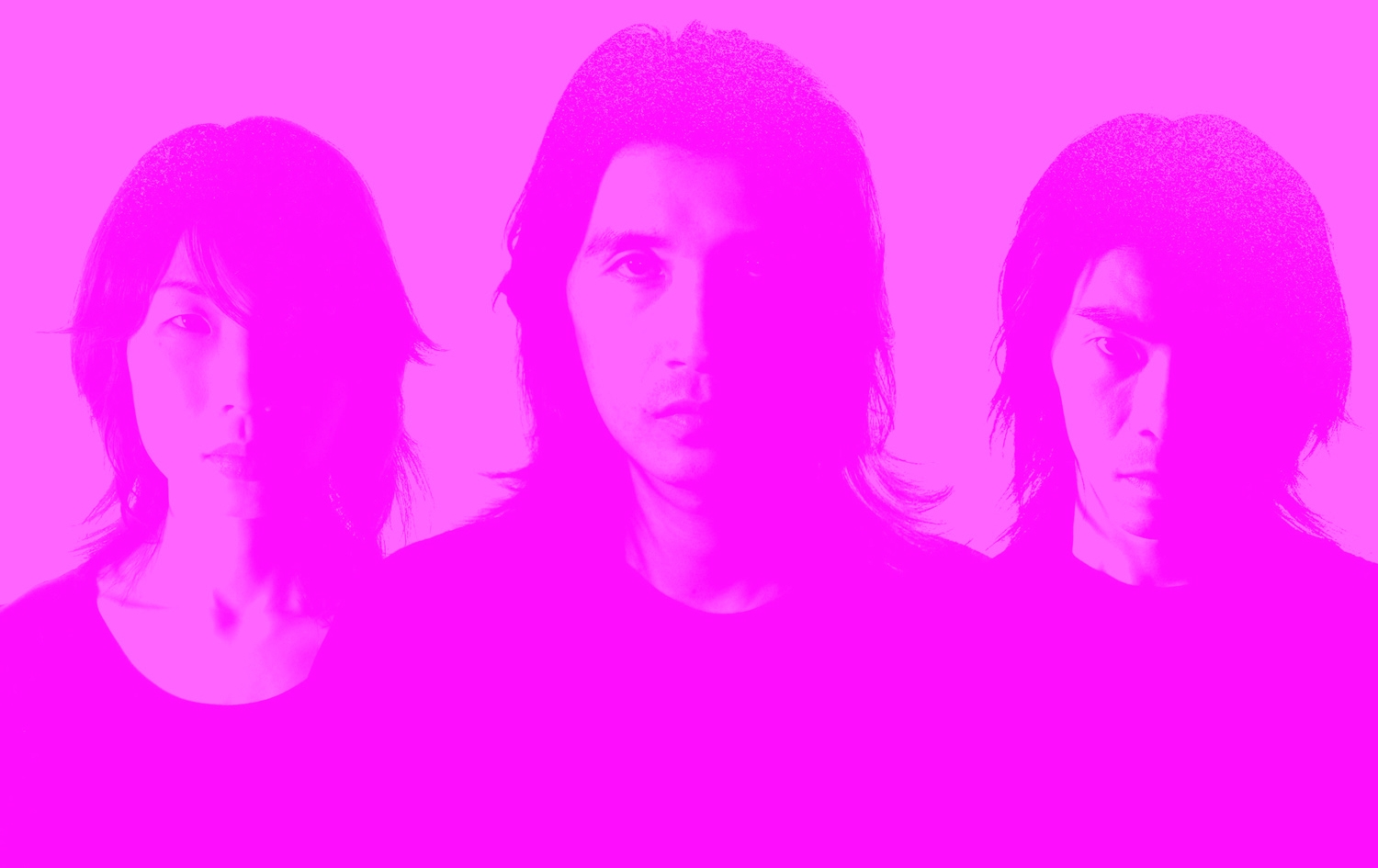
“[It’s] more than a conscious thing,” explains vocalist, bass and rhythm guitarist Takeshi Ohtani. “It’s not that we aim to change each album. We always stay true to our own desires, and we try to stay true to the ‘sound’ that is born from our jam sessions. That’s it. From jam sessions we allow ourselves to be led by the riffs and melody to an inevitable formation.” An apt summation of this approach is further elaborated on by Ohtanti, who says, “Songs come about very organically; from a neutral standpoint we ingest them as if from airborne infection.”
Rather than chastise contemporaries who endlessly follow the same predictable formula, album after album, Ohtani sees it for it is. “That is just their way,” he says. “They have a different approach than our methodology in their confrontation of ‘sound’. Or, perhaps I should say, their profound search of sound. Repetition can be monotonous. But when you cross over a certain point, the repetition of something like the kraut-rock hammer beat or drone music really reaches a certain level of comfort”
Boris is soon to visit Australia for the tenth birthday celebration of their monolithic 2005 release, Pink. Looking back, it’s clear that for Ohtani the album not only flagged a creative turning point, but was also one for which the Boris machine gained increasing momentum. “From the time a little before releasing Pink, we began to frequently tour overseas, and it was also the period we started recording more prolifically. But once we released Pink, the band’s speed become even faster.”
“At the same time our wayof doing things – touring, recording, and management – our basic methodology, became solidified. The reaction from media and various scenes was way more than we expected, and even though it came as a big surprise to us, at the same time this album made us realise, ‘This is the way we are meant to do things.’ ”
It’s important to note that the Boris discography isn’t limited to one breakthrough album. Their debut album Absolutego (1996) was an epic, one song masterpiece clocking in at 60 minutes. Another important mention, Attention Please (2011), saw Wata take complete control of vocal duties, in addition to her performing on guitar and keyboards. Dronevil (2005) was a double LP which saw Boris experiment with both sides of the spectrum – with Drone showcasing building tensions in an ambient atmosphere, before Evil delves deep into the abyss of doom influence. Smile (2007) welcomed guest vocalists of the highest order, with Stephen O’Malley of Sunn O))) and Michio Kurihara of Ghost. Those with an ache for pure, droning sludge can simply not go past Flood (2000), which saw Boris grinding through four marathon tracks with effortless ebb and flow.
With such a huge body of work, it would be easy to assume that there may be some within the Boris discography better left dead and buried – though according to Ohtani, this couldn’t be further from the truth. “There hasn’t been one work that we released that we were dissatisfied with. Because each release has its own story, and everything real we felt about that time is contained in each piece.”
In the same breath Ohtani is quick to mention that, for the most part, they have purposely detached themselves from previous work.“The emotional attachment to each period is deep so it is difficult to single any out,” he says.
“Up to the present we have had no interest in reminiscing about what we’ve done in the past, because we‘re always only thinking about our latest works and actions. As we greet the ten-year anniversary of Pink and carry out this tour to play it in its entirety, we also greet the 25th year since the formation of Boris.
“At this point we thought it would be a good opportunity to sort out our archive to present to our listeners. There are still a lot of mysteries wrapped up in Pink, as far as the sound production and performance goes. Even when playing it now, new things remain to be discovered.”
Ahead of their Australian tour and monumental performance of Pink in full, Ohtani reflects on some further highlights encountered along the Boris journey.
“In 1996, on our first US tour we played this place called Moe in Seattle. It’s when we first played on the same bill as Joe Preston (Thrones), and also met Stephen O’Malley. That show was the birth of the friendship we have now.
“The second was in 2007 on the Rainbow Tour. We played the First Unitarian Church in Philadelphia, and even though it was very hot there was no air conditioning, and on top of that it was a sold-out show, so it was like hell on that stage. It was so bad that humidity caused all the gaffer tape to peel off. If asked to play under those circumstances again I think I’d have to decline, but it was an unbelievable experience.”
By Bel Ryan