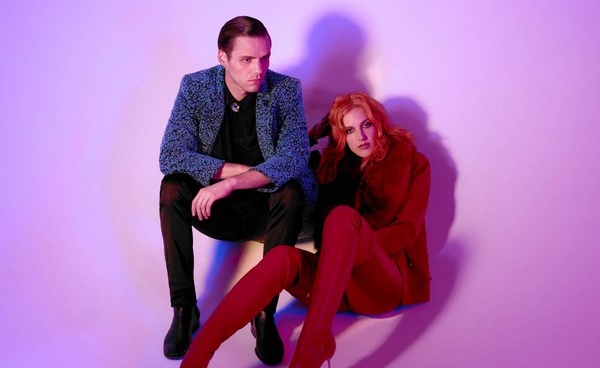
“Hold on to your hats ladies and gentlemen. Shit’s about to get real. You’re about to talk to Lizzy Plapinger. And coming up next: the interview,” she laughs. “God, what is happening? I feel like I’m on some kind of imaginary carnival ride.”
And so the tone is set for the duration of our interview; a little madcap, a little reflexive, and never a dull moment. Although worlds apart, there is a parallel here with media darling Jennifer Lawrence – someone who appears quite genuine and earnest, yet is also disarmingly charming. It makes sense that Plapinger’s gregarious, somewhat vulnerable character translates into music with such ease. What is surprising, however, is the extent to which the band hit the ground running.
“Honestly, I’d never sung in my life before Ms Mr,” Plapinger says in a rush. “I hadn’t sung for anyone before Max [Hershenow, band mate], and Secondhand Rapture were the first songs that I’d written in my entire life, the first time that I’d ever seriously used my voice. I think it’s something that’s very inherent to me. I never feel like I’m putting on airs or being someone that I’m not. But I do feel like I found my voice by just singing along to all of my favourite artists, learning how to sing through them, whether that was Patsy Cline or Aretha Franklin. The women that I’ve grown up loving my entire life – even if I don’t actually sound anything like those women – have somehow taught me vocally how to come back to myself. I think that’s sort of beautiful, and makes me hope that maybe someone out there is listening to my voice and singing along and they’re finding their own voice through that.”
Plapinger’s mention of Patsy Cline is quite topical, given that Hologram USA have just announced a holographic tour of the late country singer. Anyone out there still waiting for the future to arrive can finally kick back and relax – and really, if they can bring back Tupac, Cline’s holographic reincarnation was well overdue. But, novelty aside, you can’t shake a vague sense of horror at the whole enterprise.
“You’re kidding? Oh, that’s just awful,” Plapinger laments. “How interesting. I think I would rather just sit at home and listen to Patsy than go out and see some virtual reality version. I think that would be quite sad. Sometimes when you’re on the grind of tour, a fantasy like that does have its appeal, but ultimately… I don’t think I’d ever be comfortable with that. There’s something so important about physically being there with your audience, connecting with them. The other part about performing live is working out how you’re growing, how your audience influences and inspires you. I’d say that playing live is becoming more and more one of my favourite pieces of having this opportunity to be in a band. I think I love being on stage more than anything now, and I only really discovered that about myself through touring the last record.”
Plapinger has had ample opportunity to test this theory of late; Ms Mr’s tour schedule has seen the duo not only cross oceans and hemispheres, but feature at tentpole festivals such as Coachella and Glastonbury, as well as a forthcoming return to Splendour in the Grass. Acknowledging the importance of live performance formed a vital part of the new album, and even the most cursory first impression reveals a compelling departure from Secondhand Rapture.
“So much of enjoying touring was brought into How Does It Feel,” says Plapinger. “We wanted to make music that made people move and engage. So the challenge we set up was to make a dance record that sort of redefined what dance movement was for us – and for our audience. We didn’t want dance music to have to be EDM or house born, but to find different ways of moving to different sounds. You know, there are songs where it’s all about fist-pumping and dancing around as loudly as possible, but there are also songs that make you want to grind, to sexually move against your partner. And then there are songs that are more rock-steady stoner dance, where you just want to bop your head,” she laughs. “We really wanted to engage our audience physically as much as we could, and I think people will find that now at the shows.”
Interviewers have a tendency to gush to an artist’s face about just how much they loved their recent project. The alternative – ‘Man, your new album really sucks. How does that feel?’ – might sometimes be more sincere, but would make for a brief conversation. Yet in this case, the praise is genuine. How Does It Feel is a bold evolution in sound, but sacrifices none of the integrity or musical prowess of Ms Mr’s debut. What’s more, it journeys from celebration to despair, with stand-outs Tripolar and Leave Me Alone showcasing this range.
“Tripolar is one of my favourite songs on the record, and Leave Me Alone is probably the favourite, so you chose well,” says Plapinger. “[The album] is absolutely the most intimate, personal and honest extension of who I am. Especially in a song like Tripolar – that one almost more than any other song on the record. In a way, I thought that people would never connect with it because it felt too personal, but maybe that’s what makes a successful song. What makes me feel like a successful songwriter is that every song will sound individual to everyone who listens to it.
“I think we’re starting to cross-pollinate different songs,” she continues, “and I think musically there is an element of call-and-response across the entire record. The lyrics play off each other as a whole, even if the experience in the end is quite specific on a song-by-song basis. I think Painted is very much a song about picking yourself up and finding a way forward, but I also think All the Things Lost is one of the darkest songs I’ve ever written – a song about being the lowest, most lost and tortured version of yourself. I think each song has its own journey, but they need to be brought together for the bigger story to be told.”
Even the darker aspects of the record are presented in such a way that audiences will find something to connect with their own lives. Mention of this topic finds the singer suddenly serious. “I think I’m someone who operates in extremes,” Plapinger says. “I feel high highs and incredibly low lows. I guess part of my character has always been that balancing act between dark and light. I think How Does It Feel is a more mature relationship to that darkness. So much of Secondhand Rapture was about wallowing in it, really marinating in misery. How Does It Feel is about acknowledging that darkness within you and recognising that it’s something that you have there as a catalyst.
“I think by no means do you come out the other end of How Does It Feel and you’re triumphant. It’s not that. It’s about seeing a way forward, and bringing that darkness along with you for the ride. I think that’s a sign of where I am personally in my life, and I think it’s also just how people have to grow in order to move on. The alternative is to let something bring you down so much that you’re just paralysed by it. I would never want someone to feel that way.”
BY ADAM NORRIS
