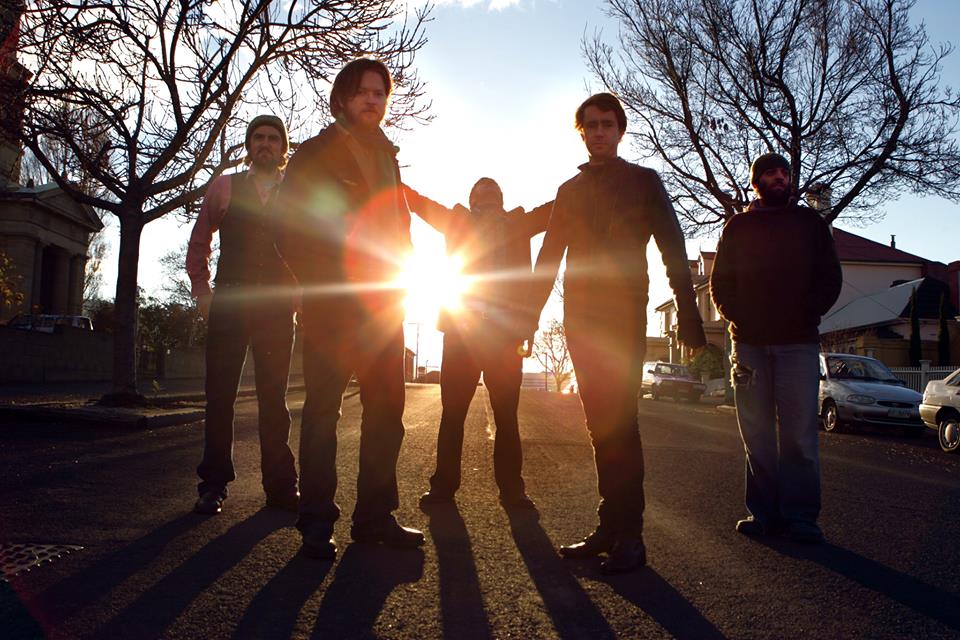
Manchester Orchestra singer/songwriter Andy Hull has been leading the band since he was 18 years old. Now 28, Hull’s known for writing big rock songs with a patent emotional core. As a result, Hull’s job involves being confronted by variations of his past self on a regular basis. And he’s often surprised by what it has it to say.
“Every time I’ve ever made a record or written about something,” he says, “it’s like a year later I’ll think of the lyric or the song and realise there was something else going – something bigger being written that I didn’t really know about as I was writing it.”
In January this year, Manchester Orchestra returned with their fourth LP, Cope. Prior to making the record, Hull and his four band mates built themselves a studio in their hometown of Atlanta, Georgia. This allowed the five-piece – which also includes lead guitarist Robert McDowell, keyboard player Chris Freeman, drummer Tim Very and newest recruit, bassist Andy Prince – to piece the album together in one room, without any disruptions. Yet even though Cope is the product of group interaction, Hull retained creative authority.
“It was certainly still my songs,” he says. “I just have this band that’s so good that I was able to sort of write in real time. So I would come up with a riff and we would write this riff together and then I would be like ‘all right, hold up, let me write the lyrics here for the next thirty minutes’, and they’d go take a break.”
It should be noted that, while Hull’s songs contain introspective tenderness, Manchester Orchestra specialise in a powerful brand of alt-rock. To gather such force, the input of all five digits is invaluable.
“I do have the final say,” Hull explains, “but there is a lot of democracy that happens in coming up with that final say. I’m certainly not one to take any offence – none of us are – to [being told] ‘That’s not really working, we need to find something better than that’. We all made the decision three or four years ago, right after [2011’s] Simple Math, that our goal is what’s best for the song and what’s best for the band. Our goal isn’t what’s best for our egos and for looking cool or feeling cool.”
So… Cope was made in the band’s own studio, under their own supervision and they’ve distanced themselves from notions of cool. This all sounds rather mature, doesn’t it? ‘Growing up’ is often synonymous with becoming somewhat conservative and losing potency. Converse to this, Cope is far and away Manchester Orchestra’s loudest and most direct release so far.
“We felt before we started this record, ‘What do we want to add to the next thing that we’ve done?’” says Hull. “The thing that made the most sense to us was to make it as fast and as catchy and as rocking of a record as we can. We wanted to take all of the bullshit out and focus on the songs and the immediacy of it. We wanted to make an immediate record.”
It’s actually the first time a Manchester Orchestra record has been written and recorded in the same room. This meant that the entire construction procedure was free from much in the way of dilly-dallying, which injected further edge into the already pithy compositions.
“I was able to write it without having to first go through the demo process, which was great,” Hull says. “I’m not sure if it’ll be that way again, but it was really, really eye-opening to see what magic was happening. Most of these songs had never been written and by the end of the day we had a recorded demo and we were able to see what we were working with.”
Track ten, See It Again, is actually the only track on Cope to break the four-minute barrier. This level of restraint is certainly novel for Manchester Orchestra, who’ve been known to stretch songs out to upwards of seven minutes. The record’s relatively refined character could suggest that, ten years into his recording career, Hull’s become more decisive with his creative vision. However, Cope shouldn’t be viewed as the realisation of an ideal.
“Our band has always been a slow burn of sorts,” Hull says. “We just continue to take a couple of steps each album cycle. Since the beginning of our band we’ve always wanted to be a career band that has a catalogue that’s pretty diverse. I’d love to have ten different sounding albums by the time we’re done. At least ten.”
This brings us back to the notion of narrative self-understanding. It’s essentially our awareness that we’re unique individuals with ongoing projects to perpetuate and relationships to preserve that gets us out of bed every day. Through reflection – be it dialogic or private – we learn about ourselves and devise effective ways to advance our story.
Songwriting is, of course, an act of reflection, which involves dipping into one’s finer feelings and extracting something of honest and constructive import. So, for a writer like Hull, who doesn’t shy away from emotional content, songwriting has played a huge part in the development of his identity.
“I started this band and then left on tour when people would be going to college after high school,” he says. “It’s just been what I’ve known. I’ve always written honestly and [written] open-up-the-chest-and-look-inside lyrics. It’s been cool to watch the growth through it and it’s really exciting to think about where it’s going to go.”
The thing is, given that Manchester Orchestra are a much loved rock’n’roll band, Hull’s intimate ruminations are subsequently broadcast to thousands of listeners across the world. Thus, important moments in his self-growth come to possess an instructive quality.
“That’s sort of a really creepy part of it,” he says. “You write this stuff that’s super personal and then people have their own meaning behind it. It’s super moving, really. I’m kind of blown away by it, that something so small can become something bigger.”
In addition to effecting personal growth through songwriting, the fact that Hull’s been touring since his late teens has also influenced his perspective on the world. Late adolescence is generally a fairly erratic period in anyone’s life. Working a job that takes you from one party environment to the next, night after night, would no doubt lead to some especially wayward behaviour. While Hull clarifies that Manchester Orchestra “were never wild… just more energetic,” these days the band have a better understanding of their primary duty.
“At a certain point, when you do it for so long, you really start to take it seriously and realise that you want to be great at what you do. You just realise that there are limits to how far you can push yourself and how much fun you can have in certain areas.”
Whatever these perceived limits might be, they haven’t reduced the fivesome’s gig schedule. Manchester Orchestra head back down to Australia next month. Having previously visited in 2009 and again in 2012, the band’s left a big impression on Australian audiences. And it’s certainly not a one-way exchange.
“There’s something to be said about the atmosphere and vibe of your country,” Hull says. “It’s pretty unbelievable. Everyone’s been so kind to us from Australia, since we were babies.
“The thing that we’re consistently blown away by with the fans: people aren’t just fans of ours for what we’re doing at the present time necessarily. They’re in it for the long run, which is really cool. That’s what brings us up to make records like Cope, because we know we can do something like that and it’s not going to freak everybody out.”
BY AUGUSTUS WELBY