“I don’t care about any of the success, money, fame – all that nonsense. The only thing I care about is the making of stuff. That’s why I get up every morning buzzing to get into the studio.”
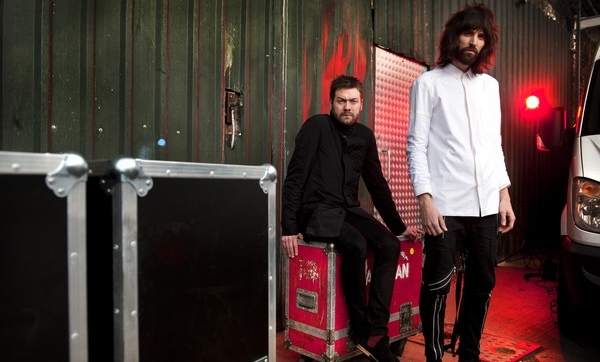
In April this year Kasabian released their fifth LP, 48:13. In the lead-up to the release, UK publications like ShortList and The Guardian again drew attention to the Leicester lads’ bravado-laden self-appraisal. Indeed, during our conversation, Pizzorno doesn’t shy away from statements elevating his group’s significance. However, it becomes apparent that this estimation stems from a fierce determination, which goes hand-in-hand with his compulsive creative tendency.
“I so love the late ’60s. I love all the music that was created there – the avant-garde stuff like Silver Apples and obviously the Stones and The Who and all that stuff. We know what they used to sound like and we know how amazing that was, but let’s figure out what they would sound like if they were making music now.”
What’s particularly striking about Pizzorno’s immodest statements of intent is the sober manner with which they’re conveyed. He gives off the impression of merely rummaging through facts, rather than trying to prove a point. Then again, perhaps the songwriter’s considered disposition shouldn’t come as a surprise. It’s his blustering sideman, vocalist Tom Meighan, who’s the band’s more outspoken member. Pizzorno, on the other hand, is the thinker, the one committed to an artistic agenda.
“I’ve always loved exploring,” he says. “That’s why on each record I sort of go off. I get bored. If a formula’s working, artistically it doesn’t do anything for me. I love just trying things and moving around.”
Nevertheless, he’s also in tune with the critical task of making music with popular accessibility. “Our music’s always had roots. It’s always been strong melodies, great hooks. What’s amazing about our band is we bring loads of people together from all walks of life, from all angles. There’s a huge part of me that’s like, ‘Let’s go so experimental and so insane and blow people’s minds,’ but then you’d lose a lot of that element of what we are. When you listen carefully there’s a lot of avant-garde, there’s a lot of experimentation going on, but there’s also a great hook or great melody that people can connect to and relate to. And that’s amazing. I’ve realised over time that that’s what makes us unique.”
There was an almost three-year interval between 48:13 and its predecessor, Velociraptor! Now, this isn’t a particularly extended gap when you consider the extent of the band’s touring commitments, and the fact that they haven’t taken any substantial time off since the release of their self-titled debut ten years ago. Additionally, Pizzorno isn’t the type of songwriter to commence work on an album purely because it’s what he’s expected to do.
Before immersing himself in the gruelling album-making process, the chief creative objective needs to be deciphered. “[Albums] always start with a kind of vision, where you’re like, ‘Right, this is where my head’s at, this is where I want to explore,’” he says. “I’m as much a producer as a songwriter. I see myself as equal on those levels. I don’t really turn up with an acoustic and go, ‘Oh, here’s a song.’ I’ll start with a beat or a loop or a bassline. Some songs, similar to paintings, can take like six months to finish. Then there are others that take ten minutes.”
When it came to 48:13, it was Pizzorno’s realisation of what constitutes Kasabian’s essential appeal that provided the record’s major impetus. “This one was to make everything direct – like distilled Kasabian,” he explains. “It feels like this is almost taking it back to the start. My first musical instrument was an Akai sampler. The music that got me wanting to start making music was the Midlands rave scene. In a lot of ways I’ve taken it back to the roots of why I started making music.
“Over the years I learnt from the best – like Bowie and Bolan – the craft of writing a great song. Then we have this element that makes us unique. Trying to push rock music forward, make new rock music – that’s the exciting bit.”
For a band so commonly associated with a fixed image, Kasabian aren’t guilty of ever releasing the same record twice. The formal act of stylistic divergence is one thing, but continually progressing whilst maintaining quality and pleasing a massive fan base is a far more impressive feat. Kasabian’s music grabs widely from the past, but the band doesn’t exclusively mimic one artist or genre. For instance, even though they still get tagged as Oasis descendants, they’re just as likely to reference Kraftwerk or trip hop.
“The combination of electronic music, hip hop and late ’60s rock’n’roll – [I try] to take elements from all those three things and rearrange them, put them back together and create a new sound,” Pizzorno explains. “Rock music’s fallen behind, definitely [behind] hip hop and electronic music, because it’s just not moved on. So we’re trying to move it on, to make the new rock’n’roll.”
Of course there’s a categorical distinction between paying homage to the past and making an innovative statement that communicates a strong sense of the here and now.
“I buzzed off the Kanye record [Yeezus] for that reason,” says Pizzorno. “Not necessarily all the songs or as a piece of work, but he just did something with hip hop. He’s dropped a massive move. I want this record to have that with rock music, for kids in bands to listen to it and go, ‘Oh, we don’t have to just use these guitars,’ and, ‘We’ve got a great song, it doesn’t have to stop there.’
“That’s why I love Tame Impala. The techniques [Kevin Parker] uses and his taste; it sounds like it’s made now although you can hear where it’s coming from, which I buzz on. They’re truly an incredible band and I think he’s massively, massively talented. It’s about grabbing little pieces from things you love and then rearranging it and stitching it back together in a different order. Then it starts to be new.”
Similar to Kevin Parker – who’s often stressed that his songwriting procedure has more in common with electronic production than jam band psychedelia – for 48:13, Pizzorno adopted a methodical approach to meld and reapply those aforementioned stylistic touchstones.
“We’re not a rock band, we don’t operate on those terms,” he says. “The techniques are really modern. Treat – that whole song started with a tiny loop, same as Glass. It’s sort of engineered that way; that’s just how I’ve always worked and what I’m into.”
While hip hop-affiliated producer Dan The Automator (Gorillaz, Handsome Boy Modeling School) produced Kasabian’s previous two records, Pizzorno decided it was time for him to produce one himself. It’s easy to credit Dan The Automator with preventing the rock riffs on 2009’s West Ryder Pauper Lunatic Asylum from sounding pedestrian and keeping the intricate string sections on 2011’s Velociraptor! from becoming overblown. But Pizzorno says the songs’ defining characteristics always originate with him.
“In some ways I should have done it earlier probably. I’ve learnt a lot from working with other people, but it’s always been my sound. It’s not like I’ve ever needed help with creating a sound. That’s just how I write. These ideas and these sounds, that’s how they all begin.”
The fact that Pizzorno – Kasabian’s sole creative force – was now sitting in the producer’s chair as well meant the outcome of 48:13 was entirely up to him. So, did the concertedly ambitious songwriter shudder under the gravity of this responsibility? Not bloody likely.
“I’m conscious of always being free and I enjoy the risk more than anything, really,” he says. “I love the feeling where you’re not sure what’s going to happen. I always think the more you feel that way, the better the work. All the best records ever made, they must have all had that moment.”
BY AUGUSTUS WELBY