That night a whole new world was revealed to me and it was bright and exciting and full of possibility. It was a world where anything could happen. It was where the extraordinary was praised and only your very best of ambitions were entertained. In this world you could experience William Burroughs’ ‘cut-up technique’ dressed in the avant-garde fashion of Kansai Yamamoto. This was where Twig the Wonder Kid rested her head on Major Tom. In this place black soul held hands with German electronica and it felt like this is how it was always meant to be.
November 9th, 1983.
The first night I saw David Bowie live.
I was 11 years old and living in Adelaide playing basketball, reading books, devouring comics and experiencing movies. I’d fallen out with my first obsession; the self-proclaimed greatest rock band in the world, KISS. Once the band removed their make-up, they no longer felt like superheroes. It was as if Batman had tried to trick us into following the adventures of Bruce Wayne. No thanks.
Mum sensed that maybe Bowie would be of interest. I liked Ashes to Ashes with that weird film clip that scared and thrilled me in equal measures. I liked the songs Space Oddity and Modern Love, even if they felt like tunes from two very different people.
“You have to let me know now if you want to go as the tickets are really expensive,” said Mum.
They were twenty dollars.
Back then twenty dollars could get you a pie, a sausage roll, an iced coffee and a two-bedroom house in Sunshine. It was a different time.
At the concert I didn’t know what to expect, but when Bowie’s band hit the stage and began playing the opening to Look Back In Anger, electricity ran through the crowd. Onstage the lights were low and Bowie entered with his back to the audience. I didn’t know what to think. Had his friends pointed him in the wrong direction? Was this a pantomime? Were we supposed to yell, ‘We’re behind you’? By the time Bowie hit the chorus everything made sense. With the opening line Bowie spun around to face the audience and the stage lights suddenly flashed brighter than a speed camera on Alexandra Parade on a cold winter night.
Everyone around me screamed. I was hooked.
My mission in life was to own every David Bowie album. I sold toys to make money so I could spend it at CC Records on every album I could find. I needed to hear the music of Ziggy Stardust and Aladdin Sane and Halloween Jack, and the Gouster and The Thin White Duke. As an only child from a single parent background I spent a lot of time alone. Often Bowie’s music was my only companionship. I was a true believer. I never wavered in the years that followed.
I grew up on his ’80s albums and love them because they were the first albums that I bought fresh off the racks. I was a fan of Tin Machine because it was something different that appeared to offend people. I loved the ’90s as he bounced back with some of his greatest songs including Hallo Spaceboy, The Buddha of Suburbia and The Motel. He received grunge respect through Nirvana, Britpop embraced the original gender-bender and hip hop sampled Fame over and over again. In the new century, Heathen felt on a par with Scary Monsters, and The Next Day proved he could still rock. Ultimately, Blackstar was his final masterpiece.
When the news came through that Bowie had died, a little part of me left with him. I know people find it difficult to understand how you can be sad about someone’s death when you didn’t know the person, but I think people underestimate art. They underestimate how it helps you see the world and find your place in society. Art can entertain and inspire and shock and soothe the soul. Bowie was an artist. His music led the way through good times, the bad times, for all of the times.
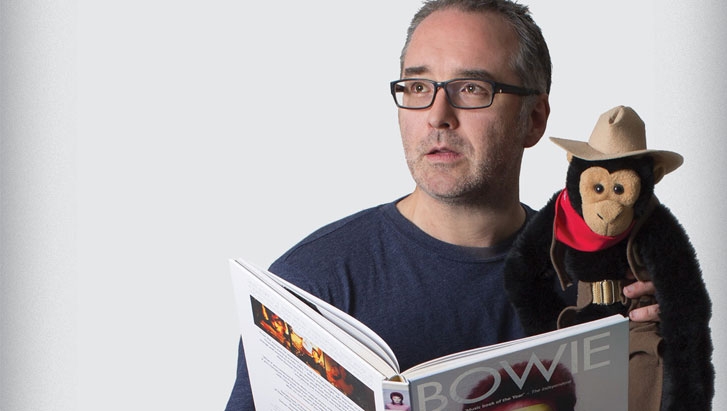
Five days before I was to open my new show Hoot in Perth, I was feeling uninspired, so I flicked through the photos that had been taken for the show. In most of the photos I’m holding a book about Bowie. Amongst all the odds and ends that make me who I am, there he is front and centre. I threw out the show and put together a new show that represented where I now found myself. I Can’t Give Everything Away played on the stereo. I was back in a world where anything can happen.
The seeds for this decision were sown on November 9th, 1983. The day everything changed
BY JUSTIN HAMILTON