Everyone has a strong reaction to the Ecoplex Cinema here at Golden Plains and Meredith Music Festival.
Passivity has no place among the manna gums, peeling like streamers — as much a part of the decor as the festival’s vivid lanterns.
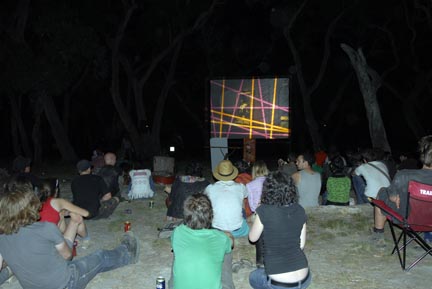
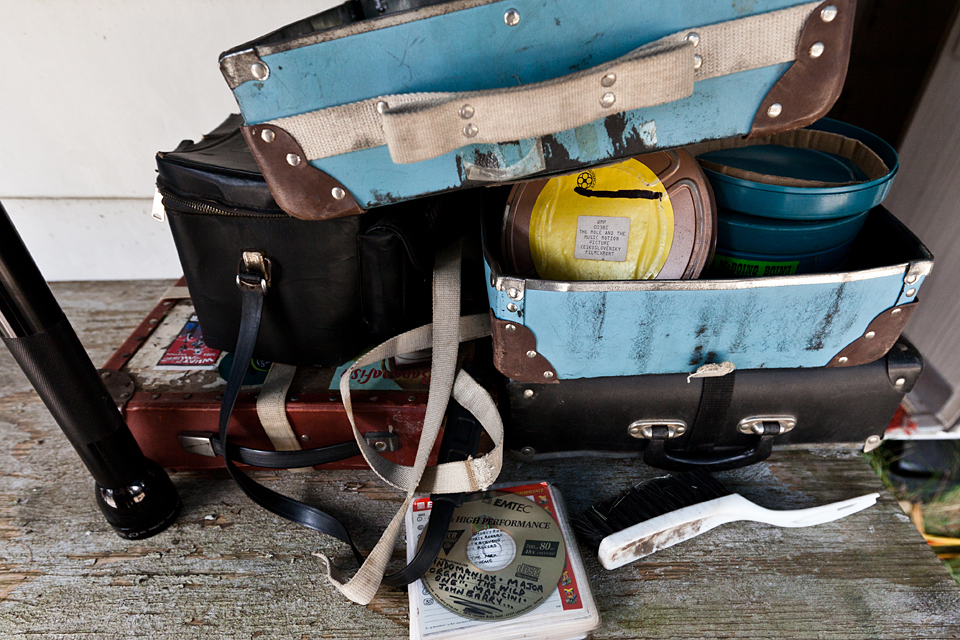
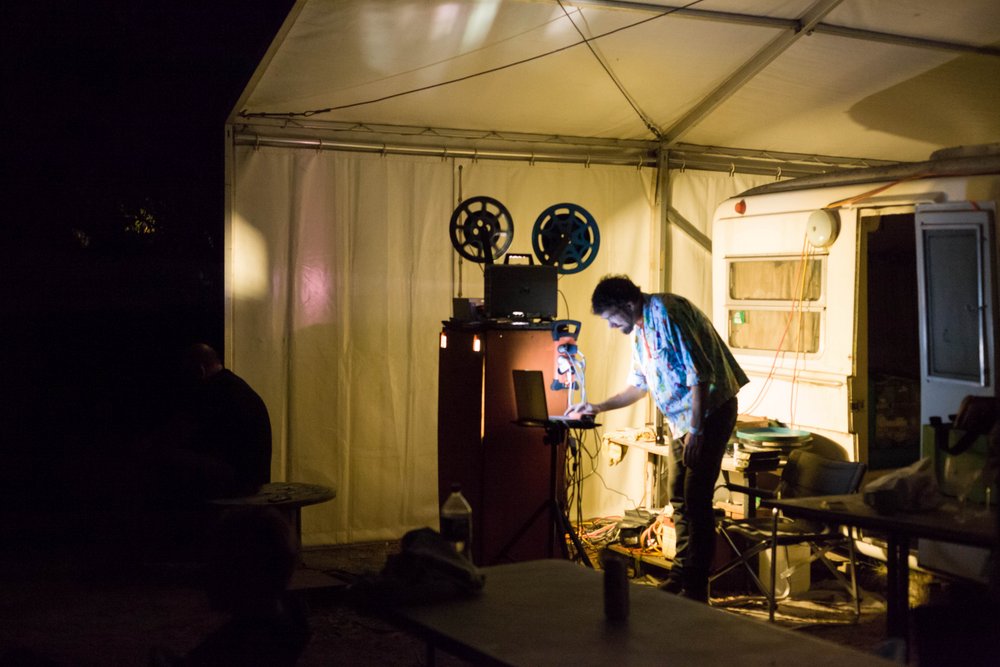
Tucked away in Bush Camp is Jim Knox and his picture palace: a fossilised caravan beneath a marquee moored by a pillar of 16mm projectors, corner-stoned by a laptop, hard-drive, and a cornucopia of celluloid cases. The cinema breaks not only minds but the golden rule of movie-watching: quiet. Neighbouring the Supernatural Amphitheatre, the stage’s sonic boom seeps into every screening, as integral to the experience as dancing is; the percussive rattle of the projector and chorus of Kookaburras just as much a part of the band. There is no pre-programming or running order. The films follow where the night goes.
Stay up to date with what’s happening in and around Melbourne here.
I stumble through the scrub — admittedly a weary traveller — after BADBADNOTGOOD’s set. Ironic, considering the band’s incorporation of 16mm film projections over their live sets; a collaboration with Canadian filmmaker Sylvain Chaussee. Following me closely is a tranche of festival goers who’ve made the pilgrimage to insist Jannik Hastrup and Flemming Quist Møller’s 1971 animation Benny’s Bathtub gets played, as per their annual festival tradition.
Knox will only play the four minute sequence that he doesn’t find boring; the one where there are octopuses and “…just a great funky bit of music”. The bush scrub becomes a living cutting room floor beneath us; the projectionist’s hand as ever-present as the film-makers’ on screen. Another visitor arrives, saying his friend had sent him a clip of this wonderful cat animation that he’d missed — so Knox puts on Sara Petty’s Furies (1978) for the second time. There seems no end to this rotation of drop-ins who turn on, tune in, then drop out.
It is all very conspiratorial; this particular audience, this particular setting. One viewer is sceptical and thinks Peter Delpeut’s Lyrical Nitrate is AI fodder, despite it having debuted in 1991. David Yashin’s Experiments in the Revival of Organisms from 1940 is to audiences a potential farce. As Jim describes, “It’s made in Russia but then it’s got this narration by this British professor, and he’s explaining it all, but he’s like, really incredulous about it … So I think now, they reckon the whole thing’s fake.”
At the end of the night, a man comes up to the makeshift projection booth to compliment the curation. He signs off the interaction with a rumour he claimed to have picked up from the festival’s volunteers: “You don’t have to confirm or deny — I heard that you don’t have to wait for the next lifetime. You can use your karma in this one.”
Here at the Ecoplex, the audience is integral and at times just as fascinating as what’s on the screen. This seems to be more than just a place for cinematic storytelling. It also seems to be a place where stories of one’s own can be made and told. People from all walks of life — primary school teachers to anaesthetists — participate in the ritual, lifting the Ecoplex to a mythical status. It is the ultimate act of voyeurism: watch people watch the movie.
The Ecoplex is as fantastic a retinal spectacle as it is jarring — swaying from painterly animations to arresting documentaries of cult status; from the philosophical to the fable. The only unifying force to these disparate genres and communities is Knox and an innate musicality.
Each selection seems to have a rhythm, a groove to fall into, a tempo to keep. Sara Petty’s Furies (1978) seems to slink through the night; Manuel DeLanda’s collage mutations of subway ads in Ism Ism (1979) is a homogenisation of each New York street corner.
Much like the disparate sections of an orchestra, DeLanda’s storytelling is cohesive in its incoherence; the walls of one street speaking in dialogue to another through the hand-held, home video accessibility that Super 8 provides. Taylor Wong’s Buddha’s Palm (1981) has battle scenes that are as choreographed and expressionistic as a waltz. Lyrical Nitrate (1991) repurposes frozen images of people and times past and reanimates them. I can’t help but think that Jim Knox has done the same with his screenings.
The Brisbane of the world
The man behind the myth is an ex-resident of Derby County, a cadastral division in the Darling Downs region of Queensland. As he describes in his own writings for Senses of Cinema, “Creative culture in Queensland is typically the fruit of catalytic personalities; frequently in collaboration but often also in obstinate isolation” — and Australia as a whole? “… [It’s] the Brisbane of the world”.
Knox’s fascination with broader culture is an extension of his curiosity about the world and the boredom bred from the conservative confines of Australia’s ‘Deep North’. His curation has become a map of diverse narrative conventions, philosophies and politics, gathering the crumbs of a world devouring itself to put together his own makeshift bread.
“You know,” he remarks, “A lot of people that curate kind of need … to be validated for [it] first … The [Melbourne] Cinémathèque[— for example] is just so … New Hollywood. Nouvelle Vague. You know … The only Japanese films they play are like Seijun Suzuki. Every two years, they have another Seijun Suzuki. Jean-Luc Godard … Its just, you know … There’s so much [other] stuff.”
“I had one girlfriend, I remember, and she was older than me. That’s when I was a teenager. And she said, ‘You know, you get to my age and you’ve seen it all, and there’s nothing left.’ And that made me feel really depressed. But it’s just not true … You’ve just got to keep digging harder.”
The forbidden fruit is always the sweetest, and particularly out of reach in the orchards of Bjelke Petersen country; the need for curiosity at an all-time critical point. With the behemoth cultural shift towards instant gratification, information is more accessible than it has ever been. And yet, passive consumption has replaced deep inquiry. Algorithmic-driven content has replaced the initiative to take a leap and seek out a broad set of new experiences. Consumers are an amnesiac, having forgotten that in order to figure out what you like you also need to experience what you don’t like.
Jim’s ethos?
“Even if [a film or piece of music] is shit, it has this really special value, ’cause it’s about a person making a creative statement, and what’s amazing about it is that it’s so wrong and strange.”
“If you think about modern art in the 20th Century, like, all the really great stuff — [it] was really strange and rare and stuff that no-one had seen before … And you know, the Nazis called it Degenerate Art — Entartete Kunst — ‘What is this? These, you know, degenerates, kind of deviants, this comedy bizarre kind of things they’re doing, it’s disgraceful.’ But, you know, the story was that in Germany they had two of the Degenerate Art exhibitions … They had that ‘special’ Nazi art, which is all the classical kind of, you know, muscle people in the sunset, and so on. No-one wanted to see that old crap. Everyone wanted to see the Picassos and the Dadaists. They were like, ‘Wow, check that out!'”
Knox and I share a love for the film Daisies (1966) by Vera Chytilova. I can see why he is so taken by it. Censored under Czechoslovakia’s communist authorities for its indulgence in nihilism, rebellion and unconventional style, Chytilova’s seminal work presented a vision of unconstrained womanhood; a world that is theirs for the taking. Instead of being marionettes, they’re the ones pulling the strings.
Rip it up and start again
Daisies personifies the aleatory literary techniques of the Dadaists and the Beat Generation that came to define the punk and experimental ethos of ‘rip-it-up-and-start-again’. It is this ethos that can be seen everywhere in Jim’s own experimental practice — even in the way he approaches the notion of archiving, curating and projecting. After all, he is a self-proclaimed punk rocker.
“I’ve never been interested in the idea of classics,” he declares. “I like things that are just fucked — the idea of anti-cinema or different aesthetics or different ways of constructing narrative … getting away from, y’know, like the kinds of literary narrative moulds that come from Shakespeare and Charles Dickens, stuff like that. Cinema can actually be a completely different kind of way of thinking about telling stories.”
It reminds me of something I’d come across in a copy of Cantrill’s Filmnotes from March 1971 — La Cinematografia Futurista. The document, dating back to 1916, declares that the human situation in its every spectrum has already been observed. For one:
“As the book is such a primitive form of thought communication it is doomed to disappear with the cathedrals, museums, palaces and the pacifist ideal … We prefer to express ourselves by means of film: by the huge luminous screens of liberated moving images.”
Its inclusion in the very first edition of Australia’s most influential experimental magazine fifty-five years later affirms film as an avant-garde medium; timeless in its response to political pandemonium.
Not only is traditional realism defied by the violation of aesthetic norms, but actually is transcendental of it — manufacturing new social insights, while simultaneously exposing the constructed and unnatural. When Jim Knox is asked about his inclination to the Czech New Wave, Eastern European animation and 1970s Italian cinema, it is justified by these films’ interesting approach to the political. His love for Jim Henson originated from the diversity of its cast and its popularisation of urban reality in all its multiplicity. He finds Wuxia akin to traditional Chinese Opera and Texas Chain Saw Massacre (1974) a mirror to redneck Queensland. He declares that he has “… never seen a bad Japanese film that was made in 1964 … ”
It is no surprise that both the Dadaists and Japanese New Wave movement emerged from post-war destruction. Although their attitudes towards its societal reset were in opposition, there was a shared fundamental truth. In a world that had been ravaged by war, burnt books, turned cathedrals to rubble, relocated museum collections, destroyed art and beauty during air raids and land battles, culture’s resulting reinvention served as a reinvention of ourselves: affecting in its visceral, avant-garde style, its frankness and its cutting socio-political commentary.
As La Cinematografia Futurista stated, “… At first it may seem that the film, as it has been with us for only a few years, is already futuristic; free of any tradition. In fact, having emerged as theatre without words, it has inherited all the traditional dross of the literary drama. For this reason we can apply to film all that we have said or done about the prosaic stage … Our vocabulary will be the universe.”
One could argue that the experimental stance and old-school-swagger of projecting on film is an act of pretension. Yet, the way in which Jim speaks about culture is anything but elitist. Tonight it is dinner table conversation; titles shared amidst the exchange of cheap cigarettes and cheese. Daytime television shows he watched in his youth are considered as formative and valuable as any other piece of so-called ‘cinema’ he has seen then or since.
“[There was one show] called Potluck. It was a talent show, and the people on it were just so fucked … Still, when I think about it, I just think that was probably the most amazing thing I’ve ever seen on TV. It was just all these comedians that were not funny, dancers who couldn’t dance, and singers who couldn’t hold a tune, and then they had these judges — Bernard King was one of [them] — he was just really cruel. He would say these terrible things to these people and make them cry … They were so fucking awful. I would love to see that stuff again but Channel Ten, I don’t believe they archived any of it.”
Out of disintegration, springs creation
Over pasta, Knox passes me a pamphlet from a State Library of Queensland exhibition he contributed to in 2007. Entitled Reel Rescues, it focused its curation on home movies, silent films and local newsreels and included a ‘Contemporary Practices’ segment. Revolving around projects which used experimental processing techniques and pre-existing footage as a catalyst for new work, the thematic broadened the notion of the archive. As the pamphlet declares; “Out of disintegration, springs creation”.
The creation, in this case, was WRLD DSSLVED BY TRS (2006): found 35 mm footage from 1980s commercials and promotional material presented in varying states of extreme decay. Here, Knox (quite literally) buries the disregarded footage and lets the body of work decompose beneath a bed of chrysanthemums. Then, in over 3,000 splices, Knox hand-edits these fragments into a rapid fire abstract colour montage rebirth — neglected pop culture revived as a tribute to his television memories.
Apart from the pamphlet, there is no trace of the film anywhere. Knox himself is unsure of its whereabouts. “If someone can find it and wants to do something about it, that’s fine. Doesn’t have to involve me. [It] has a life of its own.”
Knox’s 2006 film and his detachment from its legacy redefines what it means to truly archive. Isn’t the whole point of archiving to protect culture, to keep films in public consciousness? Under that definition, would it still count as archiving if it wasn’t following typical curatorial standards? Is it better to sample, parody, collage and cut-up rather than let a piece of culture hide quietly in the abyss, where nobody can touch it — where no eyes can see it?
Knox should know first-hand; having previously been a volunteer at ACMI, and a resourceful one at that. For years, he utilised the museum’s Steenbeck and — most inventively — his access to its 16mm archives. In September of 2008, Knox was a co-curator of its Focus on Jim Henson exhibition. Until the end of last year, he’d cashed in on a friend’s access to the ABC archives; only ceasing when his friend retired. The Ecoplex is built on these archival digs. Perhaps, the cinema is haunted by all the titles that could not be saved. As Knox recalls:
“The AFI (Australian Film Industry) had a massive 16 mm film collection …[When] the federal government took their funding away, they dissolved it. John Howard — and all those prints … Someone had a job for six months of just tracking down the filmmakers, and ringing them up and saying, ‘We’ve got this print, do you want it back? You have to come and collect it.’ So some of the films went back to the filmmakers or the producers, whom were the rights owners, and some of them, I don’t know … Maybe they kept them or they got thrown away? So all that stuff is gone … You could never get it again … So that’s really sad, because somewhere in my notebooks I’ve got a list of films from their lending catalogue [that I’d] thought could be programmed.”
“[And at ACMI] anyone could access [all this amazing stuff] … But because I spent all that time working with the collection, I knew all these films that nobody knew existed. [I got involved with them through] this big project — they had all these films on 16 mm — but they had no idea what was in the collection ’cause it hadn’t been catalogued! [There’d be a film] from the distributor’s catalogue, when someone bought it in the fifties or the sixties or whatever, no-one’s seen it for … thirty years, lets say.”
“The stuff that we showed, you just couldn’t see it any other way. It was a really special thing.”
These cultural flashbacks have only deepened Knox’s sense of what public screenings are for; his manner of sourcing and repurposing pre-existing venues reminiscent of the resourcefulness found in Australian film practitioners. Young, scrappy and hungry filmmakers such as Paul Goldman stole equipment and film stock from the Swinburne Film and Television School (now VCA) to film the legendary Nick The Stripper and Shivers music videos for The Birthday Party and The Boys Next Door. Sydney native Brad Hayward lingered around the campus of AFTRS, sneaking into the odd class and turning its lessons into Occasional Coarse Language (1998). Melbourne musicians too, such as The Primitive Calculators, workshopped what synthesisers they had until it turned into their own distinctive sound and scene.
So, it comes as no surprise that there have always been collaborations with local electronic musicians at Knox’s screenings: Ollie Olsen, Philip Brophy (who turned the symbol → ↑ → into sound), and Jaimie Leonarder of Sydney’s Mu Meson Archives amongst them.
The films screened? The subject matter can only be described as their curators have done; “Everything from Christian dating ethics, workplace hazards, perils of driving, ordinance disposal, those perverts roaming your neighbourhood, [to] personal hygiene … ”
The antidote to corporate hypnotism

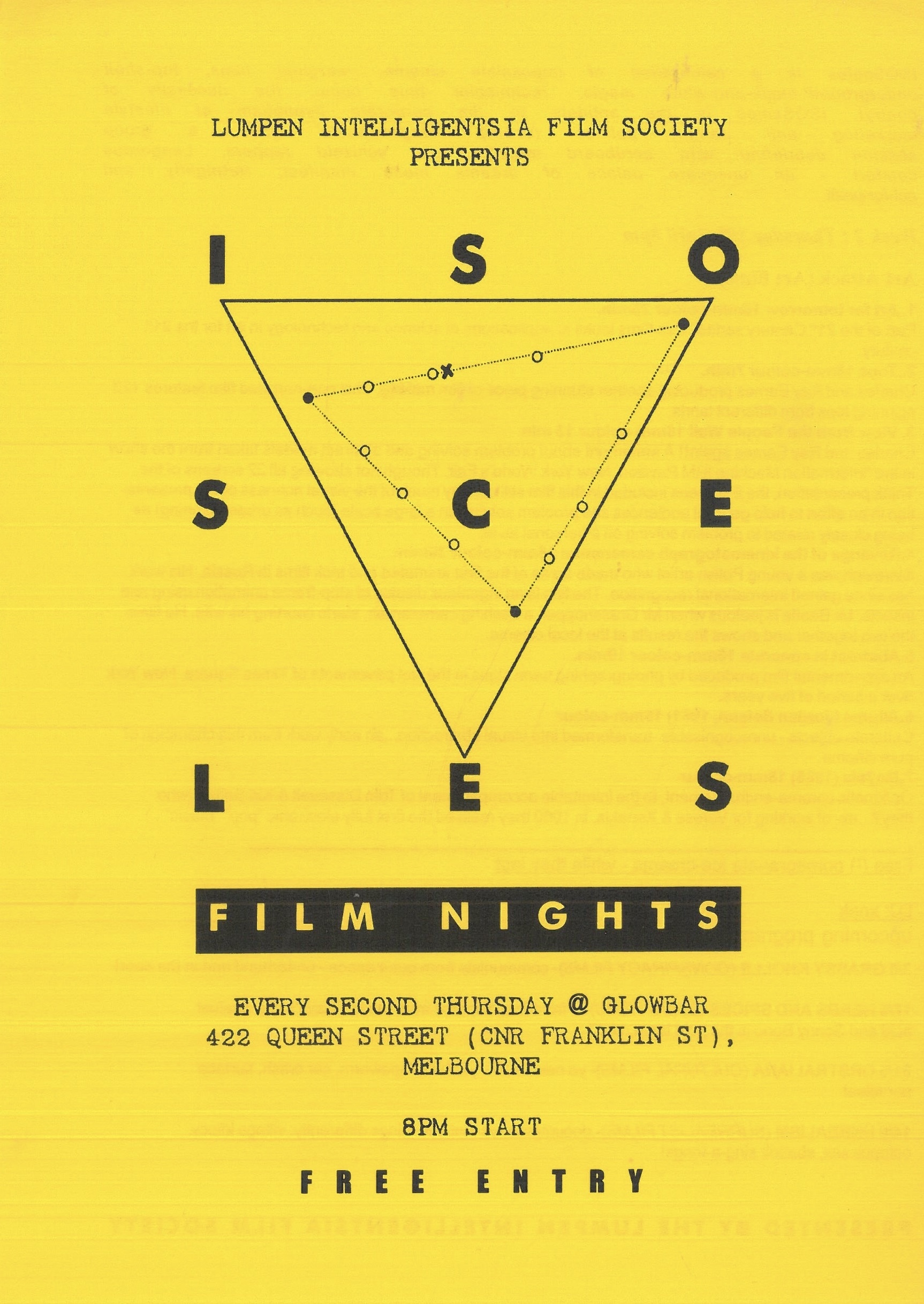
In his backyard, amongst the pumpkin patch and atop of the green bin, Knox whips out the endless folders with little preciosity. Every sleeve is bloated by an endless chromatic spectrum of paper paraphernalia. There’s the fluorescent yellow of an ISOSceles Film Nights flyer — a fortnightly, not-for-profit event, described as a ” … celebration of impossible cinema, marginal films, top-shelf underground, black-and-white magic, technicolour time bomb … [and] the necessity of poetry … the antidote to the corporate hypnotism of lifestyle marketing and haircut politics” — which Jim used to run alongside local record store figurehead Rob Bonica. An anaemic-looking one, entitled Cognitive Dissonance II: optical analogue of pleasing noise, which determines its celluloid curation by the noises the films make. Hemmed into every bill, a DJ: often under a mishmash of the (itself absurdist) English language: Quockenzocker (occasionally dubbed on other flyers as Kwokenzocker), Xonk, Fiasco, Private Benjamin, Ante-Diluvian Rocking Horse, one such Sad French DJ … Knox himself is guilty of deforming language into identities — having conducted most of his work under a range of pseudonyms.
The venues enclosed range from notorious bars such as Revolver to the (now defunct) Glowbar on the corner of Franklin Street; the top floor of a building down Flinders Lane, a friend’s loft, to Knox’s very own sharehouse-turned-venue — affectionately (and, still to his embarrassment) dubbed ‘Fort Knox’.
With 330 square metres at his disposal, Knox took it upon himself to build a stage inside and repaint the whole place — twice! Utilising the haul of expensive paints his housemate would bring back from his job as a runner on Spike Jonze’s Where The Wild Things Are (2009), each wall transformed into a rainbow of rich oranges, reds and screen blues. “I worked out [that] it’s two square kilometres of paint …” he muses.
“Some of the people there liked it and thought it was really cool, the stuff we were doing in there. Other people were like, ‘This is just a nuisance, there’s weird stuff happening, I’m not into it. There’s a mess, there’s a queue for the toilet, there’s trippers.'”
“I remember there was this one time we did a gig there … It was a record launch for Dave Thrustle[‘s] Black Lung, and for some reason everyone there was on acid … Hundreds [of them], and I remember someone took all the cutlery out of the kitchen and laid it all out. We had this big bench in the kitchen and [this person took it upon themselves to] sort all the spoons, all the forks, all the knives by size, I think? It was interesting, I guess, ’cause you can imagine how incredibly inconvenient that sort of thing would be in your house … If you come home from work and there’s three hundred people on acid in your house, and now all your cutlery is spread out, and … You just want to have a cup of tea and go to bed, y’know”.
Funnily enough ‘Fort Knox’ is now Kines café; its accompanying studio inhabited by a handful of my close friends. I have two tattoos from its recesses. My housemate fixes their cabinets. The coincidences don’t stop there: Knox and I used to live on the same street at the same time, just down the road from the warehouse. I can’t help but think of how trans-generational some experiences are, as the reactions of Knox’s housemates are a mirror to those who wander into the Ecoplex to this day — his do-it-yourself attitude a lifelong commitment. From the age of thirteen he was salvaging and selling vinyl. Before he’d even reached adulthood he was already programming for the Institute of Modern Art in Brisbane.
The death of a star

The lessons learnt from the gesture of projecting film are akin to the cut-up logic of his own practice. Knox recalls the Bruce Conner film he’d included — Mongoloid, from 1978 — a weird and wacky punk consolidation of of archival screen and sound in and of itself.
“… That print in Canberra [at the National Film and Sound Archive], there’s a burnt out frame, which is from when I screened it and it got stuck in the projector,” he recalls.
Much like a black hole tearing its way open in the universe, you can’t hear the film catching, the cosmic implosion incoming, and then — VOOMPH!
“Well, the thing is, most people I know who are projectionists — even though it’s really fucked, damages the film — [they’ll] say it’s really incredible to see it happen in real time, like you’re watching a flower bloom or the birth of a star … Maybe it’s not the birth of something, maybe it’s more like the death of a star.”
The Ecoplex encourages a way of watching that mirrors the fleeting, spectacular nature of a supernova itself. The impact lies in its real-time unfolding, shared and unrepeatable; its intensity bound to its disappearance. Like a sun waning away over billions of years into a white dwarf, it carries an older rhythm. Reincarnated is the communal anticipation of gathering around a radio, or huddling before a television set, waiting for something to begin.
As for the cataclysmic re-emergence of screening events across Melbourne?
“It’s an interesting scene…I actually think it’s much more interesting now. I really think [it should be documented]. Because it won’t last. It’s a thing that’s happening now and it will pass … Because if you think about something like Static Vision, [GalleryGallery Inc.’s] BBBC — Kinotopia could fit in there as well — Unknown Pleasures … You know, they each ha[ve] their curatorial remit.”
Knox’s championship for the new generation of Melbourne film societies reminds me of the audience at Artists Film Workshop screenings. There, the old legion sit right at the back near the projector to make way for fresh eyes. If anything, I find Knox’s reflection a hair-raising fulfilment to the prophecy made by Californian filmmaker Michael Mideke in December 1988. It is Mideke who declared:
“… The writing on the wall is plain to read. That complex marriage of chemical, mechanical and electrical engineering that is film no longer cost-effective in competition with electronic techniques of image storage and manipulation. By and large, small gauges first, the intermittent, claw-and-sprocket progress of film is giving way to continuous scanning and electronically defined frames. There are indeed areas where film still enjoys technical advantages but current research and development trends point firmly toward an ever more electronic future. The only scenario that I can see for a real resurgence of small gauge film calls for a society having both resources and wisdom to support the medium purely for the sake of its unique qualities. The fact that such a future scarcely looms on the horizon should not forestall individual and collective efforts to bring it about.”
When asked whether the scarcity aspect made screenings — such as those at the Ecoplex — more sacred, more special, Knox seems to nod at the absurdity of the whole medium of physical format film and music in general.
“… It’s why I like all this, strange arts and stuff, is ’cause I love the inconvenience of it and the wackiness … The idea of this disc that spins around and all you have is this, like, thing — arm — that’s got a little diamond on it and you drop that into the groove. It’s so wacky. It’s such a, like, crazy way to listen to music, you know … But it generates a little electrical impulse, and then gets turned into sound waves. That’s fucking bananas, I mean really — that’s a crazy idea!”
Melbourne has been diligent and devoted enough to protect its strong community of physical film formats. Collectives, such as the aforementioned Artists Film Workshop work to induct aspirant experimental filmmakers in the techniques of film developing and making, as well as regularly screening rare 16 mm prints often sourced from the NFSA.
Richard Tuohy and Dianna Barrie — both Artists Film Workshop mainstays — are responsible for running Nanolab. The new millennium marked the impending end of Kodachrome. Yet, the duo were resolute in its survival; and in 2005, their lab was established.
Volunteering their lifelong experience with the medium, the duo made attempts to process colour and extended their experience processing black and white Super 8 film by hand. All this, in the hopes that Kodak would grant Australia the new Ektachrome film that was coming to replace the precious — but unprocessable — Kodachrome. Their endurance paid off: with physical film now in resurgence. Kodak has been experiencing exponential sales. Classic film stocks are back on the market and being adopted once again by major industry players on high-profile productions.
It’s all ours for the taking
I often like to think of the analogue as an anatomy. It’s what makes this ephemera so intrinsically human. These are artefacts that will age alongside you; have a life of their own. I’ve often said that I want to age like my secondhand Pleasure Principles record. I want to have had a life, come across all sorts of people, been enjoyed, despised, have listening notes. With the tangible, there is not the same pretence of culture being monopolised by ownership as there is when we associate Daniel Ek with Spotify, Steve Jobs with Apple, Bill Gates with Microsoft. Who the fuck knows who invented the CD? The vinyl? The DVD? The reel of tape? Who the fuck cares? As Chytilová declared, it’s all ours for the taking.
Physical formats, live gigs and screening events encourage you to be curious — to explore, to read that blurb, to judge that cover, to ask for that title, to dissect what it is about that thing we love. Consuming this way encourages relationships with our surrounding environment and community in a manner that feels fundamental to our primitive human needs: a grounding connection to place, where we forfeit the need to control and allow ourselves to be at the whim of another, to the elements, to accept the cycle of life, open ourselves up, and in turn, to find love in the place we least expect.
At the end of the night, Knox hands me the 2009 Fall/Winter edition of Soundscape: Sonic Displacement: The Journal of Acoustic Ecology, a publication he helped edit. Inside I find an article by Michelle Duffy and Gordon Waitt entitled Aural (re)locations: Listening to place. Immediately, I am struck by the closing line of its first paragraph: “… In our thinking about the interconnections between bodies, place and sound: what is it about the qualities of sound that enables us to inhabit space, to call a place home?”
I begin to wonder: are we currently dispossessed? Witnessing the shifting soundscape of Australia is like staring helplessly at the ruins of a great and ancient city. The death of seemingly-immortal music festivals over the past three years — Bluesfest and Splendour in the Grass amongst them — has been a jarring reminder of how at the mercy we are to corporate monopolies and policy failures.
In the wreckage, Meredith and Golden Plains become even more sacred; the last minute scramble for tickets like something out of Wonka’s Chocolate Factory. These efforts, all for the chance to have a weekend of no advertisements, no dickheads, and all communal feeling. The festival’s single-stage setup encourages convergence; the intermissions between acts functioning as a fertile platform for DJs from community radio stations such as Triple R. There is an allowance for BYO, offering significant cost savings for its patrons and, on the whole, less commercialism — and as such — there is an oasis to be found in the shire.
On the last day of Golden Plains, I sit with my friends. One, funnily enough, is a tattoo artist from the studio that once was ‘Fort Knox’. The caravan is sobering in its daytime emptiness. The place does not feel the same without its people; feels hollowed out. I’m half-waiting for the phantom of Jim Knox to appear behind a trestle table, offering me paracetamol and pistachios and a place to sit. My friend Ava is on one of the logs collecting bugs I’d typically dismiss, noticing elaborate spirals where I see nothing but the usual antennas — and I think to myself; much like beloved friends, the experiments at the Ecoplex make you see the world differently — and different ways of seeing the world make life a kaleidoscope of colour.
The 34th Meredith Music Festival runs 11–13 December 2026. Head to mmf.com.au to become a subscriber.