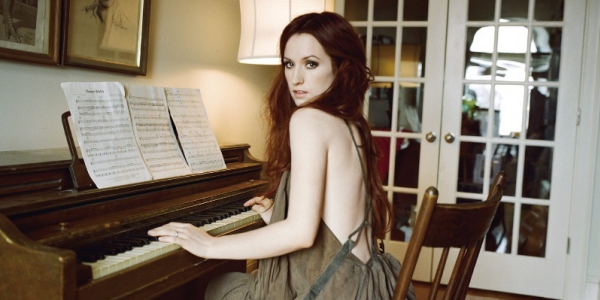
“In life we change and we grow, we experience different things, big moments, things happen that shift us for the worst or the better,” Ingrid tells me down the phone as the start of her explanation of her very deliberate change of direction. “As a writer and an artist, something is either added to you or something is taken away from you, and it changes you. So I think you become a different person with each thing that happens. So I am not the same person I was last year, I am not the same person as when I wrote my first song. If you allow yourself to view things differently as you go along I think the rest is going to fall into place and you are not just regurgitating.” It was in this context she started work on new material. “I wanted to change my sound,” she says. “I have had a lot of success with TV commercials and things like that and I feel like that out of all my songs, I have probably written close to 50 or 60 songs that are out in the world, out of all of those there are four that get licenced over and over again. And people judge me on two of those four. I get put into this box – this is the kind of music you make, this jingly, happy stuff – and those are the tip of the iceberg, there is a lot more going on. But people don’t care to look any further, that’s fine. If they hear that one song and like it, fine, if they hate it that’s fine too. Life is what it is and I am very fortunate to be where I am. But on this record I wanted to dig deeper, I don’t want to be just seen as the girl that writes the cute, little songs. I know people love that still and want that, and that is why there is a back-catalogue, so they can enjoy that part of my music because it will always be there for them. But you can’t keep doing the same thing over and over again, well you can but it gets boring. So I wanted to embrace the idea of thinking bigger, not being as contained.”
The album is bigger, with far more orchestration, which can be credited to her working with producer David Kahne (Regina Spektor’s Begin To Hope, Paul McCartney, The Strokes and he was even the producer of the Goonies soundtrack).”At the beginning of the recording, which was ongoing for about nine months, David said, ‘I want to know why you don’t sing live, on your records you are very contained and safe. When I see you live you really go for it.” Ingrid explains. “I had never realised I was doing that, so I took it as a challenge and it sparked all these new ideas in me and I wrote the entire record in the span of four months. I was inspired to sing out. In singing out and allowing my voice to go to these places, I opened up my brain and lyrically put things in a different light too.”
These new places are the also the changes that have taken place in her life, which gave the album its title. “I fell in love and married somebody, what makes you more human than that,” she challenges me. “Somebody that makes me feel alive and part of the human race. I think that when you find real love there is something really final about it that is also really frightening because “I am with this person and I am going to die with this person.” It squishes your life perspective. The record isn’t all I’m in love and I’m so happy, there is a lot of weight to it also because that is what life is also.
For the daughter of a sculptor and a composer, Michaelson had a very musically sheltered upbringing. All she knew until she was a teen was her parents’ choice in music – classical, some Beatles and some hymns (thought not a religious family), and classic ‘50s musicals. “I didn’t know anything,” Ingrid laughs. “I remember my friend loaned me a Madonna tape, when I was 12 or 13. Up until then I guess I had subscribed to what my parents had said, which was ‘All pop music sounds the same’,” she states, impersonating her father. “It’s ironic that now I write pop music, but when I got this tape I thought, ‘they all sounded the same’, but I fell in love with them. It was the album with La Isla Bonita [True Blue], I listened to that tape over and over. A few weeks later I got a radio for Christmas, I would listen to the radio, it had a tape player in it, so I could record songs, I would listen to the radio and my head exploded, “There is so much music out there.”
BY JACK FRANKLIN