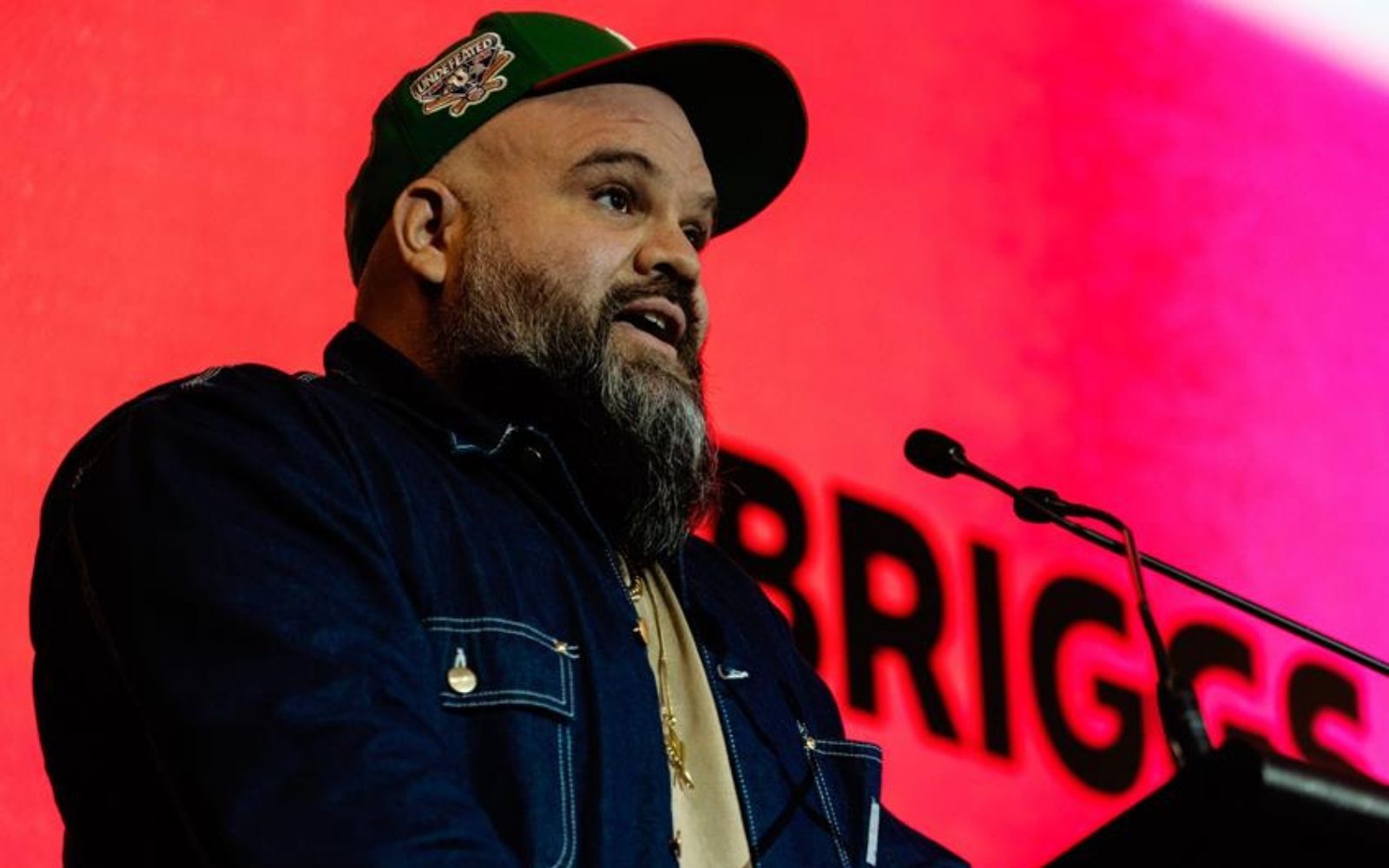
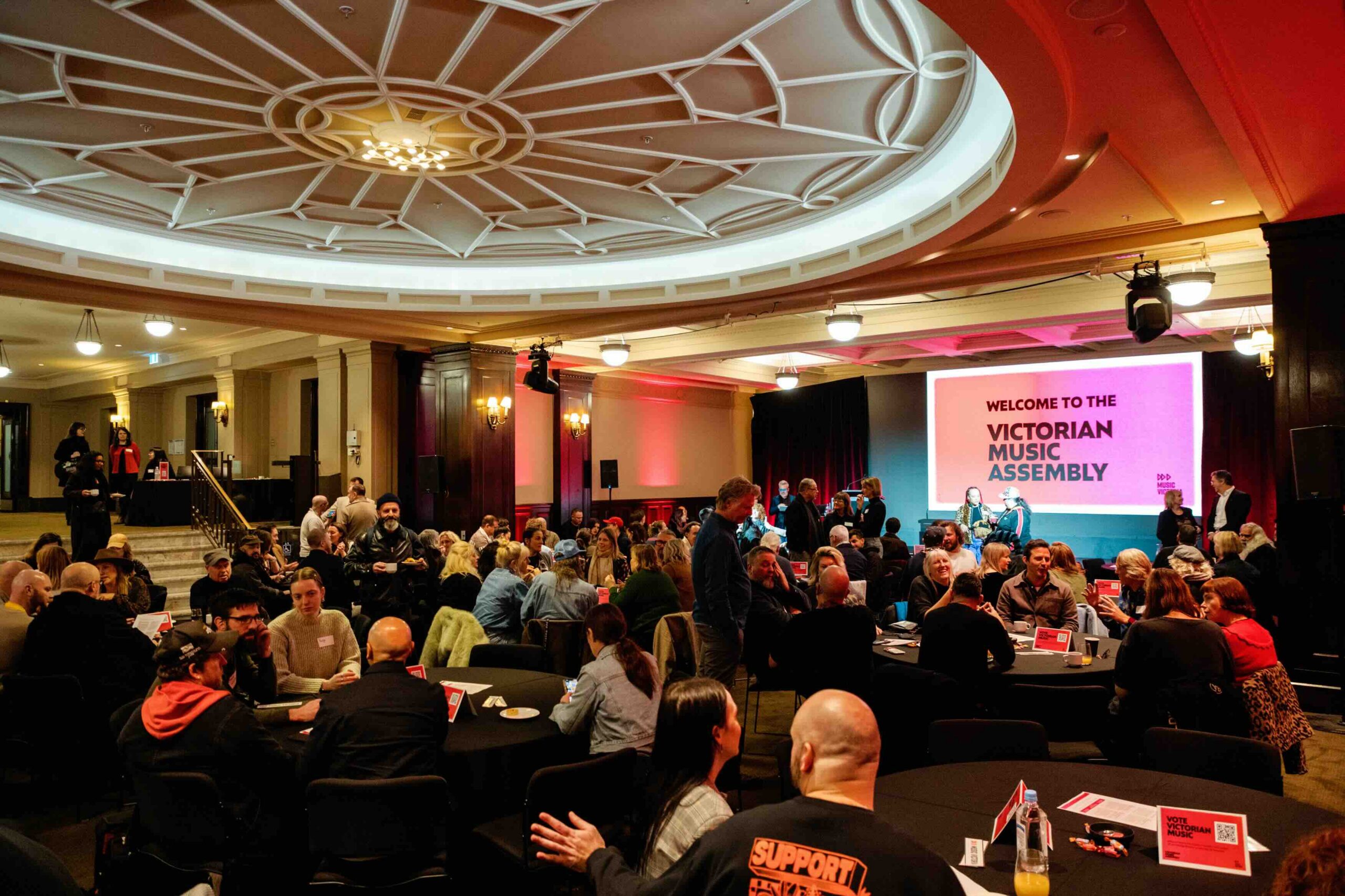
More than 150 industry figures filled Melbourne Town Hall to put four asks and a legislated levy in front of every party contesting November.
Victoria spends 48 cents per person on contemporary music. New South Wales spends $3.10.
That number, more than any other, is what more than 150 music industry leaders and representatives brought to Melbourne Town Hall yesterday.
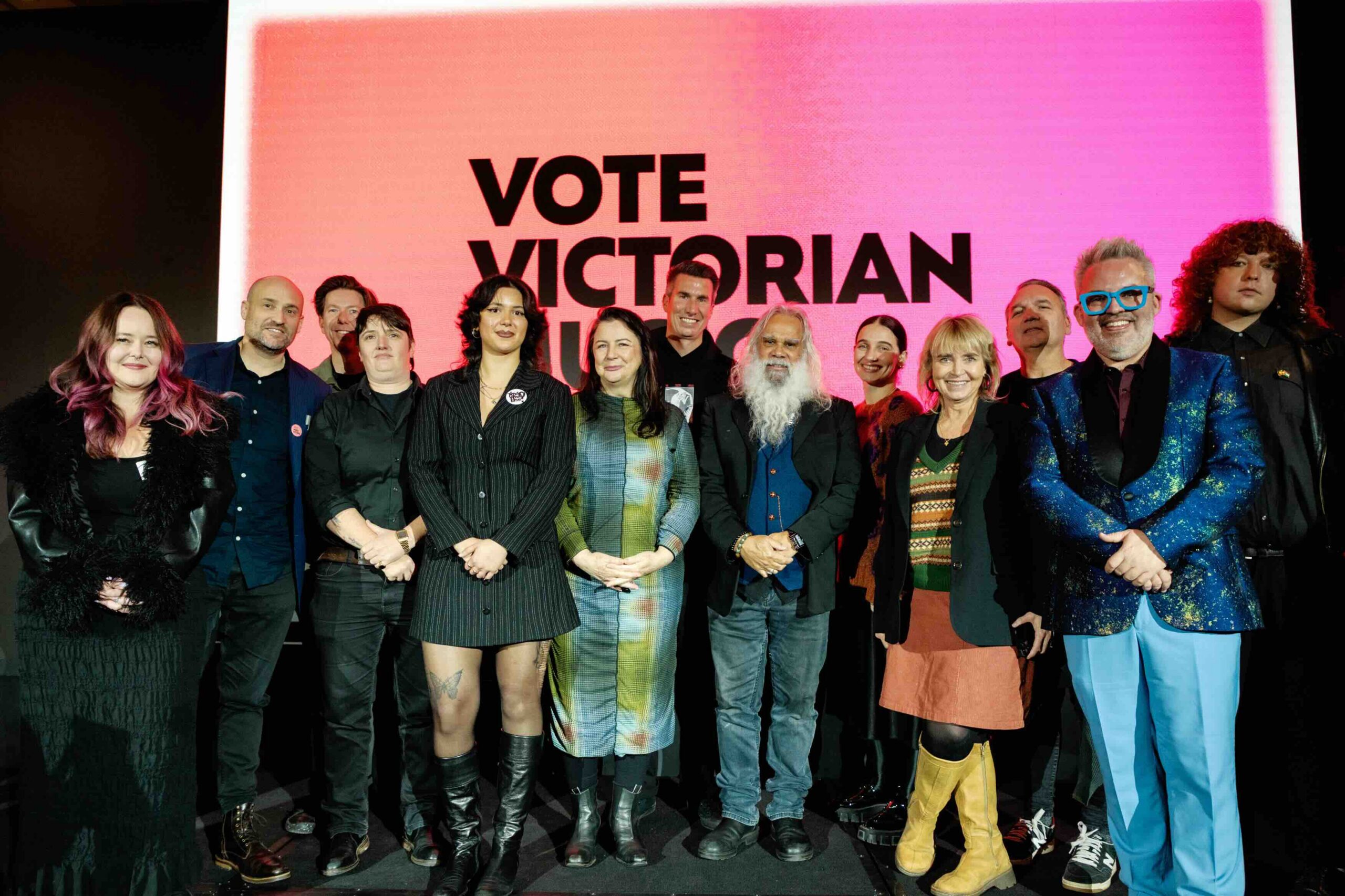
The occasion was the Victorian Music Assembly, one of the largest gatherings of its kind in years, and the launch of Vote Victorian Music – a sector-led campaign asking every party contesting the 28 November state election to commit to a permanent Victorian Music Trust.
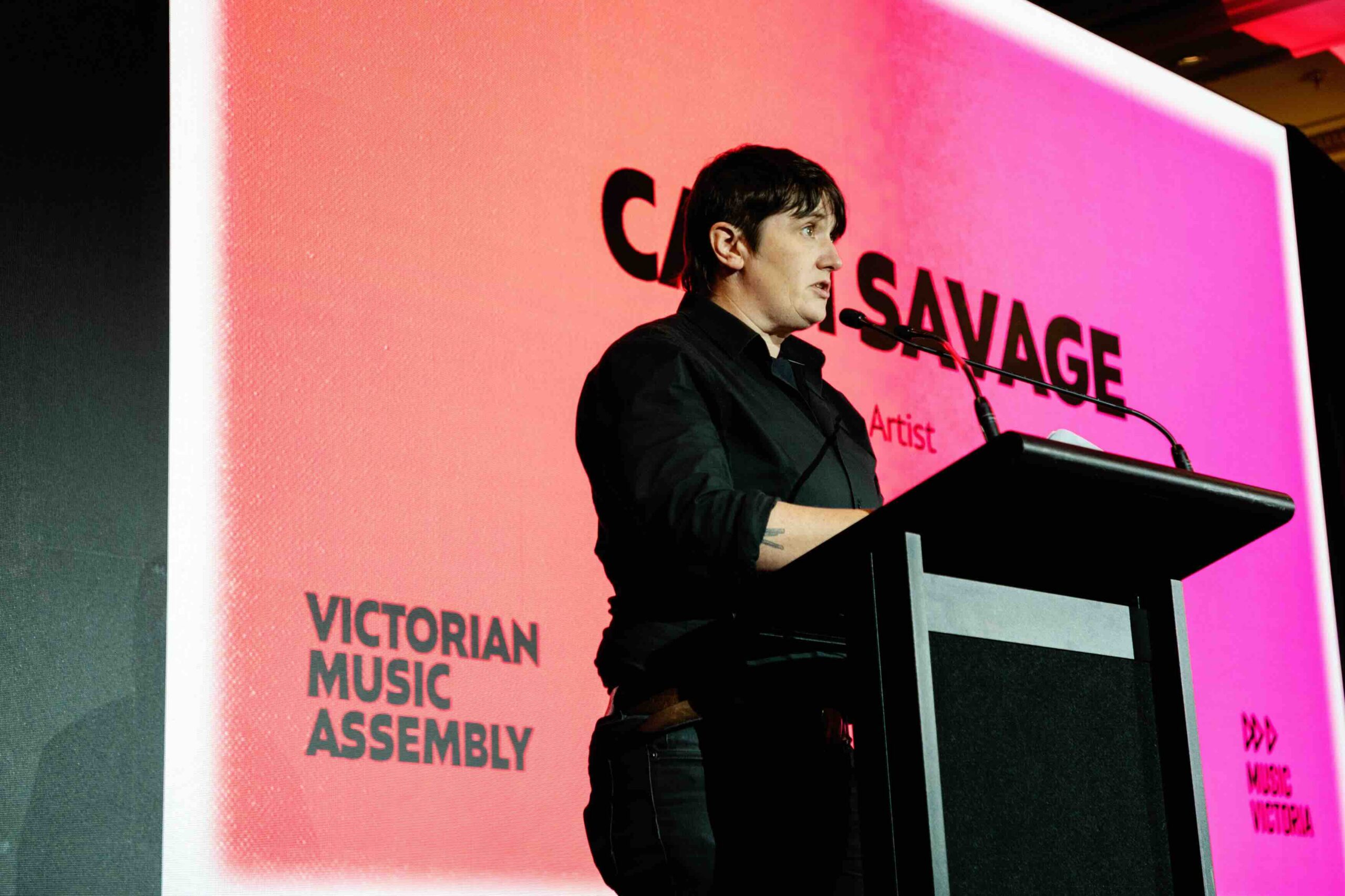
Briggs, Cash Savage, Public Figures, Robert Baxter, Jaddan Comerford and Nina Las Vegas all spoke. The room ran from Yorta Yorta hip hop, to Naarm punk, to label executives, with the campaign attracting wide industry support for the proposed changes.
The four asks, at a glance
- Invest – establish a permanent, legislatively protected Victorian Music Trust. Approx $4.4m a year once running.
- Support – lift contemporary music investment to at least $9m a year, committed across multiple years.
- Grow – build careers, skills and audiences statewide, from classrooms to regional touring. $6m a year.
- Protect – gazetted Live Music Precincts, regulatory reform and infrastructure investment. $8.5m a year.
Total: $28.5m a year, or $114m over four years, with Trust revenue arriving from Year 2.
Stay up to date with what’s happening in and around Melbourne here.
The Trust: 1% of the big shows
View this post on Instagram
The centrepiece is an independently governed fund, protected by legislation, sitting inside the Creative Industries portfolio but outside Creative Victoria. It would be bankrolled by a 1 per cent levy on ticket sales for major live music events at stadiums, arenas and government-owned venues.
How it would work:
- Rate – 1 per cent, set in legislation, reviewable as the major-event market grows
- Coverage – defined by venue capacity, annual ticket revenue and government ownership, not a fixed list of rooms
- Exemptions – small operators, low-cost events and all-ages activity, which draw from the fund rather than pay into it
- Collection – at point of sale through existing ticketing systems, remitted quarterly. No new infrastructure required
- Estimated revenue – $4.4m a year, within a $4m to $7m range depending on touring activity
Music Victoria chief executive Fiona Duncan framed it as the missing foundation under an industry surviving on annual announcements.
“Victoria has one of the strongest and most distinctive music industries in the world, but we are relying on short-term programs to support an industry that needs long-term confidence and investment,” she said.
“A Victorian Music Trust would create a permanent foundation to rebuild the grassroots, support sustainable careers, protect venues and invest in the next generation of Victorian music.”
The overseas scoreboard
The precedent is mixed.
- France – legislated levy on contemporary music and variety ticket sales, running two decades
- UK – voluntary contribution on arena and stadium tickets from 2025. By year’s end, only 8.8 per cent of eligible tickets carried one
- Germany – voluntary fund announced in 2025, commencing January 2026
- Watching closely – Cologne, Bristol, and the NSW government
That UK figure is the argument for legislating rather than asking.
There’s federal cover too. The House of Representatives Standing Committee on Communications and the Arts handed down its live music inquiry report in March 2025, with Recommendation 4 calling on the Australian Government to add “a small levy to the price of tickets to large music events”.
A national scheme would spread that money nationally. A Victorian one keeps it here.
655 rooms, down from 813
The venue data is stark.
Victoria had 2,441 live music venues in the 2025 audit covering 2023 data, 45 per cent of them regional. But rooms presenting music every week fell from 813 in 2019 to 655 in 2023 – a drop of 19.4 per cent. The trend hasn’t slowed since the audit cut-off – Collingwood’s Bendigo Hotel announced its closure this month.
Where it hit hardest:
- Metropolitan Melbourne – down 25.8 per cent
- Gippsland – down 47.6 per cent
- The Grampians – down 86.2 per cent, from 29 venues to four
These figures come from 2023, after the sector had fully reopened, with rooms that shut temporarily during the pandemic and returned counted as active. Structural losses, not lockdown hangover.
Hold that rate and the platform projects under 400 venues presenting weekly by 2030, less than half the 2019 count.
48 cents a head
The per-capita comparison is where the pitch aims directly at Victoria’s state government. It’s an even sharper version of the line Music Victoria took after this year’s state budget, published here.
- Victoria – $0.48 per person, per year
- South Australia – $1.46
- New South Wales – $3.10
Line up the institutional funding and the gap holds. The Victorian Music Development Office runs on $750,000 a year. Sound NSW received $20 million in 2025–26 to deliver that state’s contemporary music strategy.
Music Victoria itself gets $275,000 a year in core funding, less than any state peak body except the ACT and Tasmania. The platform seeks about $2 million a year for the organisation, which co-authored the document.
Against all that, the sector generated $483.9 million in 2023 and accounted for 31 per cent of Australia’s live performance revenue and attendance.
“Victoria does not need to create a music industry,” Duncan continued. “It needs to stop taking its success for granted and build the permanent foundation that allows it to thrive for decades to come.”
The missing middle
Ask Two wants contemporary music investment lifted to at least $9 million a year, committed across multiple years.
Inside that expanded pot sits a Music Career Sustainability Pilot – two years of predictable support for a defined cohort of mid-career artists, openly selected and independently evaluated. It targets what the document calls the missing middle: too established for emerging artist funding, too independent for commercial pathways.
Also in ask two:
- A dedicated business development stream for managers, labels, publishers and agents
- Funding for creative work not tied to near-term commercial return
- Government-funded campaigns and events to commission Victorian artists first, out of existing budgets.
Precincts, insurance and the Night Cat problem
Ask Four carries the regulatory teeth. It wants priority Live Music Precincts formally gazetted across metropolitan and regional Victoria, with coordinated settings for planning, noise, development and night-time activity.
Precincts would go further than Agent of Change, which handles land-use conflict venue by venue. Inside a gazetted precinct, the platform wants the burden of proof in noise and planning disputes shifted onto the objector – so established rooms aren’t made to argue their right to exist where live music is designated policy.
The case study. The document says a noise dispute at The Night Cat, initiated by a nearby residential developer rather than a longstanding resident, cost the Fitzroy venue roughly $100,000 in a single financial year:
- $30,000 in legal fees
- $30,000 in soundproofing works
- $20,000 in acoustic assessment
- $20,000 in monitoring equipment
The venue crowdfunded to stay open. The platform’s line: it did everything right and still nearly closed. The venue ultimately won at VCAT in August 2025 after proving it was operating within its permit conditions – we covered that outcome here.
Insurance gets its own recommendation. Music Victoria’s venue roundtables identified public liability cover as the single most acute structural barrier facing venues – premiums climbing, few insurers competing, risk classifications untethered from claims history. The ask is a formal government investigation, with pooled or government-backed models on the table.
Plus a permanent Live Music Desk inside government to coordinate planning, licensing and permits across agencies, and finalised EPA noise guidance.
Classrooms, traineeships and community radio
Ask Three runs $6 million a year and begins in schools:
- More classroom and instrumental music, with proper support for the teachers delivering it, prioritising regional and outer urban schools
- Paid traineeships in live production and technical roles, tied to placements and progression rather than run as a standalone grant round
- Connected regional touring routes and support for local promoters, so touring outside the city becomes viable
- Community radio – Triple R, PBS and SYN – treated as infrastructure and included in workforce and audience investment
- Targeted backing for recorded music, rights, screen, games and export
The last point is particularly prescient from an economic perspective: Victorian composers account for 40 per cent of Australia’s screen composition workforce and 70 per cent of its game composition workforce, with almost no targeted state money behind either.
What happens now
Music Victoria will seek a formal response from every party contesting the election. In the meantime the existing programs keep ticking over – applications for the third round of 10,000 Gigs are open now.
That lands with Vicki Ward, appointed Minister for Creative Industries in April, and with a government that has already committed to a contemporary music strategy, which Creative Victoria has begun developing.
Victorians vote on 28 November. Read the full policy paper here.