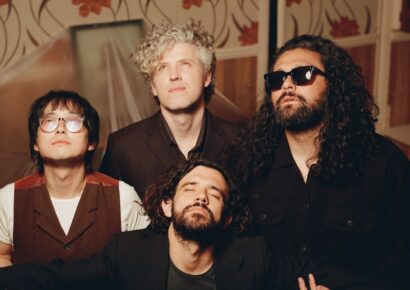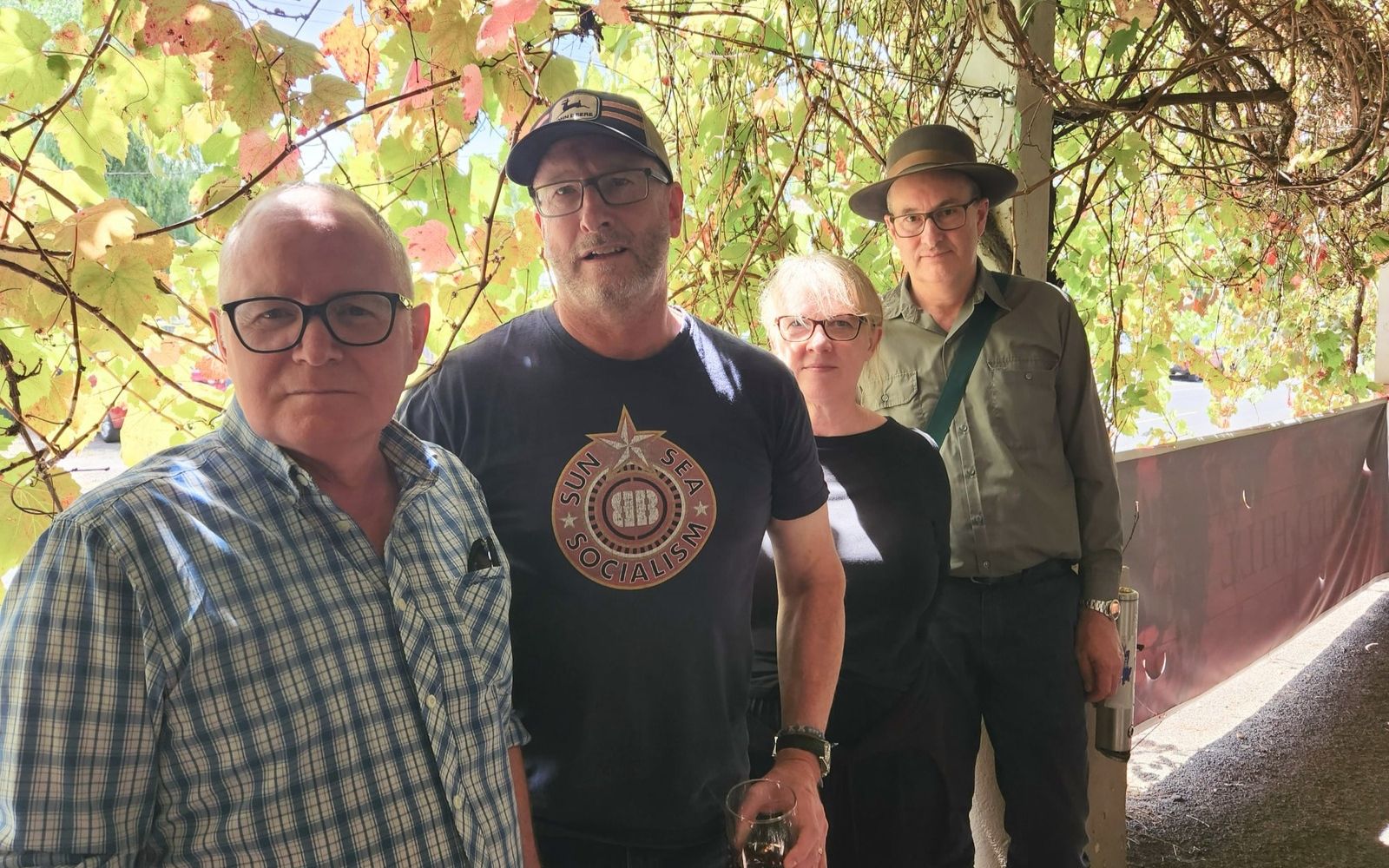
Melbourne’s The Cat’s Miaow have prowled the underground since 1992, and their debut album is finally here.
To be “the cat’s meow” is to be considered outstanding. Fittingly, to be The Cat’s Miaow — Kerrie Bolton, Bart Cummings, Andrew Withycombe and Cameron Smith — is to position the old American idiom south of the equator. It is a persistent outward-facing inwardness.
The Cat’s Miaow have prowled Melbourne since 1992. Yet When You Smiled and Turned Away is their debut album, its bashful, considered tracks rendering the thirty-four-year hesitation only natural.
The Cat’s Miaow
- Debut album launch
- The Retreat Hotel, Brunswick
- Sunday 25 October
- Tickets here
Check out our gig guide, our festival guide, our live music venue guide and our nightclub guide. Follow us on Instagram here.
View this post on Instagram
At a time when online presence is a necessary evil for sustaining a career in the arts, The Cat’s Miaow use their platform to nerd out. Rather than endless self-promotion, their Instagram stories are a jukebox program of influences.
Their bio is just as self-deflecting: “Loved releasing 7″ singles. Playing live, not so much”.
The band’s public playlists unlock a private room in a mind palace. An “Artist’s Pick” titled Plays Well With Others is an odyssey of its members’ other endeavours and a disclosure of intended purpose.
Curations such as In my room, Teenage symphonies, I wear a clean shirt every day, songs to learn and play serve as the bedroom mirror to When You Smiled and Turned Away’s own song titles, lyrics, influences and manner of production.
In turn, the forthcoming album is a continuation of the band’s train of thought.
Where their ambient project — Hydroplane — plunges its listeners underwater to observe a distorted version of a familiar reality, When You Smiled and Turned Away is the band unpacking themselves as a curio in order to find clarity. Their findings are professed in the first person, as if to slide over and offer the listener a glimpse.
Andrew says of his bandmate: “Bart makes it sound like there is someone behind the curtain.”
Four-track dreams and cups of tea
Their songs are recorded as such, with the band’s raw inception wound on Withycombe’s four-track in suburban Melbourne. He explains:
“… We partially looked at [our releases] as demos. I mean that seemed to be a mindset, where you would put out a demo cassette and then you would go and do a proper recording.”
“And we did sort of try that, in that our first single, we went to a studio … But then after that we didn’t, I don’t think we really enjoyed the experience … We preferred to work at our own pace at home and then we realised that the things we did for cassette we could put on record.”
“There was a point at the end of ’93 … We’d done a lot … Four cassettes over the two years …” Bart adds. “And I was just like, ‘Actually, I like the home-recorded — the four track recordings sound like us … And I’m not hearing anyone else it sounds like … The only time we sounded like that was in that studio.'”
“So, from then on, we just put a little bit more care into the home recordings … But yeah, it was the thing of not having to go through a third-party that sort of dilutes or changes your sound as well is really appealing …”
“And the cups of tea,” Kerrie inserts, “And doing it at our own pace.”
Much like these makeshift studios, the band have historically surrendered themselves to the scavenge: being found as much in the improvised cardboard display case at Polyester Records as by chance on a compilation.
Kerrie recalls with a giggle their tentative first release: a double album from 1992 titled Little Baby Sour Puss.
“What was it, a twenty cassette run, the first time? Twenty cassette ruuuuuun!”
Demo forever: the economics of being The Cat’s Miaow
By virtue of their perennial “demo” status, The Cat’s Miaow are a treasure in a music industry inclined towards artificial scarcity.
After all, it is this concept that is a panic response to the digital age of streaming and its delusion of unlimited access. The band? The timeless adage of “if there’s a will, there’s a way”, slotted into a sleeve.
The manufacturing of desire raises the question: is the DIY ethos so cherished by those considered “independent” simply synonymous with the way in which creatives often hold reverence for “suffering for one’s art”? Of proving devotion through one’s ability to endure?
Moreover, we often assign more cultural and monetary value to the ephemeral; the lower the number of surviving copies often correlating to a higher appraisal on Discogs.
Hypnagogic pop, dolewave and the art of recycling
One is reminded of the “hypnagogic pop” concept coined by music writer David Keenan. Defined in the 2009 The Wire article Childhood’s End, it is “… Pop music refracted through the memory of a memory … The headspace of the moment just before you go to sleep as a child, while somewhere in the distance the sounds of pop and disco come muffled through the wall and infiltrate your subconscious.”
The identifier holds a mirror to the quintessentially Australian genre of dolewave; a sound described by critic Everett True as “… Slightly doubtful of itself and its surroundings, recalcitrant and ramshackle … Music that also comes directly out of the ‘makeshift venue culture’ … Born out of necessity in the big Australian cities.”
Considering the economics of it all, it is unsurprising that dolewave is connected to The Cat’s Miaow. Down to the very name, the genre is evocative of the poverty so intertwined with an arts career, its practice of recycling.
Akin to working-class Teddy Boys repurposing Edwardian frills, the dolewave generation regurgitate the jangle-pop hiss of 1980s Australian bands and New Zealand label Flying Nun Records.
Resurgent is the tendency towards lo-fi recordings: a cassette tape the insignia worn as proudly as members of Monnone Alone do The Cat’s Miaow T-shirts. The evidence is smeared all over the merchandise table of their collaborative gigs.
In reviving the original context behind limited releases, these bands remind listeners how cultural reinventions often synchronise with wider socio-political and economic discontents. T
hough often perceived as contained within the immediate context we find ourselves in, these reinventions are merely the same happenings written in a different font elsewhere.
For instance, the band’s foundational experiences parallel those of the British band Dolly Mixture. Just as the three-piece packaged copies of Demonstration Tapes themselves, numbering each LP and branding them with a pink pen, Andrew recalls that he and Bart “were in England in the mid-90s … We stayed with the guy who ran Wurlitzer Jukebox and he’d hand-stamp the labels”.
Both bands, too, have had reincarnations of their early recordings, giving impetus to the likes of Chapter Epilogue — a sub-label of Chapter Music intent on bringing rare vinyl, cassette and CD releases into the digital sphere.
The band often appear on other people’s releases and compilations, and are associated with not one but fifteen interchangeable labels.
The band themselves come first, regarded as a musical entity in their own right rather than as the source of a single popular album or label. It is “pop” in the sincerest sense: reverence, rather than a pining for commercial success.
The narrator at the heart of The Cat’s Miaow
The structural foundations of the band are this very sentiment. The songs Kerrie embodies through clenched and unclenched fists are actually written by the other members. Thus, she is positioned less as a protagonist and more as a narrator.
“Just for me, personally, my personality … I don’t know, I really love doing music. I just don’t need it to be about [me],” Kerrie reflects.
Perhaps her sentiments are why she recoils at the mention of When You Smiled and Turned Away’s album graphic — the first to bear a glimmer of their image. Even then, it is partial coverage.
“[Bart] said, ‘Hey, can I use a bit of one of your pictures?’ And I thought, look, I’ve never even put a whole picture out before, just little snippets,” Kerrie exclaims, pivoting to Bart. It’s an exposé tit-for-tat. “And you said, ‘Can we put it out?’ and I guess ’cause I don’t think of us as a big thing, I did not expect it to be everywhere …”
“… Every time I’d look on Instagram, my face was there! And then somebody went and used the whole painting — it’s not even good! Like … I did a course … I did like a self portrait class, ’cause I enjoy painting and um yeah … This was not my intention!”
There remains a tendency towards the presence of a hand rather than a body. As surmised by the cassette insert of Eat Your Greens, fashioned by dolewave lineup companions The Sprouts:
“This is homegrown music from the sill above the sink … Made by those who sing softly, songs of joy lined with linoleum and olive oil. A tape that begs the big questions, like, when was the last time you sang with your Mum? And, when was the last time you danced with your cat?”
The aroma of hypnagogic pop’s TV dinners lingers in the nostalgic veneration of The Cat’s Miaow present in The Sprouts’ discography, where local subcultural landmarks such as Dangerfield are a pit stop on the journey of self-discovery.
In this way, pop-cultural references serve as the cushion to fall back on. For instance, when unpicking the details of their stint in England, Andrew gets his bearings by inquiring: “Was that just before the Stereolab split or …?” Cultural references, such as the descent of Skylab in The love you bring, nail down the otherwise fleeting moment.
It is the view of a true artist: the world through the lens of their craft. After all, consuming arts and culture can be as much a part of our lives as having breakfast — the track recommended to you by a lover becoming as much a part of the memory of that person as the person is of the song.
Upcycling the past, one back catalogue at a time
Through everything, an upcycling of the past. The love you bring, for instance, was originally released on Hydroplane’s Selected Songs 1997–2003.
“We are dipping into the back catalogues of our other bands [and] redoing them as The Cat’s Miaow,” Bart declares. “CBGBs is a Bart & Friends song. Dull Light from the recent split single was originally done by The Ampersands. We’ll be doing more in the future as a way [of] bringing some under-appreciated songs some love.”
He then sends me an image of The Shapiros’ Gone By Fall: The Collected Works of the Shapiros. Expanding ever outwards on the record’s insert is a family tree of the band members’ contributions to other projects. One imagines being a star emerging from a greater constellation.
At its very epicentre is The Cat’s Miaow, though Bart is quick to insist that “… In reality, we were on the periphery.”
The trepidation building towards the release of When You Smiled and Turned Away speaks volumes about an enduring desire for contemplative moments in a world that demands so much of us. Sanctity is afforded in the reprieve of a passing daydream, projected outwards through the window and juxtaposed with our own coy reflection.
The universality of these feelings explains the tendency towards mending the disconnect between conceptual present and reachable past, a sense of relief when we grasp The Cat’s Miaow.
You can catch The Cat’s Miaow at The Retreat Hotel on Sunday October 25. Tickets here.