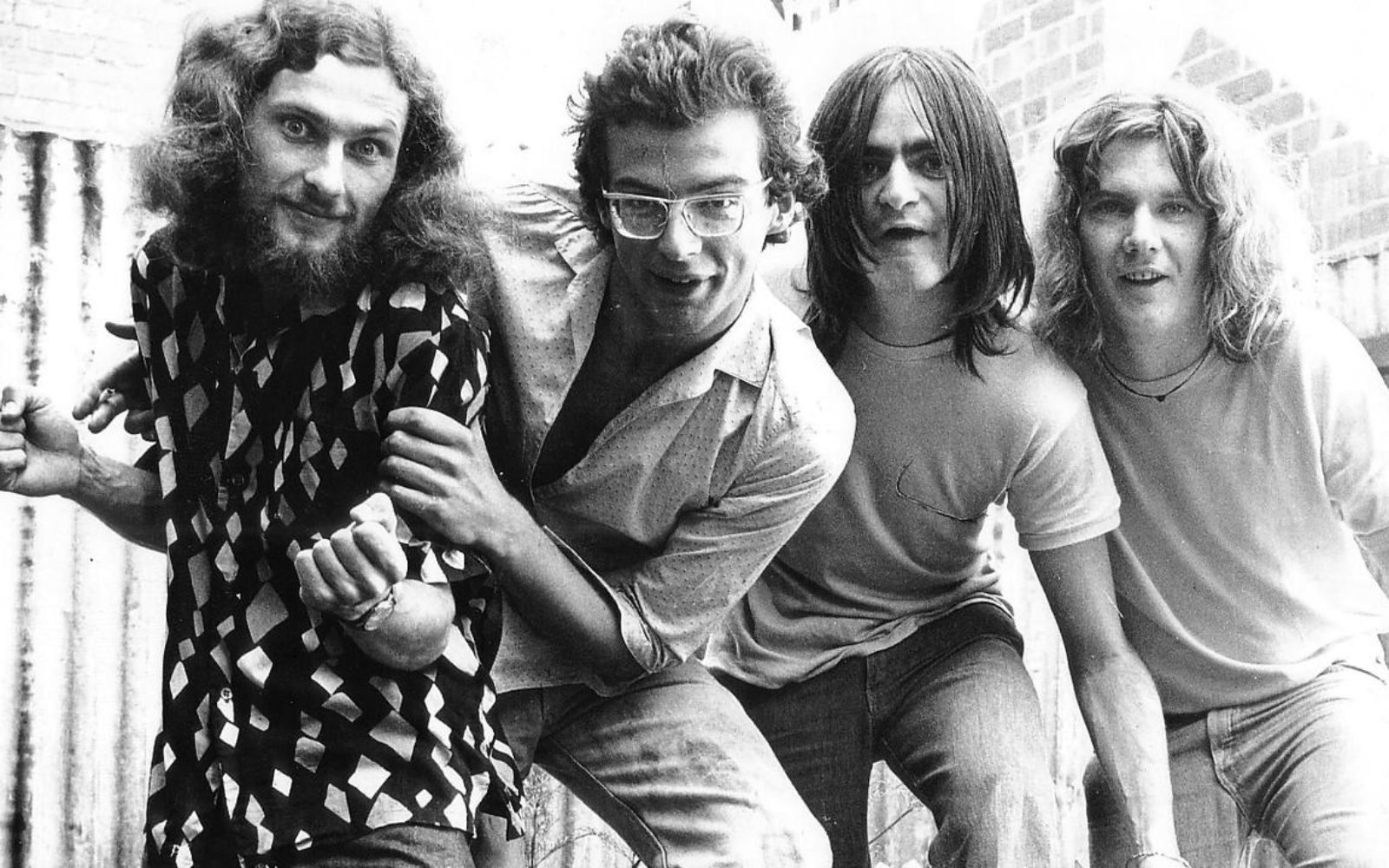
For a songwriter, the comment 'that sounds like…' is a bit of a mood-killer, especially if they’ve been secretly planning how to spend their next million bucks.
The better the riff or melody, the more worried the creator is that they heard the tune somewhere, forgot it, then recalled it in a blaze of faux ‘creativity’. But hey, that’s showbiz!
Such was the case in 1970, when Daddy Cool founder Ross Wilson composed the opening riff to their hit debut single Eagle Rock while teaching himself boogie-style finger picking. He spent a few days asking people in the Surrey house he was sharing if they had heard it before. ‘’I thought I must have pinched it from somewhere,’’ he said on the ABC’s Long Way to the Top documentary.
Keep up with the latest music news, features, festivals, interviews and reviews here.
Wilson had been living and performing in England when he stumbled upon the opening riff. The title of the song was inspired by a photo Wilson saw in a Sunday Times music lift-out, of a group of people dancing in a dirt-floor juke joint in America in the 1930s. The caption read, ‘Some (African Americans) cut the pigeon wing and do the eagle rock’. When Wilson got back to Melbourne after backpacking across Asia with his wife, he had the song’s title, the riff, and a few lines. He quickly worked out the chorus of ‘’Hey hey hey/ good old Eagle Rock is here to stay’’, and finished the rest of the lyrics. The song, augmented by Ross Hannaford’s rolling hammer-on rhythm guitar and the super-tight rhythm section of Gary Young on drums and Wayne Duncan on bass, was an instant hit when they played it live.
Daddy Cool was a 50s style throwback band with an emphasis on fun. Formed initially as a bit of a joke, it was an antidote to the seriousness of many ‘’progressive’’ and intellectual Australian bands at the time such as MacKenzie Theory and Tamam Shud. Wilson’s own bands, The Party Machine and later, Sons of the Vegetal Mother, were themselves serious experimental bands of similar style, but Wilson had also enjoyed playing 50s doowop-style music with a southern country boogie edge. Songs like Lollipop and Cherry Pie had long been on his playlists, and Daddy Cool had co-existed with Sons of the Vegetal Mother, playing alternate sets to provide a little light relief. Soon, Daddy Cool’s popularity rendered the Vegetal Mothers irrelevant and that band was quietly abandoned.
The band’s big break came when child-prodigy guitarist and newly-established record producer Robie Porter, recently returned from the USA, saw the band perform at a 7 May 1971 gig in Melbourne and immediately signed them for his new label Sparmac Records. Things then moved quickly! Eagle Rock was recorded in only four takes at Armstrong Studios in Melbourne in May 1971, as part of a rapid two and a half day recording session for the band’s debut album Daddy Who?…Daddy Cool. The tapes for the single were then taken to the USA by Porter for mixing by a brilliant sound engineer remembered only as ‘John’, which resulted in the song’s unusually crisp, clean sound, which still sounds fresh today.
The iconic black and white film clip of the band in several Melbourne locations was by 23-year-old Melbourne filmmaker Chris Löfvén. The opening scene in which Wilson enters a fish and chip shop to be greeted by bassist Wayne Duncan serving behind the counter, and Hannaford, Young and two young women sipping milkshakes, was filmed at the Dolphin Café at 293 Clarendon Street, South Melbourne on Löfvén’s 16mm Bolex camera. The shop, chosen because it had a real jukebox, continued operating as a takeaway business for decades. The Aussie Burger Bar near Luna Park in St Kilda (now a McDonalds) and Wayne Duncan’s white FJ Holden sedan also feature in the film clip.
Löfvén’s concert footage for the clip (featuring Ross Wilson wearing his foxtail) is from Daddy Cool’s rapturously-received performance at the Myponga Pop Festival in South Australia, not Sunbury as is sometimes supposed. Myponga was South Australia’s first outdoor music festival, held at a farm south of Adelaide from 30 January to 1 February 1971.
The song has left an interesting legacy. For example, it inspired – if that’s the word – University of Queensland students to drop their trousers to their ankles and strut around like eagles every time the song came on at dances or celebrations, in a practice dubbed the ‘Eagle Drop’.
The song made a lasting impression on Elton John. He and lyricist Bernie Taupin were inspired to write their hit song Crocodile Rock after hearing Eagle Rock while touring Australia in 1972.
In 1973, Marc Bolan and T. Rex arrived in Australia at Melbourne Airport and declared to the waiting media contingent that they weren’t moving until Ross Wilson came to meet them. So, Ross jumped in his car and drove across town, only to be ambushed by the media-savvy Bolan with the outrageous and somewhat confected accusation of ‘riff theft’. Marc Bolan claimed Wilson stole the riff from the 1970 T. Rex single Ride a White Swan. While it was always a stretch, it was a nice little publicity stunt to get T. Rex some media attention.
The song broke all records for an Australian single on its release. Entering the national charts on 31 May 1971, Eagle Rock reached No. 1 on 28 June, where it stayed for a then-record ten weeks (Kent Music Report). It was later re-released in 1982 where it peaked at number 17. It charted three times in New Zealand – in 1971 (peaking at no.17), 1986 (no.19) and 1990 (no.1) – but was not a major hit in the USA or the UK.
Eagle Rock has been used in the Australian films Red Dog (2011) and Wolf Creek (2005), and has featured as one of twelve special-edition stamps celebrating Australian rock‘n’roll, released by Australia Post in 1998.
In 2001, APRA in its 75-year anniversary celebrations, awarded Eagle Rock second place in their Best Australian Songs of all time awards, behind the Easybeats’ Friday on My Mind. It was ranked at number 21 in Triple M’s Ozzest 100 most Australian of all time poll in January 2018.
Eagle Rock was added to the National Film and Sound Archive’s Sounds of Australia registry in 2010.