“Let’s play, ‘Cowboy or cosplayer’.”
We’re in the grandstand at the Hunter Valley Stampede. It’s my first rodeo. The crowd’s a composite of every country music show I’ve reviewed or attended: big-hat-and-Ariat Zach Bryan fans, Charley Crockett-loving two-step hipsters, Lainey Wilson bellbottom femmes and dolled-up denim gals and those big-buckled silent types with telltale cowboy heel-toe gaits who’d probably catch cattleman-singer William Alexander down the pub.
Four events; bullriding, saddle bronc, bareback and barrel racing, take us into the night. Touted as ‘Australia’s largest rodeo series’ (but far from the only one) Stampede has scored Bodriggy sponsorship this year, the same beer I’d usually be drinking at Out On The Weekend, Williamstown’s alt-country Americana festival I’m missing to be here.
When it comes to cowboys, you’d put me more in the fruity Orville Peck camp.
I’m seeing it through a cultural lens, but it was the camera lens that hauled me here out of curiosity. Melbourne photographer Michael Danischewski followed the Victorian rodeo circuit from 2018 to 2025. Photos from his book, ‘Trouble Rides a Fast Horse’, were exhibited at the 2025 Ballarat Foto Biennale. They’re vignettes of a community subculture parallel to, but distinct from, my own.
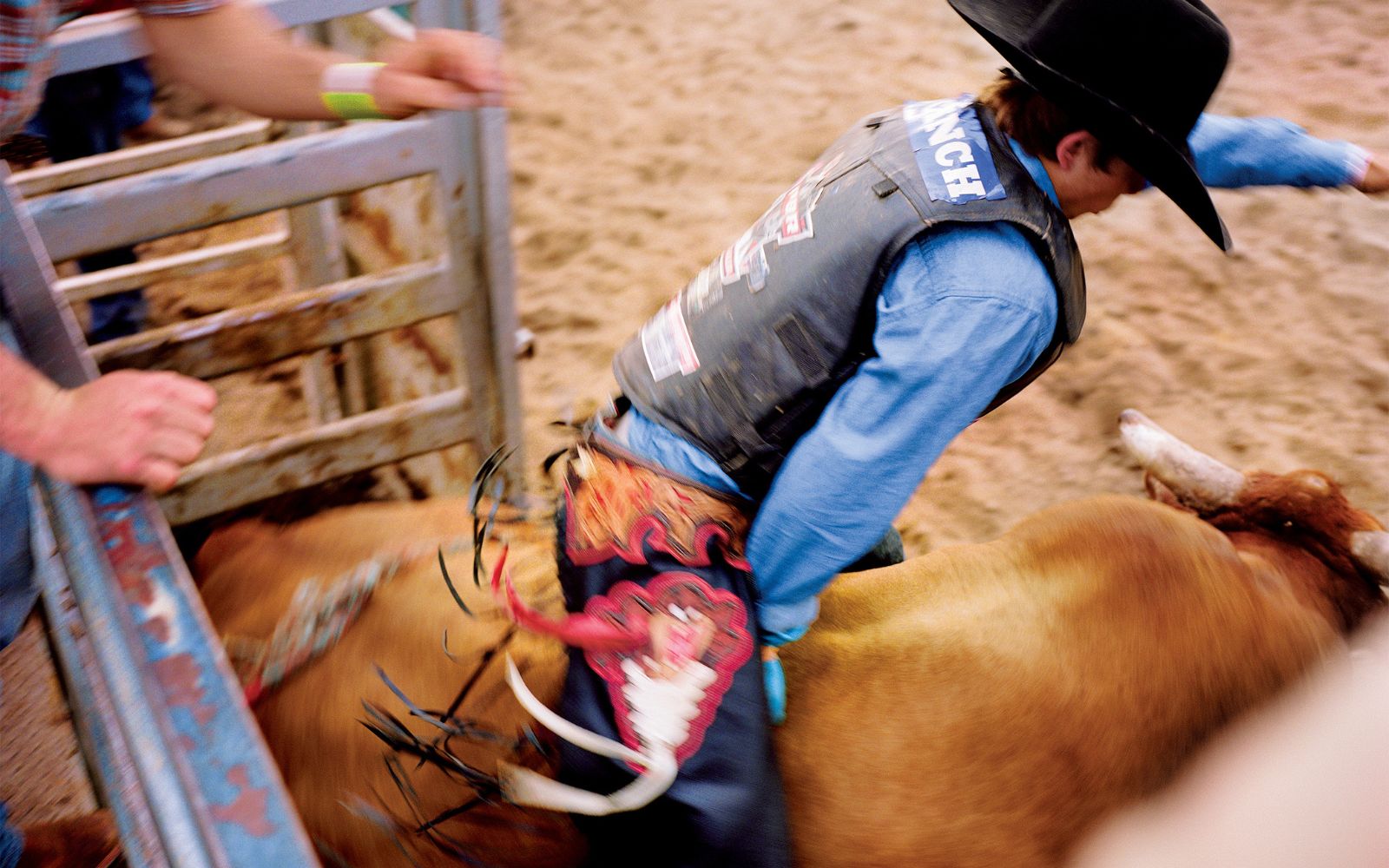
They’re evocative. Brief flurries of action with long drawls of waiting. Cowboys poised above chutes or caught midair in a dizzying animal-and-human blur. Riders and crowds jostling, smoking, sitting in saddles and squinting in sunlight. Blood, scars, tattoos.
Take a look at our feature, behind the scenes of Melbourne’s underground ballroom scene here.
View this post on Instagram
Country music, bellbottoms, dizzying danger: the reality of rodeos
I was impulsive, unprepared for how alarmingly real rodeo is. Arena-side, the red patina of dust in Danischewski’s photos crunches between my teeth. It’s an intoxicating spectacle, and the realness doesn’t always sit comfortably with urban sensibilities. But like Danischewski, I want to understand it. And to know whether my relationship with the rural is purely parasocial. Cowboy or cosplayer?
Cowboys are generally shy, but Danischewski found them open to a curious cameraman. What unites the competitive cowboy isn’t upbringing or nature, but desire.
“I think it’s a challenge, a test of body and nerve against the unknown,” he says. “Going up against something infinitely more powerful than yourself and so unpredictable.”
That’s the show crowds come for. Bucking is idiosyncratic. A rider’s skill is not in fighting, but responding in a split second, absorbing impact, reading rhythm, when to grip and when to flop. Spurs aren’t sharp or fixed, no goading, just 8-second rider endurance.
I watch a bareback rider lie back to synchronise with the bounce of a horse, its body arched like a cat, rear legs flicking up in a long equine sweep. He leans against its curve, one hand wedged in a fragile-looking handle and rope securing him. His free hand flies back, splayed against dusty velvet darkness as though to catch the moths swarming in a frenzy around floodlights. It’s a single line from his outstretched legs to his fingers.
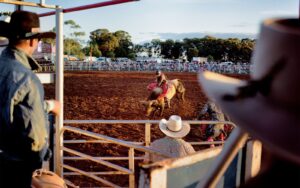
A fraction of a second. In reality he is, as the rodeo clown says, “flying around like a rag doll”. Time done, two pickup riders sweep alongside to unhook and pull him off.
It’s not just the ride, but the escape. A bull twists its huge body, seal like, dewlap swinging as it launches a rider into the sky. He drops into the dirt, dodging trampling hooves by inches. Another bull spins a rider like a record, then charges the rodeo clown and ‘protection athletes’ who leap and scale the fence like spider monkeys.
Danischewski’s photos show ceremonial, even gaudy, competitor costume. The attire creates theatrical presence, from huge badge-of-honour awarded belt buckles to decorated chaps and official cowboy uniform.
Even female barrel racers have flourishes like bedazzled bridles and unbound hair. Speed makes the winner in this event. Riders dash across the arena weaving ‘cloverleaf’ patterns around barrels. Twirl, swish, flicking back, taking the force of the motion, kicking up dust on the swerve. Country music playing all the while.
This Stampede differs from North American events. There’s no wrestling or roping (though it’s found at other Australian rodeos), no tradition of bareback Indigenous Relay Racing.
It’s not art, but it is performance, even theatre. Without spectacle, there is no rodeo. The threat of violence to a rider’s body creates tension.
It’s like a joust, like acrobatics with an adversarial element. And live animals.

I grew up in paddocks near a sweet-stinking dairy. My high school had livestock and a grain silo. But my romance with cowboys came during lockdown Melbourne, divorced from rural reality. I’ve always been half in either world, outside looking in. Or listening in – cowboys feature prominently in country music.
It’s a strong Melbourne country music scene: honky tonk at the Coburg RSL, Gem and Rooks Return, Heartache Tonight nights at Lulie, bootscooting and two-step across the city.
The aforementioned Peck not only sings of the Queen of the Rodeo, but also hosts his own version of ‘rodeo’ centred on music and lavish queer joy. His single with country legend Willie Nelson (rodeo fan and former rodeo clown), Cowboys are Frequently Secretly Fond Of Each Other, is possibly a playful riff on Nelson’s other iconic duet, Mammas Don’t Let Your Babies Grow Up to Be Cowboys.
Laura Flynn draws on the latter song in her essay accompanying Danischewski’s photos: ‘The Fevered Chase’.
It has echoes of Gretel Ehrlich, nature writer and rancher of Wyoming whose essays about rodeo and its people have a heady, visceral poetry. They both speak from inside, rather than a visitor passing through. Flynn encapsulates conflicting feelings; her mother’s fearful prayers for her buckjumping brother juxtaposed with lyrical praise of the riding sensation, “Intoxicating and shocking and flashing with brilliance.”
“…isn’t that the point of art – the point of anything? To find yourself, if only for eight seconds, buckled to the back of greatness.”
Communal intensity binds the subculture of rodeo, enhanced by danger.
“To love rodeo is to know pain, in every capacity,” Flynn writes.

The final photo in Danischewski’s book is a portrait of a blood-spattered young man, Jayden Lane. His expertise is bareback, known as the “suicide ride.”
“It’s a lot of adrenaline,” he says. “It’s really calm and quiet the whole time you’re riding. As soon as the gate opens, you blur out. It’s a hundred miles an hour for 8 seconds.”
Lane was an ex-volleyball player from Queensland who decided to try bullriding during Covid. While I was binge-watching Deadwood in an Akubra with contact-free whiskey, Lane was going from bulls to bareback. Far from a passing culture, Danischewski and Lane see a new wave of young competitors.
His photo was taken at Bundalong Rodeo in 2025, after a kick to the face by a horse named Sin City. He’d returned to riding following a catastrophic injury. In January 2023, the handle slipped under the running horse on a bareback ride, his hand trapped as he was “hung up” and kicked repeatedly. Broken scapula, shoulder, eye socket, cheekbone, bleeding on the brain.
It’s the most dramatic in the litany of Lane’s injuries and repairs (including two recent broken knees). He shrugs it off. Riders get hurt.
Rodeo may be the last truly extreme performance, so aspects of its theatrics can feel dissonant or bizarre.
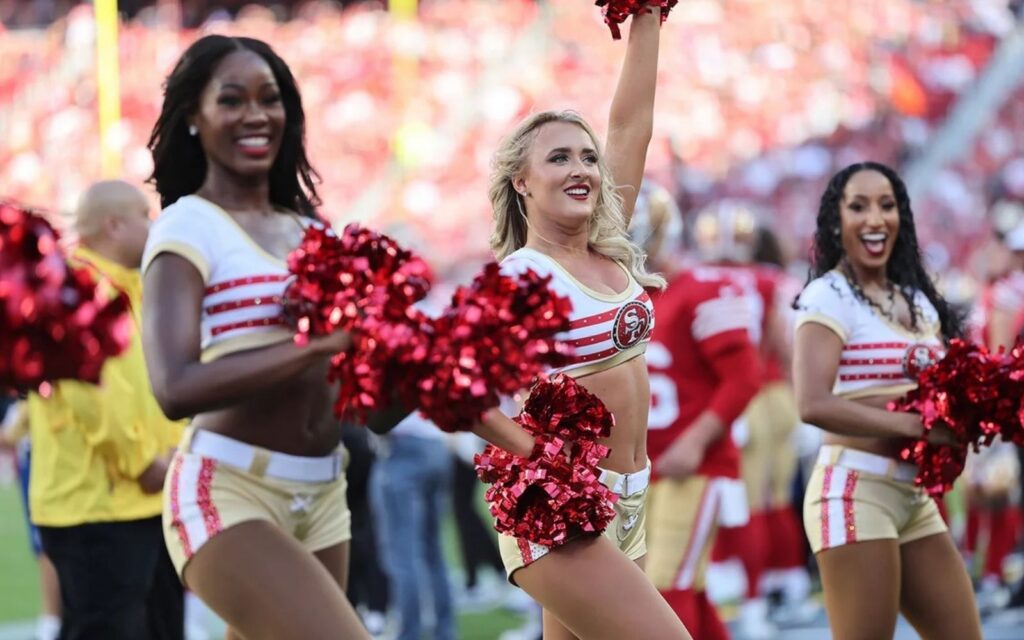
Music, country music, is integral at this Stampede, from live entertainment to soundtracks blasting during rides: clinging on for dear life to ‘Danger Zone’, taking a mouthful of dirt to Dolly Parton, men perched on gates and guiding a junior rider as ‘Save a Horse, Ride a Cowboy’ plays. Here, crowds chorus ‘Sweet Caroline’, dance to ‘Cotton Eye Joe’, watch green-and-gold Northern Beaches cheerleaders (a curious Americanism: Lane and Danischewski say they’ve never seen cheerleaders).
A woman sings the national anthem atop a restless horse with jerky vibrato. It’s more pronounced at Melbourne Muster, I’m told: a country music fest with rodeo between.
Stampede’s a festival, down to a long line at the bar, a mechanical bull, Ringers merch truck and comically large dagwood dogs. Forgot your cowboy hat? Buy a pink, glittery one. All it’s missing is showbags (and Sydney Royal Show does hold a Federation Rodeo Challenge).
It’s a transitory life. Lane rode 26 times in 36 weeks, across the country. He recognises familiar faces from Danischewski’s book as riders converge again and again in a floating rural community.
“You’ve got to be good to people. Everyone’s going to the same place.”

Rodeo (from the Spanish rodear, ‘encircle’) started with vaqueros in Mexico, moving through ranching culture of 19th century America to become travelling Wild West shows and today’s entertainment.
In Australia, the work of stockmen and drovers also morphed into roving shows. It’s been a performance longer than it was a skills test. Riders like Lane that do well here can compete in America and Canada at world-famous rodeos like Cheyenne, Calgary and Vegas, peregrinating through circuits.
Women also travel to compete. A Victorian, Tup Forge, won the Women’s Ranch Bronc Championship title at Wyoming this year. But it’s men I watch in roughstock. A glance through Danischewski’s lens also shows women as barrel racers, spectators and rodeo queens. Theoretically anyone can enter “open” roughstock categories. I’m told women don’t.
I ask Lane about flank straps on roughstock bulls and horses. The flank, he says, is loose skin at the back of the belly. The flank strap, generally leather and cotton, is tied around and “gives them something to kick at” because it relaxes when they kick up.
“They’re trained, that’s their signal to buck,” he says. “If a horse doesn’t want to buck on a flank, it won’t.”
He says horses are bred to be calm in the chutes, strong and athletic to bounce hard and “neat”. A wild kick is messy and dangerous.
Organisations like PETA take a strong opposing position to rodeo. While current statistics for injury or stress in rodeo animals aren’t readily available here or in the US, qualitative assessments come down to principle more than percentage (not that a lacuna of data undermines one’s ethical standpoint). But I’m aware that as a sometime-cheesemonger in woollen jumpers who eats steak because it’s delicious, my grounds for lecturing anyone on the use of animals for human purposes is very thin.
The legendary American Old West was a short period, Australian bushmen somewhat longer, both histories synonymous with frontier colonial violence. But the modern cowboy idea is mellifluous, embodying everything from Marlboro Man-style conservative white masculinity to glittery queer pageantry and First Nations Western dramas like Mystery Road. The cowboy roams across imaginations – and rides out uncomfortably real.
Standing in rodeo crowds, I feel an awareness of my place outside of it. But when the gates open the fiction falls away. The spectacle is raw and present. These are two animals. Our mouths are full of dust and our eyes blinded as we swirl like moths around a false sun of spotlights.
I remain seduced by the cowboy. But I’m a cosplayer.
You can grab a copy of Michael Danischewski’s book here.