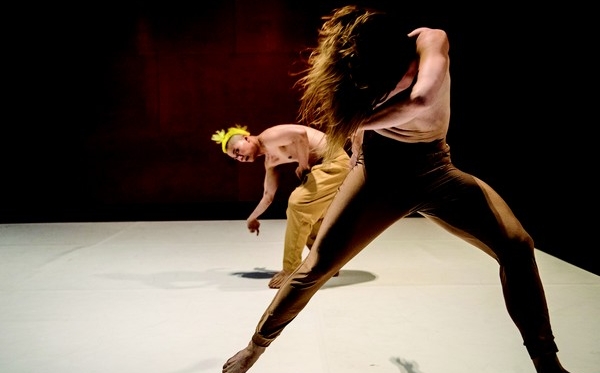
Creating Confusion for Three has led Lloyd to think about where all dance movement comes from, in terms of what happens on stage. “It’s not another ‘nice dance piece’ – I know how to do that,” she continues. “I was reading an article about voguing (a dance style inspired by the posing of fashion imagery which came out of drag culture, in particular the ‘Houses,’ of the 1980s) and the article was saying it shouldn’t be done by everyone, that it belonged to the transgender world. In the process of making this piece I deliberately used the imagery of different dance forms, things I could make a clear choice about that already existed in the history of my body. Copy mechanisms come into play. But I looked at the reasons behind this and asked ‘why?’ I’m always thinking about ‘why? This piece is a display of what we’ve found looking at the umbrella of dance, where it comes from.”
When Lloyd showed a video of Confusion for Three to her composer, Duane Morrison, he remarked that it looked as though ‘she was falling down a well,’ not necessarily a bad thing in terms of imagery. “The music for the work is now in a similar situation to the dance,” Lloyd notes. “Duane has been reading a lot from us, he watches us work and composes while he watches. I asked him to work from the piano since he’s trained as a classical pianist but has moved into pop. I wanted the music to stem from the source. What has happened is less about a cinematic score creating a mood, although at moments it can go there, but it works to reveal modes of behaviour.”
Morrison is a long-time collaborator and Lloyd is aware of how easy it is to fall into familiar patterns when you know how a creative process works well between artists. “We’ve worked together since 2002. It’s a long time. Through that it’s easy to become complacent, comfortable, or you can ask something more of each other, so what we’ve done now is kind of similar to my premise for the whole piece.”
Lloyd hasn’t been able to totally indulge herself in developing Confusion for Three, as the title of the work states, it’s a piece for three dancers, and development of the piece has depended on her colleagues, Rebecca Jensen and Shian Law. “What role do they play? It’s a huge role,” says Lloyd. “There’s history in the dance of everything we’ve learned. I leave gaps for their histories, to play with concepts that are not derived from my body, which is much more interesting for me. It’s an investigation of sharing with other dancers in a new way. I set the parameters of the dance but it’s not tailored, it’s not as loose as improvisation, there is something to be depicted; we’ve stitched a set of attempts together.”
The work might have ‘confusion’ in the title but the actual dance isn’t as random as that might suggest. “There are parameters,” Lloyd assures us. “I mean, I can’t just get on stage and sit and have a cup of tea! But I was disturbed by the idea of watching dancers think about what they’re doing, when they’re redoing steps from the night before, about dancing in that mode. I’m not so interested in that, I have done it for a long time. My agenda is to make the work I don’t know how to make.”
Confusion for Three is described as containing a ‘hypnotic tension generated by three dancers as they negotiate a progressively unravelling system of choreography.’ How much of the performance depends on a set choreography? “It’s a freeing up of how we go about dancing, it’s not right left right left, but there are definite boundaries, there are cues, stuff from one segment to the next,” says Lloyd. “One of us makes a choice that shifts the piece. We read each other’s choices and move from there.”
The responses from early showings of Confusion for Three have been positive. “One audience member told me she felt like getting up and joining in,” says Lloyd. “That’s my fantasy; I’d love it if everyone could! But you’d have to think about the possibility of people getting injured, OH&S stuff.”
As a choreographer Lloyd talks about herself as a ‘bridge’ – as manifesting an idea into action. “It’s not like we’re up on a pedestal,” she muses. “We’re trained, we’re virtuosic and there are skills involved, but good work is when you can look at what someone’s done with an idea.”
BY LIZA DEZFOULI