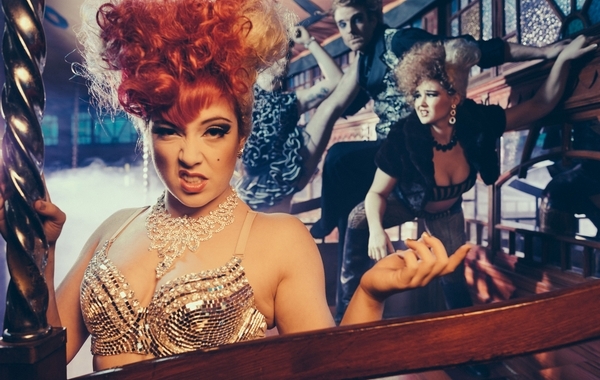
“[Close to the Bone is] an interesting one because the previous two shows – of this sort of nature – Circus Oz has done have been called The Blue Show,” which debuted at The Melba Spiegeltent with a sold-out season in 2011. “They had very distinct adult themes. Now, this show [may have] a different title and different intention – this show is more about exploring what Close to the Bone means and experimenting with new acts – nonetheless, there’s many other connotations that can be read into it, [and because of that] it’s a show that’s recommended for adults. We’re not describing it as a family friendly show,” details musical director Ania Reynolds; a major difference from their usual family-friendly big top shows.
The titian-haired woman has been part of the company for four years now and she has an extensive catalogue of musical performance and composition experience, including stints with Polyglot Theatre (Tangle, The Big Game, Checkout!), a Green Room Award for Best Musical Direction (2010) in Cabaret Yana Alana And Tha Paranas In Concert, and being part of afrobeat group Papa Chango, The Whoopee Project, and garage-rock outfit Johnnie and the Johnnie Johnnies. Throughout her tenure, her creative ear – a fusion of nearly everything: from funk to polka to jazz and to ska – has been responsible for setting the mood for shows like From The Ground Up (2012), Cranked Up (2013) and But Wait… There’s More (2014).
“Our director, Deb Batton, came up with a list of various acts she wanted to out in the show based on people’s individual skills and groups skills,” says Reynolds animatedly, explaining the rehearsal process so far. “So we have a list that we’re working to and everyone’s been given various takes to devise their acts to. Meanwhile, in the music room, we’ve [Reynolds and Circus Oz buddy Ben Hendry] got to working on a bunch of different tunes and with a variety of different feels, so [that] when someone comes up and they’re like ‘I need something kind of jazzy for my act’, then we’ve got a few ideas to present them with.”
“We’re [also] working on some vocal pieces and having nine people doing it as opposed to three… you just need that kind of volume,” adds the musician, explaining that throughout the years many non-musically-trained members have helped with Oz’s music score. “When we’re going group percussion, it becomes an ensemble and the cool thing about working with acrobats as musicians is that they’re not necessarily musically trained, [and] they have, in my experience, [an] approach to music that is very performative. They might not know what notes they’re playing or how to play the instrument, but they’re really good at selling a performance. So there’s this sort of lovely freedom and joy to be explored with people who just approach the instrument as a thing to make noise with, rather than from a traditional, conventional-trained music background.”
It’s this fluidity, collaboration and freedom that, Reynolds insists, keeps Oz operating as vigorous machine of creativity and improvisation: “One of the most awesome things about Circus Oz is that it’s a company that really encourages and celebrates people’s individuality in their artistic expression and their creativity.”
Conceived from the amalgamation of two already successful Australian groups, Soapbox Circus and the New Circus, Circus Oz was founded in 1978 under the ethos of creating contemporary circus performance imbued with traditional circus skills (minus the animals), satire, popular theatre elements and the spirit of rock’n’roll. Their brand of entertainment is still as popular 36 years later. Circus Oz has performed to over three million people in 27 different countries and become a well-loved surrealist icon nationally, and overseas. In fact, the troupe is so loved that Arts Victoria donated $15 million to redeveloped the Old Collingwood TAFE into a state-of-the-art rehearsal and performance facility for them; the company relocated there last February from Port Melbourne Drill Hall. They even shifted The Melba Spiegeltent there, from its former periodic home on the Docklands.
“That’s the joy of the Spiegeltent: you’re so close to the audience. [In the big top] there’s not much room for intimacy or subtly, whereas in the Spiegeltent, it’s all about that,” gushes Reynolds. With just under 200 capacity, the Belgium tent is tiny compared to the 1,500 seating-plan of the Big Top. “Mingling amongst the audience has always been a part of the Circus Oz shows,” regardless of the venue, and “the difference is that the performers aren’t separated from the audience [in the Spiegeltent], and it’s just a lot more fun.”
BY AVRILLE BYLOK-COLLARD