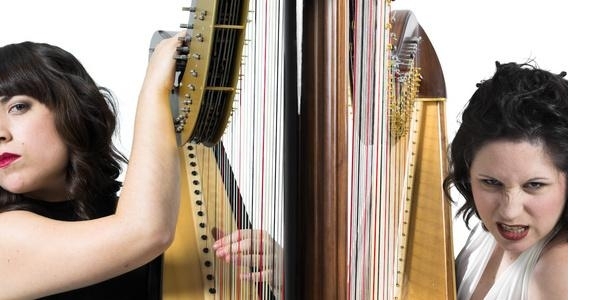
The harpist’s love for her instrument comes across strongly. “I always wanted to play the harp,” Smith says. “But it’s a very expensive instrument and I didn’t have millionaire parents.” Starting her musical education at the age of three, Smith had to be content with learning piano, cello and classical guitar. “But they didn’t give me the fiery feeling in my stomach,” she continues. By the time Smith was 23 she realised if she were going to learn to play the harp then she had better do something about it. Fortunately Ashley felt the same way and between them the two applied for a bank loan to buy a harp. “My life changed direction. I’ve never looked back,” says Smith.
Jazz harpists are a rare species; Smith found there was no-one to teach her jazz harp in Australia so left for the United States to study. Smith obtained a mentorship to go to Boston and says she can’t wait to go back. “There are no more than 100 jazz harpists in the USA, and about the same number in Europe,” she notes. “I am the only one in Australia, and I’ve looked high and low in this country. Once I’ve mastered jazz I want to set up workshops and extend the knowledge of jazz harp in Australia.”
Learning to improvise jazz rhythms is a huge undertaking in itself, whatever instrument you’re playing. It’s a job that can’t be hurried. “It takes about five years to become a good improviser,” Smith says. “The more I learn, the more I find I don’t know. But when you can do it properly, it’s jaw-droppingly amazing. You have to have been playing for about ten years. It’s a wonderful thing that the older you are the more likely you are to get noticed.”
Classical versus Jazz is Smith’s first interstate performance. She won’t be playing her own instrument: the size of harps means that transporting them is a problem.“I wouldn’t put my harp on a plane, no way,” Smith says with a shudder. Fortunately Melbourne harpists have been supportive of a show which will be new to everyone, really everyone and Smith and Ashley have been loaned harps for their show. Not only does the show expand on the proverbial classical versus jazz debate but it does it in a way that’s entirely new. “This the world’s first harp battle,” Smith notes. “There has never been a harp battle before.” Will Smith be playing her own music? “The opening pieces is original, it’s my composition,” she answers. “The music includes some Latin and classical flamenco in a duet. There’s a Chopin arrangement. We’re taking the music to other areas.” Smith is keen to explore everything that can possibly be played on a harp – cabaret numbers, blues, hip hop, “It gets you into all sorts of things.”
Who inspires her musically? “The greats. Miles Davis, the way he plays with space. It’s not so jarring as some jazz music. Blues. Johnny Lee Hooker. I’m learning more about jazz musicians as I go along, found different ways to make it listenable as opposed to theoretical. Music is a language, it should be spoken and accessible to everyone.” Smith says she’s experienced some sceptical reactions from jazz musicians who play more traditional instruments. “No-one comes out and says ‘you can’t do that’ but there’s a weird energy about me trying to do it, like ‘do you really think you’ll get anywhere’, or ‘let’s see if we can turn you into a real jazz musician; try playing this’. But as my mentor says, you’ve got to be bad before you can be good.”
BY LIZA DEZFOULI